ChemBB
Member
Welcome to the "Mythbusters" Series: Discussing common misconceptions/folklore about AAS!
In this first edition, we're tackling high-concentration steroid blends and the infamous PIP. We will cover:
One of the biggest myths in this space is that high-dose blends are inherently more painful than their individual components.
This is fundamentally incorrect. Let's break down why.
The Two Primary Causes of PIP
Post-injection pain generally stems from two distinct mechanisms:
Let's focus on the second point, as it's the source of the myth.
Solubility: The "Salt & Sugar" Principle
To understand why blends work, we need to understand HOW crystals form.
A crystal lattice can only be formed by molecules of the exact same type. Different steroid esters are, chemically speaking, different molecules.
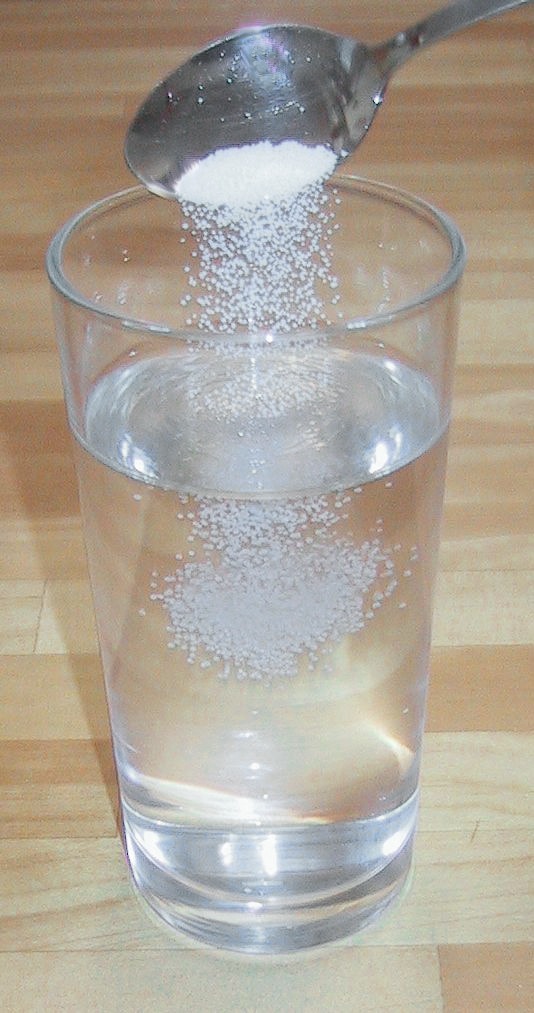
Think of it like dissolving salt and sugar in a glass of water. You can dissolve a certain amount of salt, and you can dissolve a certain amount of sugar. Dissolving one doesn't stop you from dissolving the other. If the water evaporates, you'll be left with separate salt crystals and sugar crystals—they will not form a single "salt-sugar" crystal.
Steroids work the same way.
So, if a carrier oil can hold 100mg/mL of Trenbolone Acetate and 200mg/mL of Trenbolone Enanthate, you can brew a perfectly stable 300mg/mL blend containing both. From a crystallization perspective, injecting this blend is no different than performing two separate injections of the single esters.
The Real Culprit: In-Muscle Crashing
So if the blend itself is stable, why do people still experience PIP from high-dose formulas?
The problem isn't the blend; it's the concentration of an individual hormone being pushed to its absolute limit.
Here's the process:
These tiny crystal needles cause mechanical irritation + trigger a localized inflammatory immune response, resulting in the long-lasting pain we know as "PIP".
TL;DR
High-concentration blends are not inherently problematic. The issue arises when a manufacturer pushes a single compound within the blend to its absolute solubility limit, leaving no margin for error once the co-solvents diffuse away post-injection. A well-formulated, high-dose blend can be just as smooth as a low-dose, single-ester product.
---
Planned Future Topics:
In this first edition, we're tackling high-concentration steroid blends and the infamous PIP. We will cover:
- How solubility and crystallization actually work.
- Why a well-formulated blend isn't the problem.
- What really causes high-dose blends to "crash" in the muscle.
One of the biggest myths in this space is that high-dose blends are inherently more painful than their individual components.
This is fundamentally incorrect. Let's break down why.
The Two Primary Causes of PIP
Post-injection pain generally stems from two distinct mechanisms:
- Solvent/Carrier Irritation: Solvents like Benzyl Alcohol (BA) are effective at dissolving hormone powder, but they are also irritants. Gear brewed with a high % of BA can cause a burning sensation + immediate post-injection inflammation.
- Hormone Crystallization: This occurs when the steroid hormone itself comes out of the oil solution and forms solid micro-crystals within the muscle tissue ("crashing").
Let's focus on the second point, as it's the source of the myth.
Solubility: The "Salt & Sugar" Principle
To understand why blends work, we need to understand HOW crystals form.
A crystal lattice can only be formed by molecules of the exact same type. Different steroid esters are, chemically speaking, different molecules.
Think of it like dissolving salt and sugar in a glass of water. You can dissolve a certain amount of salt, and you can dissolve a certain amount of sugar. Dissolving one doesn't stop you from dissolving the other. If the water evaporates, you'll be left with separate salt crystals and sugar crystals—they will not form a single "salt-sugar" crystal.
Steroids work the same way.
- Tren E molecules can only crystallize with other Tren E molecules.
- Tren Ace molecules can only crystallize with other Tren Ace molecules.
So, if a carrier oil can hold 100mg/mL of Trenbolone Acetate and 200mg/mL of Trenbolone Enanthate, you can brew a perfectly stable 300mg/mL blend containing both. From a crystallization perspective, injecting this blend is no different than performing two separate injections of the single esters.
The Real Culprit: In-Muscle Crashing
So if the blend itself is stable, why do people still experience PIP from high-dose formulas?
The problem isn't the blend; it's the concentration of an individual hormone being pushed to its absolute limit.
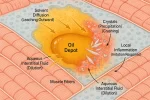
Here's the process:
- You inject the oil depot, which contains the hormone powder, the carrier oil (e.g., GSO, MCT), and co-solvents (e.g., BA, BB).
- Once in the muscle, the highly mobile co-solvents (BA/BB) begin to leach out of the oil depot and disperse into the surrounding aqueous environment of your muscle tissue ("aqueous interstitial fluid")
- As the co-solvents leave the oil, the oil's capacity to hold the hormone in solution decreases dramatically. The "saturation point" is now much lower.
- If any single hormone in that blend was brewed right at its maximum solubility limit, it has now exceeded the new, lower limit. The hormone begins to precipitate out of the oil, forming jagged micro-crystals at the injection site.
These tiny crystal needles cause mechanical irritation + trigger a localized inflammatory immune response, resulting in the long-lasting pain we know as "PIP".
TL;DR
High-concentration blends are not inherently problematic. The issue arises when a manufacturer pushes a single compound within the blend to its absolute solubility limit, leaving no margin for error once the co-solvents diffuse away post-injection. A well-formulated, high-dose blend can be just as smooth as a low-dose, single-ester product.
---
Planned Future Topics:
- Does Nandrolone aromatize? If so, how?
- Trestolone (MENT): Facts vs. Fiction