Spaceman Spiff
Subscriber
My badIt's all from the same batch.

MESO-Rx
Anabolic Steroids

Follow along with the video below to see how to install our site as a web app on your home screen.
Note: This feature may not be available in some browsers.
My badIt's all from the same batch.


yesRoom temp and no vacuum does seem more degraded no? Even room temp with vacuum seems fine.

yes
seems like fridge vs no fridge has become more the experiment than vacuum vs no vacuum when you look at it overall. but no fridge has just made the degradation faster and shown the difference.
what it shows; you probably shouldnt care too much under 5 years with no fridge and shouldn't care for it under 20+ years as long as you have +95% hgh + fridge with that stastical difference. thats atleast how im reading it
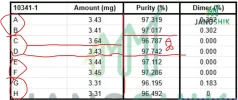
i hope my lines can make it more obvious. 3.64 is the only irregular and is to be ignored.I'm reading it as: they're all the same
Less than one percentage point difference is well within the margin of error
C & D are replicates and the difference between C & D is bigger than any other comparison in these data
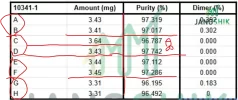
i hope my lines can make it more obvious. 3.64 is the only irregular and is to be ignored.
everything was pretty much the same besides no vacuum no fridge
View attachment 354652
i hope my lines can make it more obvious. 3.64 is the only irregular and is to be ignored.
everything was pretty much the same besides no vacuum no fridge
View attachment 354652
seems like detection issues but no worries in those amounts.Jano's method precision with this measurement.
Yep, just stating the obvious statistical results. Significance vs practical importance.seems like detection issues but no worries in those amounts
maybe you can make same model forYep, just stating the obvious statistical results. Significance vs practical importance.
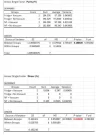
Good point on the mg amount for sample C. That might qualify for outlier Q test but too lazy to do it. Good eye and very perceptive. I just ran the purity and dimer+ columns.seems like detection issues but no worries in those amounts.
thanks for your analysis.
i was just comparing higher mg amount >= lower purity vs lower mg amount >= higher purity but we end up getting pretty much the same. so i was thinking lobster manufacturing proccess at c and d making it a irregurlar and adding a dick to it
I'm good.maybe you can make same model for
baseline >=3.41mg
no vacuum no fridge =<3.31mg
purity fridge & no fridge + vacuum = avg +- variance (-) no vacuum no fridge = avg +- variance
avg +- variance in = baseline mg - no vacuum no fridge (+) purity baseline - purity no vacuum no fridge.
and * with 10 or 20 to get 5 or 10 years ahead from 6 months difference.

its just simple catch.I'm good.
We are just talking to each other. Nice chatting.its just simple catch.
the purity scaling lower in % + less mg content im uncertain if will be non linear or linear.
im also too lazy so i will drop it haha.
at the top of my head it will be around 1iu drop every 3 years no vacuum no fridge.
Good idea and would be fun to superpose trend over literature data.at the top of my head it will be around 1iu drop every 3 years no vacuum no fridge
it seems like i will pass the ball onto @GhoulGood idea and would be fun to superpose trend over literature data.


it seems like i will pass the ball onto @Ghoul
he can do that and strengthen his position on no vaccum difference.
probably have to find stronger differantion methods than the one i freestyled
Since you are so knowledgeable via chat gpt are you going to make any comments on these results? Or are you going to talk shit about @janoshik and retreat back to NMR structure evaluation which you failed to assist with?One problem is that unlike the studies attached, UGL vials don't have identical starting amounts of rHGH. Filtering prior to analysis removes large aggregates. So if you know with certainty there was precisely 1mg of rHGH in each vial, you can account for this loss and add the "disappeared" rHGH to the measured amount of degradation. But with UGL if one vial is 1.25mg and the other is 1.12mg there's really
no way to determine how much is lost to large aggregates that formed immediately after reconstitution and caught in the filter.
There's also no vacuum sealed control vial to compare these to, unless Jano has one lying around he can use.
Still though, it should be possible to measure greater degradation in the unrefrigerated vial vs the refrigerated one over a week's time.
If you dig into the rHGH oxidation / stability studies, what oxidation really does is make rHGH unfold at much lower temperatures than if it's not oxidized. So the room temp stored vial should degrade faster than the refridgerated one.