Chronic low HDL but good LDL (need advice)

Do you think this risk mitigates with concurrent GLP-1 therapy? I know that’s not the point but just curious if we are stuck with non Pita prescribers

It's an issue of worsened insulin sensitivity, so GLP would offset that risk to some degree by improving insulin sensitivity.

I’m sorry if I missed it in any of your prior posts but can you share the data on Pita showing that it improves HDL? That would be the main selling point for me.


IMG_2043.webp
 
If you're in the US a telemedicine provider will prescribe it in 5 minutes, and 99% of insurance policies cover it (with zero deductible if you're over 40).
European peasant here. I can get it prescribed but a pack of 4mg costs about 77€, insurance would only give me a 10€ discount on it for a pack of 30 pills
Rosuvastin i get a pack of 100 pills 20mg, which can be split into 5mg for free
 

Conclusion​

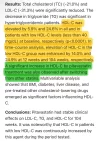
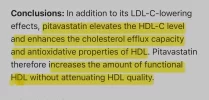
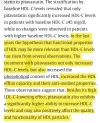
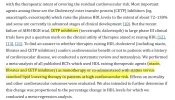
Besides decreasing serum LDL–C levels, pitavastatin elevates serum HDL–C levels and modulates the size, composition and levels of HDL–associated enzymes, but as a whole, increases HDL particles with preserved anti–atherosclerotic properties.”
This is great thank you so much. Will show it to my cardiologist. I can hear him scoffing at the N of 23 already but he honestly doesn’t seem to know anything about it.
 
Not to hijack the thread, but I'm dealing with something similar. About a month after finishing a steroid blast (~1.5g/week of injectables and had orals on top), I had bloodwork done. Everything came back in range, but I noticed my HDL is very low. My doctor didn't even mention it, I only caught it while reviewing the results myself.

Should I be concerned? Is there anything I can do to improve it?

Here are the relevant numbers:
Total cholesterol: 44 mg/dL (ref <190)
HDL: 12 mg/dL (ref >35)
LDL: 23 mg/dL (ref <100)
Cholesterol/HDL ratio: 3.7 (ref <5)
Non-HDL cholesterol: 32 mg/dL (ref <130)
Triglycerides: 45 mg/dL (ref <150)

I also checked liver markers since I saw GPT mention low HDL could be linked to liver issues, but those came back fine:
ALT: 30 (ref <41)
GGT: 10 (ref <60)

Diet:
My diet is extremely low in fat. I don't include any direct fat sources because I'm eating a high amount of carbs and protein. Whenever I try to add fats, I end up not digesting well. After seeing my bloodwork, I started taking 5g of fish oil daily.
 
Not to hijack the thread, but I'm dealing with something similar. About a month after finishing a steroid blast (~1.5g/week of injectables and had orals on top), I had bloodwork done. Everything came back in range, but I noticed my HDL is very low. My doctor didn't even mention it, I only caught it while reviewing the results myself.

Should I be concerned? Is there anything I can do to improve it?

Here are the relevant numbers:
Total cholesterol: 44 mg/dL (ref <190)
HDL: 12 mg/dL (ref >35)
LDL: 23 mg/dL (ref <100)
Cholesterol/HDL ratio: 3.7 (ref <5)
Non-HDL cholesterol: 32 mg/dL (ref <130)
Triglycerides: 45 mg/dL (ref <150)

I also checked liver markers since I saw GPT mention low HDL could be linked to liver issues, but those came back fine:
ALT: 30 (ref <41)
GGT: 10 (ref <60)

Diet:
My diet is extremely low in fat. I don't include any direct fat sources because I'm eating a high amount of carbs and protein. Whenever I try to add fats, I end up not digesting well. After seeing my bloodwork, I started taking 5g of fish oil daily.

This is another one of those odd situations that could be very bad, or very good, but it needs advanced testing to determine which.

You need to see ApoA-I and HDL-P.

If both are high, it means you have many tiny, but well functioning HDL particles and the low HDL-C number is no concern. In fact it's an extremely good position to be in with that rock bottom LDL-C.

If ApoA-I and HDL-P are low, you're at high risk and steps will have to be taken to protect your endothelium from the damaging effects of oxidative HDL.

Suggest you get the Lipomap test I posted about earlier.
 
Last edited:
Not to hijack the thread, but I'm dealing with something similar. About a month after finishing a steroid blast (~1.5g/week of injectables and had orals on top), I had bloodwork done. Everything came back in range, but I noticed my HDL is very low. My doctor didn't even mention it, I only caught it while reviewing the results myself.

Should I be concerned? Is there anything I can do to improve it?

Here are the relevant numbers:
Total cholesterol: 44 mg/dL (ref <190)
HDL: 12 mg/dL (ref >35)
LDL: 23 mg/dL (ref <100)
Cholesterol/HDL ratio: 3.7 (ref <5)
Non-HDL cholesterol: 32 mg/dL (ref <130)
Triglycerides: 45 mg/dL (ref <150)

I also checked liver markers since I saw GPT mention low HDL could be linked to liver issues, but those came back fine:
ALT: 30 (ref <41)
GGT: 10 (ref <60)

Diet:
My diet is extremely low in fat. I don't include any direct fat sources because I'm eating a high amount of carbs and protein. Whenever I try to add fats, I end up not digesting well. After seeing my bloodwork, I started taking 5g of fish oil daily.
My HDL always bounces back after I end my cycle and do a reset. I concentrate on keeping total cholesterol, LDL and triglycerides low because I know I’m going to crush my HDL on cycle every time. After a 2 month break of only TRT my HDL returns to baseline.
 
My HDL always bounces back after I end my cycle and do a reset. I concentrate on keeping total cholesterol, LDL and triglycerides low because I know I’m going to crush my HDL on cycle every time. After a 2 month break of only TRT my HDL returns to baseline.
Still a good idea to be very aggressive managing HDL on cycle. Even if the values are low briefly, damage is being done.
 
Still a good idea to be very aggressive managing HDL on cycle. Even if the values are low briefly, damage is being done.

One of the things being suggested by recent research looking at why AAS users seemingly have permanent high cardiovascular risk, despite good looking markers, calcium scores, etc, often years after stopping, is that the very bad short term lipid conditions may not be around long enough to damage large vessels in any noticeable way, but are wrecking microvessels in heart muscle and elsewhere, which is virtually impossible to see, even in an autopsy, unless the tissue is specifically examined for that type
of damage. And when they've looked for it, more often then not, in AAS users they find it.
 
Still a good idea to be very aggressive managing HDL on cycle. Even if the values are low briefly, damage is being done.
Nothing can be done to raise HDL when on cycle. Studies show that increasing HDL via pharmaceuticals is not helpful. So how do you propose to aggressively manage HDL on cycle? That’s why a reset is necessary and focusing on keeping total cholesterol, LDL and triglycerides as low as possible on cycle.

“Increasing HDL levels via pharmacological manipulation beyond optimal lipid lowering therapy for secondary prevention is not beneficial.”
 
Nothing can be done to raise HDL when on cycle. Studies show that increasing HDL via pharmaceuticals is not helpful. So how do you propose to aggressively manage HDL on cycle? That’s why a reset is necessary and focusing on keeping total cholesterol, LDL and triglycerides as low as possible on cycle.

“Increasing HDL levels via pharmacological manipulation beyond optimal lipid lowering therapy for secondary prevention is not beneficial.”
would this data not then negate the main argument for using Pita (HDL increase), assuming you can tolerate another statin?
 
would this data not then negate the main argument for using Pita (HDL increase), assuming you can tolerate another statin?
If the only reason you are going to switch from Rosuvastatin to Pita is to increase HDL, then it’s a waste of time. But Pita is more tolerable in most with less side effects. It’s cholesterol lowing effects are pretty close to Rosuvastatin plus the insulin sensitivity benefits mentioned above.

Knowing what I know now, if I wasn’t already taking Rosuvastatin, I’d ask my Doc for Pita.
 
If the only reason you are going to switch from Rosuvastatin to Pita is to increase HDL, then it’s a waste of time. But Pita is more tolerable in most with less side effects. It’s cholesterol lowing effects are pretty close to Rosuvastatin plus the insulin sensitivity benefits mentioned above.

Knowing what I know now, if I wasn’t already taking Rosuvastatin, I’d ask my Doc for Pita.
Me too. I’m still just very thankful to have all this information available to bounce off each other. My Ivy League cardiologist just says “I’ve never prescribed it.”

One thing I do wonder is if the insulin resistance shown with the other statins is mitigated / eliminated in our population eating clean, lots of muscle mass, and (most of us) on a GLP-1.
 
Me too. I’m still just very thankful to have all this information available to bounce off each other. My Ivy League cardiologist just says “I’ve never prescribed it.”
I’m seriously considering getting a Concierge Doctor just so I can breakout of the same medical groupthink you are referring to. $100-200 a month is worth getting the level of care I’m seeking.
 
If the only reason you are going to switch from Rosuvastatin to Pita is to increase HDL, then it’s a waste of time. But Pita is more tolerable in most with less side effects. It’s cholesterol lowing effects are pretty close to Rosuvastatin plus the insulin sensitivity benefits mentioned above.

Knowing what I know now, if I wasn’t already taking Rosuvastatin, I’d ask my Doc for Pita.

No.

Hundreds of studies after that 2014 paper went on to establish that cardiovascular risk is lowered by quality, not only quantity of HDL. HDL's ability to remove cholesterol, measured by CEC (cholesterol efflux capacity) and anti-inflammatory properties are what matters most.

Increasing poor quality HDL-C doesn't help, Worse, since it's inflammatory it damages blood vessels.

The interventions used in that study increase low quality HDL.

Pitavastatin, uniquely, generates high quality HDL with high CEC function.

IMG_2044.webp


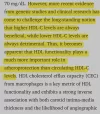
Increased HDL quantity and quality:

IMG_2046.webp


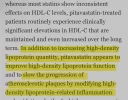
Even improving the quality of existing HDL and making it less inflammatory:


IMG_2048.webp


IMG_2047.webp

 
Last edited:
No.

Hundreds of studies after that 2014 paper went on to establish that cardiovascular risk is lowered by quality, not only quantity of HDL. HDL's ability to remove cholesterol, measured by CEC (cholesterol efflux capacity) and anti-inflammatory properties are what matters most.

Increasing poor quality HDL-C doesn't help, Worse, since it's inflammatory it damages blood vessels.

The interventions used in that study increase low quality HDL.

Pitavastatin, uniquely, generates high quality HDL with high CEC function.

View attachment 339091


Increased HDL quantity and quality:

View attachment 339102


Even improving the quality of existing HDL and making it less inflammatory:

View attachment 339101


View attachment 339100

Bookmarked. Incredible content. Thank you!
 
No.

Hundreds of studies after that 2014 paper went on to establish that cardiovascular risk is lowered by quality, not only quantity of HDL. HDL's ability to remove cholesterol, measured by CEC (cholesterol efflux capacity) and anti-inflammatory properties are what matters most.

Increasing poor quality HDL-C doesn't help, Worse, since it's inflammatory it damages blood vessels.

The interventions used in that study increase low quality HDL.

Pitavastatin, uniquely, generates high quality HDL with high CEC function.

View attachment 339091


Increased HDL quantity and quality:

View attachment 339102


Even improving the quality of existing HDL and making it less inflammatory:

View attachment 339101


View attachment 339100

Hmmm. Might make the switch after all.
 
No.

Hundreds of studies after that 2014 paper went on to establish that cardiovascular risk is lowered by quality, not only quantity of HDL. HDL's ability to remove cholesterol, measured by CEC (cholesterol efflux capacity) and anti-inflammatory properties are what matters most.
The 2014 studies looks at the following, all of which i believe improve CEC, with CETP providing the strongest improvements.

1754236790408.webp

1754237175461.webp

1754237197968.webp

In a different post i believe you ranked Niacin and Fibrates as well, right after Pita, both of which were also evaluated in the 2014 study as not being beneficial.
Edit, found it

 
Back
Top