Post up your Natty IGF-1 Level

43 years old. Was only planning another six weeks or so through PCT.

Also, that’s all the hgh I have left from last order. I figured it was a good time to be completely off everything and let the body renormalize.

It would take 5+ years at that level to develop acromegaly symptoms. By comparison, at 60 it might only take a year. Other risks like faster colon polyp development are elevated, but that's the case with any elevated IGF.
 
It would take 5+ years at that level to develop acromegaly symptoms. By comparison, at 60 it might only take a year. Other risks like faster colon polyp development are elevated, but that's the case with any elevated IGF.
Acromegaly develops more quickly with age?
 
Acromegaly develops more quickly with age?

Yes. With age IGF binding hormones drop leaving more bioactive IGF free, higher density of IGF receptors in tissues (a side effect of long term inflammation), and slower cell turnover leads to more tissue accumulation.

All adds up to greater IGF sensitivity with age. When older patients get pituitary tumors, at the same elevated IGF they develop acromegaly features much faster than younger people.
 
156.0, z-score -0.1 after 3 years of fucking with pituitary with secretagogues and hgh (4 month wash out before test). Technically down from 182 from natural before ever starting but I think it has more to do with me ramping sema and being on a steep cut.
 
That’s pretty interesting.

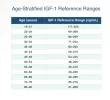
For long term use you just have to keep IGF to no higher than 1.2x of the top of range for your age.

IMG_1824.webp

That keeps acromegaly risk 1-3% over a year. 5-10% over 5 years (unless you adjust down again for age).

At 1.3x it's 3-5% over one year and 20-30% over 5 years. 1.3x is where doctors would start to suppress GH.

If only a mild IGF elevation, late onset acromegaly is often mistaken for normal aging so goes undiagnosed. Tell me you haven't seen an older person go this way...

Diagnosed in 1987

IMG_1823.webp

Right now 15% of newly diagnosed acromegaly cases are in people over 65, but that number has been rising every year as doctors increasingly learn to recognize symptoms they also used to just attribute to aging.
 
So do you think 600 is an ok range to run in for a few months (2.5 months already and 2 more to go) for early 40’s age or would you dial it back right away?

It’s pretty far above reference range.
 
So do you think 600 is an ok range to run in for a few months (2.5 months already and 2 more to go) for early 40’s age or would you dial it back right away?

It’s pretty far above reference range.

You're not going to see visible acromegaly symptoms in 4 months.

That doesn't mean changes aren't happening though.

From what I've read, soft tissue changes from a short period of very high IGF can reverse in 6-12 months after returning to physiologic range.

Bone changes are slower, and the initial cellular level changes may reverse after 2 years. Another very high IGF cycle before then "picks up where the last left off" in terms of bone remodeling, so you inch closer and closer to a bigger jaw unless you drop to a lower dose for a significant period of time between cycles.
 
Hmm . . . Sylvester Stallone did not really exhibit those symptoms, and I would be that his doses are high and consistently nonstop for years.
 
For long term use you just have to keep IGF to no higher than 1.2x of the top of range for your age.

View attachment 335787

That keeps acromegaly risk 1-3% over a year. 5-10% over 5 years (unless you adjust down again for age).

At 1.3x it's 3-5% over one year and 20-30% over 5 years. 1.3x is where doctors would start to suppress GH.

If only a mild IGF elevation, late onset acromegaly is often mistaken for normal aging so goes undiagnosed. Tell me you haven't seen an older person go this way...

Diagnosed in 1987

View attachment 335784

Right now 15% of newly diagnosed acromegaly cases are in people over 65, but that number has been rising every year as doctors increasingly learn to recognize symptoms they also used to just attribute to aging.
Where can I read more about these numbers (source)?
 
Where can I read more about these numbers (source)?
I don't know if this is helpful, but 1.3x seems to the a treatment threshold for acromegaly.

This paper is not about injecting hgh.


Just search for "1.3"
 
I don't know if this is helpful, but 1.3x seems to the a treatment threshold for acromegaly.

This paper is not about injecting hgh.


Just search for "1.3"

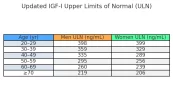
Correct. 1.2-1.3x ULN (Upper Limit of Normal) IGF-1 is the trigger for treatment of acromegaly.

In addition, recently, ULN has been redefined downwards from the levels I quoted.

Someone mentioned they expect dirt cheap rHGH to lead to problems in the future, which I agree with. There's no longer a cost barrier to continuous, long term, high dose use. Like TRT+, risks increase based on Exposure x Time, so to make informed decisions for long term use, I see staying at or under the official "acromegaly treatment" IGF level to be a good starting point for deciding how much risk you're willing to take.

If someone really wants to push it, they should probably consider IGFBP-3 levels, which reduce effective IGF, and calculate free IGF, since that's the cause of acromegaly. Managing estrogen levels and perhaps using IM (to maximize GH while reducing IGF) might be other strategizes for being able to safely use higher doses without the excess growth risks from acromegaly.

3F51A436-DCE5-4CBC-983B-ED8082525F6D.webp

 
I don't know if this is helpful, but 1.3x seems to the a treatment threshold for acromegaly.

This paper is not about injecting hgh.


Just search for "1.3"
Yep. Therapy for those secreting too much. Any transference to those injecting is extrapolation. Whether one is correctly extrapolating or not is another issue entirely.
 
Yep. Therapy for those secreting too much. Any transference to those injecting is extrapolation. Whether one is correctly extrapolating or not is another issue entirely.

Which extrapolation carries greater risk?

Being guided by the IGF levels clinicians use to diagnose acromegally, and set the limits of growth hormone replacement in GH deficient adults, or one that arbitrarily disconnects elevated IGF levels from risks because they're induced by exogenous GH?

Also, reducing GH isn't the treatment end target for excess secretion, reducing IGF is.

Pegvisomant dropping IGF into normal range is considered treatment success, and sufficient to prevent acromegaly and other sides from excess secretion, even through GH stays where it was. That seems to be a clear indicator all the problems stem from too much IGF, not directly by GH or some other substance being secreted.
 
Last edited:
Using that chart, though, you could be at around 400 until you are 40, but 30 I too high when you are 60?

That does not seem to make much sense.
 
Back
Top