
malfeasance
Member
We need name, date of birth, social security number
oh . . . and bank account numbers
oh . . . and bank account numbers

MESO-Rx
Anabolic Steroids

Follow along with the video below to see how to install our site as a web app on your home screen.
Note: This feature may not be available in some browsers.

In that studies where does it says about CJC? I'm just trying to understand the correlation etc. I never did and never will use CJC but it's nice to understand the whole thing better

Bloodwork results came back.Mid-40s
No idea on natty levels but:
165 on TRT
195 on TRT + 2iu Opti Greys
??? on TRT + 3iu Opti Greys
Getting bloodwork next month so we’ll see what the 1iu bump does.
Either way my shoulder injuries don’t hurt anymore, skin looks great compared to before HGH, and people are surprised when they find out my age and tell me I look mid to late 30s, so even at low doses it’s doing something for me.

The paper is like 100 pages, I didn't use the search function to search for CJC however, have to admit thatDid you skip the part ... of actually reading the paper?

Oof, that’s really unexpected - hard to believe there’s such a small jump from 2iu to 3iu. I’d honestly expect a more noticeable increase. Could be individual response, testing variability, or even the Opti Greys themselves. I’m not an expert, I’ve only just started using HGH myself, but I’ve read that IGF-1 can fluctuate based on overall metabolism, diet, and other hormones. Still, that’s disappointing. Were all your previous tests done under the exact same conditions? Are you considering increasing the dose to 4 or 5iu?Bloodwork results came back.
209 ng/mL on 3iu Opti Greys.
Didn't really know what to expect but was thinking it would be higher than that.

Bloodwork results came back.
209 ng/mL on 3iu Opti Greys.
Didn't really know what to expect but was thinking it would be higher than that.
Oof, that’s really unexpected - hard to believe there’s such a small jump from 2iu to 3iu. I’d honestly expect a more noticeable increase. Could be individual response, testing variability, or even the Opti Greys themselves. I’m not an expert, I’ve only just started using HGH myself, but I’ve read that IGF-1 can fluctuate based on overall metabolism, diet, and other hormones. Still, that’s disappointing. Were all your previous tests done under the exact same conditions? Are you considering increasing the dose to 4 or 5iu?
Oof, that’s really unexpected - hard to believe there’s such a small jump from 2iu to 3iu. I’d honestly expect a more noticeable increase. Could be individual response, testing variability, or even the Opti Greys themselves. I’m not an expert, I’ve only just started using HGH myself, but I’ve read that IGF-1 can fluctuate based on overall metabolism, diet, and other hormones. Still, that’s disappointing. Were all your previous tests done under the exact same conditions? Are you considering increasing the dose to 4 or 5iu?
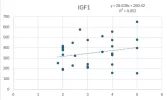
Kaizoku consistently responds on the lower end of the spectrum. According to data from other people in this thread, 2-3 IU/d should roughly correspond with IGF1 @ 320-350 (see graph posted above).

It seems that the studies are using what we would call "CJC 1295 with DAC" because they define it as a long acting GHRH.What's your baseline and how much cjc are you taking?
And be mindful of long term exposure to cjc. There Might be some issues.
DNA damage and growth hormone hypersecretion in pituitary somatotroph adenomas - PMC
Drivers of sporadic benign pituitary adenoma growth are largely unknown. Whole-exome sequencing of 159 prospectively resected pituitary adenomas showed that somatic copy number alteration (SCNA) rather than mutation is a hallmark of ...pmc.ncbi.nlm.nih.gov
It seems that the studies are using what we would call "CJC 1295 with DAC" because they define it as a long acting GHRH.
I got away from using things like CJC DAC and MK 677 because they are long acting. Our bodies are designed for periodic transient spikes of GH. The constant stimulating agents have much harsher side effects than short acting versions or GH which can also be timed properly to minimize risks. The side effects are pronounced and outweigh the possible benefit of a bigger IGF 1 number. This new info adds to my list of why not to use the long acting compounds.
Thanks for sharing this.
I'm not doubting your exact same conditions, although maybe kinda xDAll tests done under the exact same conditions.
Dose split AM/PM, TRT level of test (200mg/wk), fasted 12 hours when blood drawn, inject first thing in the AM even on bloodwork days.
I’ve only ever used Opti Greys and since I’m not getting good results I’ve been considering swapping to a new source to see if it’s me or the greys…but with most of the affordable sources drying up I have to decide if it’s worth it financially.
I’ve got 2 more kits of greys, going to bump to 4iu and pull bloods again in 6 weeks.
I have no plans to compete, I’m just a mid-40s guy who likes looking and being in better shape than 95+% of other guys my age but at some point there has to be some return on investment and if I just don’t respond well to HGH I’ll drop it and put that money into something else.
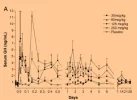
Long acting does. 1/2 life of ~6 days if I remember right. The CJC no DAC gives a spike then clears/metabolized pretty quick. Never used Tesa so haven't looked into it much.The human study on CJC-1295 showed it increased pulsatile secretion. Baseline hGH level was higher, so people called it "increased drip" but that was not reflected in the clearly increased higher pulses. Not sure if tesa has a similar study.
Long acting does. 1/2 life of ~6 days if I remember right. The CJC no DAC gives a spike then clears/metabolized pretty quick. Never used Tesa so haven't looked into it much.
True, exact conditions is a stretch.I'm not doubting your exact same conditions, although maybe kinda xD
Just mainly that IGF1 response is all over the board. And IGF1 may not be the only benefit of using hGH
View attachment 318504
It seems that the studies are using what we would call "CJC 1295 with DAC" because they define it as a long acting GHRH.
I got away from using things like CJC DAC and MK 677 because they are long acting. Our bodies are designed for periodic transient spikes of GH. The constant stimulating agents have much harsher side effects than short acting versions or GH which can also be timed properly to minimize risks. The side effects are pronounced and outweigh the possible benefit of a bigger IGF 1 number. This new info adds to my list of why not to use the long acting compounds.
Thanks for sharing this.
Long acting does. 1/2 life of ~6 days if I remember right. The CJC no DAC gives a spike then clears/metabolized pretty quick. Never used Tesa so haven't looked into it much.
Split, so 1.5iu morning and 1.5 iu evening?All tests done under the exact same conditions.
Dose split AM/PM, TRT level of test (200mg/wk), fasted 12 hours when blood drawn, inject first thing in the AM even on bloodwork days.
I’ve only ever used Opti Greys and since I’m not getting good results I’ve been considering swapping to a new source to see if it’s me or the greys…but with most of the affordable sources drying up I have to decide if it’s worth it financially.
I’ve got 2 more kits of greys, going to bump to 4iu and pull bloods again in 6 weeks.
I have no plans to compete, I’m just a mid-40s guy who likes looking and being in better shape than 95+% of other guys my age but at some point there has to be some return on investment and if I just don’t respond well to HGH I’ll drop it and put that money into something else.
Exactly. 1.5 as soon as I wake up, 1.5 right before bed.Split, so 1.5iu morning and 1.5 iu evening?
As alex properly linked, the pituitary output remains pulsatile, however, that still doesn't mean that the RHGHr's aren't constantly agonized, which creates the problem.
I'm also not sure if the subject in the study were fasted? As if they weren't, then the pulsatile nature could be because of fed/fasted states. Alex, mind looking that up?
My first IGF-1 ever tested was at ~25 and was 250 or so. You’re in the 25th percentile based on a quick search. So not awful, but definitely on the low end.How poor is a level of 191 at 22? For reference I'm on the fatter side of things which Lowers it but not insanely fat


