The T3/T4 Trap: How Thyroid Hormones Destroy Your Hard-Earned Muscle

Type-IIx

Member
image_square_no_preview.webp

Author

Cormac Mannion (Type-IIx)

Date

Friday, October 03 2025

Introduction

Key Takeaways

Key Takeaways

  1. Exogenous T3 significantly breaks down muscle protein
  2. T3 selectively destroys growth-responsive type IIA muscle fibers
  3. GH naturally increases peripheral conversion of T4 to T3, which is beneficial
  4. The reduction in serum T4 from GH use is typically not problematic for healthy individuals
  5. Thyroid hormone supplementation is irrational for bodybuilders as it accelerates muscle loss
  6. Exogenous GH cannot cause central hypothyroidism but may reveal pre-existing conditions
  7. Thyroid hormone misuse carries serious health risks including cardiac arrhythmias
  8. Common bodybuilding practices of using T3 deep into competition prep can be extremely destructive to muscle mass
Share

Introduction

Here’s another Q&A format article that was asked by a user in the Team Ampouletude Telegram group and led to a fruitful discussion… and fleeting references to still widespread bad practices among bodybuilders with respect to thyroid hormone use… something so destructive to muscle mass deep into prep when it’s typically applied… commonly with a hand-wave to the effect that “he’s on Halo, he won’t notice any muscle loss…

Thyroid hormone is potently muscle catabolic. It chews through muscle aggressively and selectively, especially the growth-responsive type II fibers.

Question

Since exogenous growth hormone (exogenous GH) reduces serum T4, should a healthy bodybuilder supplement exogenous T4 (Levothyroxine; Synthroid; Tiromel) or T3 (Liothyronine; Cytomel) as a rule with exogenous GH?

Definitions

T3: Triiodothyronine

T3 (exogenous) [Cytomel, LT3]: Liothyronine

T4: Thyroxine

T4 (exogenous) [Tiromel, Synthroid, LT4]: Levothyroxine

T3 in its endogenous (triiodothyronine) and exogenous (liothyronine) form is the actively catabolic hormone among the thyroid hormones (e.g., T2, T3, T4). T4, despite some endogenous effects, for enhanced bodybuilding discussion is effectively the prodrug to the active T3.

fT3; FT3: free T3, the bioactive fraction in blood

RMR: resting metabolic rate

REE: resting energy expenditure

UCP: uncoupling protein

LBM: lean body mass

Dose-Response

Metabolic Rate

Given a seventy-five microgram (75 µg) Cytomel dose (daily for 14 days):

  • fT3 increased by 1.7-fold
  • RMR increased by 15% (adjusted for LBM)
  • UCP2 increased 1.7-fold and UCP3 increased 2.4-fold. [1]
A trend was also seen for a direct correlation between REE/LBM and increases in fT3 levels, with an average 0.11 kcal/kg/d increase in REE/LBM for each 10 pg/dL increase in fT3.

Read More on Substack​

Substack | Read

 
I gotcha. I was just trying to find out if it's replacement to like a 3 tsh, which is still normal range" or to what's more considered "trt optimized" TSH of 1 or less. That could just be a little too much and maybe you need to split the dose in half. That's all. I tried the to do the thyroid optimization with my trt doc to understand what is all about. My natural TSH was a 3 which is still in range but on the middle to higher side. He got me down to around 1.2 TSH but I just didn't like it. I was hungry all the time. It was harder to stick to a diet. I felt hotter in the sun than normal, etc.
In the end it just worked more against my progress than to help it
tsh isnt really good to see if you hypo/hyper thyroid you gotta check free t3 and free t4 (ft3/ft4)
 
tsh isnt really good to see if you hypo/hyper thyroid you gotta check free t3 and free t4 (ft3/ft4)
Tsh is the most widely ordered test by doctors so it's an easy starting place since I don't know what tests he has performed. Sure it can be more complex than that

I mean it sounds like you're taking too much. You're getting all the classic side effects of taking too much (Flat, unable to add weight in what is usually a caloric surplus for you) and now trying to make excuses for TSH being a bad test. When you hear hoofbeats think horsies, not zebras. This entire post is all about this exact issue.

1763138715642.webp
 
Last edited:
I was at
3.61 ulU/mL TSH,
1.6 ng/dL t4 free
3.1 pg/mL t3 free
25.9 ng/dL reverse t3

trying to get more into the "optimal range"
I take 45mg T4 and 60 mcg slow release t3 every day.

they are now
1.11 ulU/mL TSH
0.8 ng/dl t4 free
3.0 pg/mL t3 free
12.0 ng/dL reverse t3

I feel better but, was going that high year-round a bad idea?
So your ft3 barely changes with 60mcg of t3, that's really interesting... i wonder if its because the high rT3... i just pulled some bloods for rT3 waiting for the results...
 
Guys, it's possible to use only t3 to upregulate metabolism in a cut, like low doses 12,5mcg-25 max, without t4?
Of course. But 12.5mcg is less than a replacement dose for most people so you may be going backwards. Also, did you read the first post? The whole point is that you shouldn't use t3 unless you want to burn off your hard earned muscle. T3 is catabolic
 
It sounds like you're gonna be fine doing this. Still, T4 is risky to combine with GH. The reason it can be particularly risky to supplement T4 on GH is thyrotoxicosis, that section is in the article there near the end. Overt thyrotoxicosis can happen under the conditions that you describe, and if you're on gear too, even more readily. Everyone on gear has suppressed TSH. Everyone on GH has "suppressed" T4 and increased T3, it's just partly how they work.

I know I've heard it all before too bro – that T4 can't make you hyperthyroid – it's just bad broscience. In fact, 1/5 US patients on thyroid hormones is subclinically or overtly hyperthyroid, and the usual treatment is levothyroxine (L-thyroxine) or T4. They get into it in this paper here, I went and looked this up for you on the topic: The problem of exogenous subclinical hyperthyroidism - PubMed

Now, I would never say it's wrong to replace thyroid when on a diet to endogenous levels, like 25 mcg T3 daily or 75 mcg or so of T4, right? But to use it under a misguided belief that it's beneficial for enhanced protein turnover and extra fat-burning? That's where the notion becomes counterproductive, and muscle losses will follow.

But frankly, even replacement will in itself cause some muscle loss, still. This is because the reason the body suppresses thyroid levels and output during caloric restriction (& very low carbohydrate intakes) is to spare muscle protein/anticatabolism… that's the very well supported theory anyway!
 
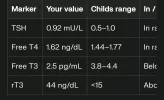
Im lost. The attached image shows my most recent levels. The "Child's range" refers to Dr. Westin Child's custom reference ranges.

Basically I tanked my calorie intake on tirzepatide and just didnt eat much. I still exercised but I was just trying to preserve muscle. 40% of the 38 lb I lost in 4 months was muscle. I did get down to 13.7%bf but now I I cannot lose any more fat. Ive been stuck at 13% for 3 months. I switched to reta and my food aversion abated and I can manage 2000-2700 calories a day. My BMR is 1950.

How do I replenish my fT3 and lower rT3? Im now on GH. Should I continue on GH? Im on TRT levels of test and very low NPP (85% of test dose) and also a little masteron (100mg/week). Im just trying to prevent muscle loss at this point.
 

Attachments

  • Screenshot_20251216_202023_Perplexity.webp
    Screenshot_20251216_202023_Perplexity.webp
    27.9 KB · Views: 5
Back
Top