In The $$$MONEY$$$

Re: I Am In The $$$MONEY$$$

Jacobsen, Ben and Zhang, Cherry Yi, The Halloween Indicator: Everywhere and All the Time (October 1, 2012). Available at SSRN: The Halloween Indicator: Everywhere and All the Time by Ben Jacobsen, Cherry Zhang :: SSRN

We use all available stock market indices for all 108 stock markets and for all time periods to study the ‘Halloween indicator’ or ‘Sell-in-May’effect. In total 55,425 monthly observations over 319 years show winter returns – November through April – are 4.52% (t-value 9.69) higher than summer returns. The effect is increasing in strength: The average difference between November-April and May-October returns is 6.25% over the past 50 years. A Sell-in-May trading strategy beats the market more than 80% of the time over 5 year horizons. The data allows us to address a number of (methodological) issues that have been raised with respect to the effect.
 
Re: I Am In The $$$MONEY$$$

PWC - 2012 Patent Litigation Study
http://www.pwc.com/en_US/us/forensic-services/publications/assets/2012-patent-litigation-study.pdf
 
Re: I Am In The $$$MONEY$$$

[ame=http://www.youtube.com/watch?v=usDyYsLDMlQ]Ex-SEC GC: Financial Markets Aren't Rigged, They're Broken - YouTube[/ame]
 
Re: I Am In The $$$MONEY$$$

[ame=http://www.youtube.com/watch?v=TBiUm0ojcOA]Psychology of Leadership - Seth Klarman - YouTube[/ame]
 
Re: I Am In The $$$MONEY$$$

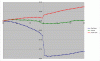
Cumulative Abnormal Returns around Management Forecasts

The figure shows the cumulative average abnormal return for three groups of firms – those issuing bad news (N=4,415), neutral (N=1,263) and good news (N=2,708) management forecasts. Abnormal returns are calculated using the CRSP value weighted index as the benchmark. Bad news and Good news denote management forecasts that are $0.01 below and above the last consensus analyst forecast prior to CIG issuance (Pre-AF), respectively. Management forecasts within $0.01 of Pre-AF are denoted neutral.

10476


Das, Somnath, Kim, Kyonghee and Patro, Sukesh, On the Anomalous Stock Price Response to Management Earnings Forecasts (November 1, 2011). Available at SSRN: On the Anomalous Stock Price Response to Management Earnings Forecasts by Somnath Das, Kyonghee Kim, Sukesh Patro :: SSRN

This paper examines stock price formation subsequent to management forecasts of quarterly earnings. In the post-announcement period, we find a significant upward price drift for both good news forecasts and bad news forecasts. The asymmetry in the initial market response and the subsequent upward drift in stock prices are consistent with a reversal of an initial overreaction to managers’ bad news forecasts and a continuation of an initial underreaction to managers’ good news forecasts. This interpretation is supported by a negative (positive) relationship between the initial market response and the post-guidance drift in the bad news (good news) group. The drift pattern is robust to issues arising from measurement. Trading strategies exploiting the post-announcement drift suggest the existence of economically significant trading profits, net of estimated trading costs.
 

Attachments

  • Cumulative-Abnormal-Returns.gif
    Cumulative-Abnormal-Returns.gif
    29.4 KB · Views: 27
Re: I Am In The $$$MONEY$$$

HEDGE FUND OWNERSHIP
http://www.factset.com/websitefiles/PDFs/hedgefund_ownership/hedgefund_ownership_11.19.12
 
Re: I Am In The $$$MONEY$$$

Jeremy J. Nalewaik. "The Income- and Expenditure-Side Estimates of U.S. Output Growth—: An Update to 2011Q2." Brookings Papers on Economic Activity 2011, no. 2 (2011): 385-403. http://www.brookings.edu/~/media/Projects/BPEA/Fall%202011/2011b_bpea_nalewaik.PDF

In light of recent large revisions to the official measures of U.S. output, this update reviews the evidence in my 2010 Brookings Paper showing that the income-side estimate of output (currently called gross domestic income, or GDI) likely captures business cycle fluctuations in true output better than its better-known expenditure-side counterpart (called gross domestic product, or GDP). Most notably, over the 2007-09 downturn, the revisions moved the expenditure-side estimates closer to the income-side estimates, which showed that the downturn was considerably worse than reported initially by the expenditure-side estimates. The tendency for the expenditure-side estimates to be revised toward the income-side estimates is clearer now, as is a tendency for the smoothed income-side estimates to be revised away from the smoothed expenditure-side estimates.
 
Re: I Am In The $$$MONEY$$$

Empirically rich new study finds most people alter their risk-management approach depending on the type of decision.
Empirically rich new study finds most people alter their risk-management approach depending on the type of decision


Einav L, Finkelstein A, Pascu I, Cullen MR. How General Are Risk Preferences? Choices under Uncertainty in Different Domains. American Economic Review 2012;102(6):2606-38. AEAweb: AEAweb Journal Articles Display

We analyze the extent to which individuals' choices over five employer-provided insurance coverage decisions and one 401(k) investment decision exhibit systematic patterns, as would be implied by a general utility component of risk preferences. We provide evidence consistent with an important domain-general component that operates across all insurance choices. We find a considerably weaker relationship between one's insurance decisions and 401(k) asset allocation, although this relationship appears larger for more "financially sophisticated" individuals. Estimates from a stylized coverage choice model suggest that up to 30 percent of our sample makes choices that may be consistent across all 6 domains.
 
Re: I Am In The $$$MONEY$$$

Sturm, Ruger & Company
(NYSE:RGR)
Sturm, Ruger & Company: NYSE:RGR quotes & news - Google Finance

On RGR, they declared a $4.50 per share dividend. [Sturm, Ruger & Company, Inc. Declares a Special Dividend of $4.50 Per Share - Ruger Corporate ] IMO, the stock will trace back to the $60 level and MORE. I would HOLD. IMO, RGR is as sure a bet on a stock as one can make. I can see NO reason not to be in this stock.
After all, this is GUNS!


Sarepta Therapeutics (SRPT)
Sarepta Therapeutics Inc: NASDAQ:SRPT quotes & news - Google Finance

SRPT is a trade on Duchenne Muscular Dystrophy [DMD]. I would BUY on a pullback from overall market reaction to the "fiscal cliff." A price below is $20 is a STRONG BUY.

Markets are already preoccupied by the fiscal cliff. If negotiations appear stuck, share prices will fall as yearend approaches. Then, if the deadline passes without agreement, they will probably plummet. Under that pressure, as in 2008, Washington will probably produce a deficit agreement. At worst, Congress and the president would extend the middle income tax cuts on which they agree. There will be no direct blow to the economy.
 
Re: I Am In The $$$MONEY$$$

The stock is getting hit simply because their guidance was lower than expectations. IMO, a guaranteed 10-20%+ return within 12 months; 10% return within 3-6 months.


[BUY] Smith & Wesson Holding Corporation
(NASDAQ:SWHC)
http://www.smith-wesson.com/webapp/wcs/stores/servlet/CustomContentDisplay?catalogId=750051&content=11001&langId=-1&storeId=750001
Smith & Wesson Holding Corporation: NASDAQ:SWHC quotes & news - Google Finance


Smith & Wesson Holding Corporation Reports Record Second Quarter Fiscal 2013 Financial Results
Investors - Press Releases - Smith & Wesson
 
Re: I Am In The $$$MONEY$$$

Where to Invest
With uncertainty roiling the market, the big question is not, will the market go up next year, but what stocks will go up. Think Apple, Royal Dutch Shell, JPMorgan Chase, and more.
http://online.barrons.com/article/SB50001424052748703555704578163174281808756.html

SATURDAY, DECEMBER 8, 2012
By ANDREW BARY

How come we feel so bad when we've got it so good? Even after a 12% gain in the S&P 500 index this year, uncertainty about the fiscal cliff, increased taxes, and still-high unemployment continue to wear down investors. Year to date, domestic equity funds have seen $110 billion in net outflows.

The new year could bring more of the same if economic uncertainty fails to lift, making the key question for investors not which way the market is headed in 2013, but which stocks are going to go up.

For the third year in a row, Barron's is taking a crack at that question, with our 10 Favorite Stocks for 2013, including blue-chips like Apple (ticker: AAPL), JPMorgan Chase (JPM), Royal Dutch Shell (RDSA), and Novartis (NVS), and smaller companies like Barnes & Noble (BKS) and disk-drive maker Western Digital(WDC), which appear sharply undervalued.

Many of this year's picks have been the subject of bullish articles in Barron's during the past year. Apple was featured in a recent cover story, while BlackRock (BLK), Barnes & Noble, and Viacom (VIAB) were profiled in recent months.

We're coming off a good year. Our 10 stocks for 2012 outpaced the market by four percentage points, gaining an average of 17% (see accompanying table). The two big winners were disk-drive maker Seagate Technology (STX) and cable operator Comcast (CMCSA), both up more than 60%. The worst performer was

Freeport-McMoRan Copper & Gold (FCX), which declined 22%, with nearly all of that drop coming last week amid negative investor reaction to its deal to buy two energy companies for $9 billion.

No matter which way the market goes, well-run companies should be able to deliver higher revenue and profits, even in a tough environment. All of our new favorites could produce 15% to 20% total returns (including dividends) next year. Here's a closer look:

APPLE is still going strong, even as the company's shares have traded down 23%, to around $540, from a September peak of $705. None of the recent investor concerns -- lower margins, supply constraints, management changes, iPad competition, and the iPhone 5 map fiasco -- are major. It's true that Apple's earnings growth has slowed to a 23% rate from more than 100% a year ago, but that's understandable, given the company's $156 billion in annual sales.

Veteran UBS tech analyst Steve Milunovich recently wrote that it's a "good time" to add to positions in Apple before year end, with the stock trading near its lowest price/earnings ratio in five years after two disappointing quarters. He carries a price target of $780. Apple trades for only 11 times projected profit of $49 a share in its current fiscal year, ending in September 2013. Strip out Apple's huge cash holding of $128 a share, and the effective P/E is just eight.

Even after implementing a dividend -- now providing a 1.9% yield -- and a modest buyback program, Apple should build cash at a rate of $40 billion annually. There's room for a higher dividend and a more aggressive share-repurchase program in 2013. Both could play well with investors.

BARNES & NOBLE'S bookstore division dominates the field, and the company's Nook e-reader unit is holding its own against Amazon.com (AMZN) and Apple. These achievements aren't reflected in Barnes & Noble's depressed stock price, which is flat this year at around $14. The stores now control almost two-thirds of the country's retail shelf space for books and are expected to generate more than $300 million of pretax cash flow in the fiscal year ending in April. The stores could be worth the entire current stock price -- Barnes & Noble has an equity value of just $880 million.

The Nook division is losing money, but that reflects a market-share grab, as Barnes & Noble seeks to get its e-readers into the hands of as many consumers as possible and then sell them profitable digital content, including books and magazine subscriptions. Microsoft (MSFT) likes Nook, having invested $300 million this year for a 17.6% stake in the division. That implies that Barnes & Noble's 82.4% of Nook is worth $1.4 billion, or $24 a share. While this calculation likely overstates Nook's value, the division probably is worth a good deal more than its implied price of zero. One fan is media magnate John Malone, whose Liberty Media (LMCA) owns about $200 million of Barnes & Noble convertible preferred stock.

BLACKROCK received a big vote of confidence this fall when director James Grosfeld purchased nearly 500,000 shares of the investment manager in the open market for $94 million, one of the largest insider purchases in the past decade. Grosfeld, a former CEO of Pulte Homes, wouldn't comment, but he clearly sees value in BlackRock shares, which have lagged behind those of its peers this year.

BlackRock, at $193, is valued at 13 times projected 2013 profit of $15 a share, a slight discount to its rivals; it yields 3.1%. BlackRock is the No. 1 investment manager, overseeing $3.7 trillion in assets. Its iShares is the leading provider of exchange-traded funds, with half of the market.

The three main concerns about BlackRock are that it's too big to grow, that competitive pressure in ETFs from Vanguard will push down fees, and that longtime CEO Larry Fink, viewed as one of his industry's best executives, might leave for the top job at the U.S. Treasury Department. (See Feature "Madame Treasury Secretary?".)

Bulls such as Morgan Stanley analyst Matthew Kelley see double-digit earnings growth next year, driven by iShares. Fink has dismissed talk that he wants to succeed soon-to-retire Treasury Secretary Timothy Geithner. "I'm not leaving this job," Fink said last week. "I will be at BlackRock as long as my board wants me here."

GENERAL DYNAMICS is best known as a defense contractor, but unlike its peers, it has a valuable nondefense business that isn't reflected in its share price. Gulfstream, a leading maker of corporate jets, produces almost 30% of General Dynamics' profits, and that percentage should rise in the next few years, with deliveries of Gulfstream's new top-of-the-line plane, the G650, which sells for $60 million and can fly nonstop from New York to Tokyo.

General Dynamics, at around $67, looks inexpensive, trading under 10 times projected 2013 profits of $7.32 a share. Gulfstream is expected to generate more than $2 a share of that. Put a P/E multiple of 14 on that contribution, and the private-jet business could be worth $30 per General Dynamics share. This suggests that the defense business -- including tanks, other armored vehicles, and nuclear submarines -- is valued at just seven times forward earnings. Defense contractors face tighter Pentagon appropriations, but the industry probably will avoid draconian reductions in spending, assuming Congress and the president reach a budget deal.

Barclays analyst Carter Copeland argues that General Dynamics could be the only major defense contractor to show higher operating profits through 2015. Incoming CEO Phebe Novakovic, who takes the top job on Jan. 1, could be a positive catalyst. What could be in store? A higher dividend, more aggressive share buybacks, or even a Gulfstream spinoff. The company has rejected the spinoff idea, but some investors think Novakovic might reconsider. Copeland's price target: $87.

JPMORGAN CHASE is a best-in-class bank, trading at a below-average price. At around $42, its shares fetch just eight times projected 2013 profit of $5.31 a share. That's one of the lowest price/earnings ratios among major banks.

JPMorgan is strong in all of its major businesses, including trading and investment banking, asset management, private and consumer banking, credit cards, and processing services. While rivals like Citigroup (C) and Bank of America (BAC) had to worry about survival during the financial crisis, JPMorgan invested to bolster key areas. It was embarrassed by $6 billion of trading losses this year caused by the "London Whale," but CEO Jamie Dimon is determined that a similar event won't occur.

Ross Margolies of Stelliam Investment Management recommended JPMorgan in a recent Barron's interview ("How to Play the Economic Recovery," Dec. 3), saying it should benefit from market-share gains at the expense of weaker European banks. The stock trades at only a small premium to tangible book value. JPMorgan yields 2.9%.

MARATHON PETROLEUM is a leader among independent oil refiners, one of the strongest industry groups in the stock market during 2012. Now trading at about $60, the stock could hit $82, according to Morgan Stanley energy analyst Evan Calio. Refiners have benefited from the boom in oil production in the central U.S. and western Canada, which has enabled them to buy crude at a discount to world prices, bolstering profit margins. That favorable price gap is expected to remain in place next year.

Even with its runup, Marathon commands less than seven times projected 2013 profits of $8.77 a share. In October, it agreed to purchase, at what appears to be a very favorable price, a huge Gulf Coast refinery from BP that will boost its capacity by 38%. A big plus for Marathon is its ability to transfer pipeline and other assets at high prices to a newly created master limited partnership, MPLX (MPLX). Marathon's dividend, now 2.4%, probably will rise in 2013.

NOVARTIS combines one of the pharmaceutical industry's best profit outlooks with an overlooked sum-of-the-parts story. At $62 -- 12 times projected 2013 profits -- the giant Swiss drug maker trades in line with its global peers. Its shares yield 3.4%. Profits at Novartis are expected to be down this year, in part because of the loss of U.S. patent protection for the blockbuster blood-pressure drug Diovan. But earnings are likely to rise next year.

Key drivers include Gilenya, a new drug for multiple sclerosis. Novartis also owns Alcon, a leading eye-care outfit, and Sandoz, one of the world's top generic-drug makers. Novartis doesn't get much credit for Alcon, which it bought in 2011 in a deal that valued Alcon at about $55 billion. Bernstein drug analyst Tim Anderson writes that Novartis "has one of the best revenue and EPS-growth profiles through 2016." He carries an Outperform rating and a $71 price target.

Breakups have been a big industry story, as Abbott Labs (ABT), Pfizer (PFE). And Bristol-Myers Squibb (BMY) have shed key units or split up entirely in moves that have played well on Wall Street. Novartis is cool to the idea, but it probably would gain more from a split than any other major pharma company.

ROYAL DUTCH SHELL has trailed Chevron (CVX) and ExxonMobil (XOM), its "supermajor" peers, in the stock market this year, with a decline of 8%, to $67. The shares look inexpensive, given the dividend yield of 4.4% and a 2013 P/E ratio below eight.

Headquartered in The Hague, Royal Dutch has bet big on huge liquefied-natural-gas projects in Australia and elsewhere; it now gets about half of its energy output from gas. That exposure worries investors for two reasons: First, the cost of massive LNG projects is rising, running into tens of billions of dollars; and second, the current link of LNG prices to oil could weaken. However, prices for internationally traded gas -- which mostly goes to the Asian market -- are much higher than those in the U.S.

The LNG concerns seem overdone, and Royal Dutch has the wherewithal to complete existing projects, even if oil prices fall moderately. Royal Dutch looks like a low-risk way to play the energy market.

VIACOM is an outlier in the hot media sector. Shares of the owner of the MTV, Nickelodeon, and Comedy Central cable networks, and the Paramount movie studio, are up 15% this year to $52, while Disney (DIS), Time Warner (TWX), CBS (CBS), andNews Corp. (NWSA, the publisher of Barron's) all have gained about 30%. Viacom fetches 11 times projected 2013 profit, a sharp discount to its peers' average 13.

The shares have been hurt by persistent rating declines at the cable networks, mainly Nickelodeon. The bull case is that Viacom is steadily going private through one of the media industry's most aggressive share-buyback programs. That could lift the stock in 2013. Viacom repurchased more than 10% of its stock in its fiscal year ended in September, and a comparable buyback is expected in fiscal 2013.

Viacom could fetch a sizable premium in a takeover, thanks to its valuable cable assets. The company is controlled by Sumner Redstone, 90. While Redstone plans to pass on his stake to his grandchildren, unexpected things can happen after the death of a controlling shareholder. Analysts at Gabelli have put Viacom's private-market value at $86 a share in 2014.

WESTERN DIGITAL and rival disk-drive maker Seagate have languished amid worries about the future of the PC market. The two major players trade at single-digit price/earnings ratios. Our preference now is for Western Digital, which has badly trailed Seagate this year. At $37, the shares trade for less than five times projected profits of $7.65 a share.

The disk-drive market remains substantial, with annual sales of more than 500 million storage devices. While PC sales aren't growing, demand for storage is, and other forms of memory are too costly for storing massive amounts of data. And since Seagate and Western Digital control more than 80% of the market, pricing pressures are unlikely. Western Digital has a strong balance sheet, with $1.4 billion, or $5 per share, in net cash. Given that and its earnings power, a leveraged buyout of the company is possible.

The company has pledged to earmark half of its free cash flow for stock buybacks and dividends, and there's room to boost the payout, which at 2.7% is just half of Seagate's. Needham analyst Richard Kugele has a Strong Buy rating on Western Digital and a $46 price target.

 
Re: I Am In The $$$MONEY$$$

Biotech Players Lead a Boom in Cambridge
http://www.nytimes.com/2013/01/02/r...s-lead-a-boom-in-cambridge.html?smid=tw-share

January 1, 2013
By KAREN WEINTRAUB

CAMBRIDGE, Mass. — Anyone who knows the history of this town would be surprised to find a fashionable coffee shop on Third Street, with dozens of people walking by. The lattes and chai teas are being sold on a Kendall Square site that had been empty for most of the last 40 years — since factories with names like American Rubber and the Badger Company were razed for a NASA facility that was never built.

Instead, the land lay fallow for decades, even as spinoff companies from the adjacent Massachusetts Institute of Technology transformed the neighborhood into a major research hub.

But now, this corner of Cambridge is at the center of a real estate boom.

“You sit here and you’d never know there’s a recession going on anywhere else in the country,” Travis McCready, executive director of the Kendall Square Association, said over chai tea recently at Voltage Coffee & Art.

Cranes are busy on eight separate construction sites in this area, and roughly two million square feet of space is being built or renovated or is under city review here. An additional 1.4 million new square feet is committed, and more is expected elsewhere in this city of 106,000, located directly across the Charles River from the city of Boston. If it all gets built, the new investment in Cambridge will come close to $2 billion.

“It’s one of the hottest submarkets in the country,” said Steven Purpura, managing partner of Richards Barry Joyce & Partners, a commercial real estate firm based in Boston. “Top two or three for sure.”

Most of that growth is connected to the biotechnology and pharmaceutical industries, including new buildings for Pfizer and Novartis. Amazon just revealed plans to rent 100,000 square feet here; Google is expanding its footprint by 40,000 square feet; and Microsoft, I.B.M. and Nokia are nearby.

Pharmaceutical companies traditionally preferred suburban enclaves where they could protect their intellectual property in more secluded settings and meet their employees’ needs.

But in recent years, as the costs of drug development have soared and R.& D. pipelines slowed, pharmaceutical companies have looked elsewhere for innovation. Much of that novelty is now coming from biotechnology firms and major research universities like M.I.T. and Harvard, just two subway stops away.

“People are putting their pride away and working with who they need to work with,” said George A. Scangos, chief executive of Biogen Idec.

Mr. Scangos’s company illustrates the trend. When he took the helm at Biogen in 2010, his predecessor had just relocated the company’s headquarters to the suburban town of Weston, leaving its scientists behind in Cambridge, a half-hour’s drive away.

Mr. Scangos thought the separation was bad for the company, but rather than move the scientists, he decided to bring the company back to town. Biogen is now the anchor tenant of a $500 million, 1.7-million-square-foot development being built by Alexandria Real Estate Equities, on the former urban renewal site. The rest of its 3,500 local employees will occupy a second building nearby also expected to be completed by late 2013 by Boston Properties.

“It’s an amazing place to be,” Mr. Scangos said. “The intellectual firepower that is in Cambridge, between Harvard and M.I.T. and the number of companies, is quite remarkable.”

Pfizer also chose Cambridge when it was looking to consolidate some of its research operations. In 2011, the pharmaceutical giant announced it would move 400 research jobs to a new building on M.I.T.-owned land in Cambridge, even as it was closing facilities in Groton, Conn., and elsewhere. That $300 million, 180,000-square-foot building is expected to be completed later this year.

Novartis, one of the first giant pharmaceutical companies to set up major operations in Cambridge, is adding two buildings to its campus on Massachusetts Avenue. They will occupy a combined 550,000 square feet at a cost of $600 million when they open in 2015.

And a fourth pharmaceutical company, Millennium: The Takeda Oncology Company, hopes to double its Cambridge footprint, occupying a 250,000-square-foot building proposed in Central Square, just down Massachusetts Avenue from M.I.T.

Trends in philanthropy are helping Cambridge, as well. Large donations from private philanthropies helped build the $200 million David H. Koch Institute for Integrative Cancer Research, completed last year on the M.I.T. campus, in addition to a second, 250,000-square-foot building for the Broad Institute, a genetics research institute spun off from Harvard and M.I.T. The Ragon Institute, a collaborative venture of M.I.T., Harvard and Massachusetts General Hospital to support AIDS vaccine research, will move into a nearby building now being renovated.

Another boost is coming from area hospitals. Five Harvard-affiliated hospitals and Harvard Medical School are clustered in Boston’s Longwood Medical Area. While that area is nearly built out, Kendall Square is one stop on the rail line from Mass General, the other Harvard-affiliated flagship hospital, providing easy collaboration.

Mr. Scangos said he liked to look out his office window and see all his competitors. When he goes downstairs to lunch, he has choices now, beyond the food trucks and cafeterias that were the only options a few years ago.

Although the closest drugstore and market are still a 20-minute walk away, that may change soon, too. Over the last seven years, 1,000 housing units have opened up in Kendall Square, adding to demand for such stores, Mr. McCready said. And last month, M.I.T. formally filed a rezoning petition with the city to turn 26 acres near its red line subway stop into a “gateway” for the campus, along with nearly 1 million square feet of office space and 240,000 square feet for housing units.

“All in all, it’s a pretty exciting time,” said Robert Healy, Cambridge’s city manager for more than three decades. “This is not the best of economic times. Yet there’s still the faith being shown in Cambridge by virtue of what’s in the ground and going up now.”
 
Re: I Am In The $$$MONEY$$$

This Guy Turned $20K Into $2 Million (You Can, Too)
[ame=http://www.youtube.com/watch?v=MrEQFFfYFa0]This Guy Turned $20K Into $2 Million (You Can, Too) - YouTube[/ame]


Last edited by a moderator:
Re: I Am In The $$$MONEY$$$

The Good, The Bad, The Ugly for 2013
The Good, The Bad, The Ugly for 2013: Video - Bloomberg

Jan. 3 (Bloomberg) -- On today's "Street Fighter's," US Trust Bank of America's Joe Quinlan, Bank of New York Mellon's Michael Woolfolk and Sica Wealth Management's Jeff Sica discuss central banks' monetary policies, jobs and inflation. They speak on Bloomberg Television's "Street Smart."


Woolfolk Advises Going `Long Cash' Into End of Year
Woolfolk Advises Going `Long Cash' Into End of Year: Video - Bloomberg

Dec. 24 (Bloomberg) -- Kathy Boyle, president of Chapin Hill Advisors Inc., and Michael Woolfolk, senior currency strategist at Bank of New York Mellon Corp., talk about their investment strategies for the end of 2012 and the beginning of 2013, and the outlook for the U.S. economy. They speak with Adam Johnson and Alix Steel on Bloomberg Television's "Street Smart."
 
Re: I Am In The $$$MONEY$$$

[ame=http://www.youtube.com/watch?v=1NXaafTpVjM][FULL VERSION] Nassim Nicholas Taleb explains Antifragile - YouTube[/ame]
 
Re: I Am In The $$$MONEY$$$

Investors put $18bn into equity funds
Investors put $18bn into equity funds - FT.com

January 11, 2013 1:25 pm
By Mary Watkins in London

US equity funds drew in $18.3bn in 2013’s first full week of trading, making it one of the busiest weeks on record as investors took advantage of the positive market conditions in the wake of a compromise deal on the US fiscal cliff.

Thomson Reuters’ Lipper service said the week to January 9 was the fourth largest for net inflows of equity funds since it began calculating weekly flows in 1992.

The data, which include exchange traded funds, come as global equities have reached multi-year highs.

US stocks climbed to a five-year high on Thursday and the FTSE 100 in London is trading at the highest levels since before Lehman Brothers’ collapse. The FTSE All-World index is on course to close the week at its best level since May 2011.

Some analysts have suggested that 2013 could be the year that sees a “great rotation” as investors look to equities rather than bonds for strong returns. However, others remain more sceptical.

Mario Draghi, the ECB president, talked of “normalisation” in certain market conditions earlier this week after the European Central Bank elected to keep interest rates at their record low levels.

He cited falling yields on sovereign bonds, strong capital inflows, an increase in bank deposits in crisis-hit eurozone countries, a shrinking of the ECB’s balance sheet and improvement in business confidence surveys among the factors that had improved.

The strong figures from Lipper come in the wake of the compromise deal that avoided the so-called fiscal cliff, billions of dollars’ worth of tax cuts and spending hikes due to automatically kick in at the start of the year. The new budget passed by Congress increased taxes for richer Americans and extended unemployment benefits but delayed a decision on planned spending cuts for two months.

Lipper said that overall, investors were net purchasers of fund assets totalling $34.2bn. Taxable bond funds attracted $4.2bn over the same period, municipal funds $1.6bn, while the money market drew in $10.1bn.

Investors also placed more money with emerging equity market and bond funds as investors search for higher yielding assets.

According to data from EPFR, the funds research company, emerging market equity fund inflows in the week to Wednesday more than doubled to $7.4bn, the highest level since April 2011. Inflows into emerging market bond funds hit $2bn, more than 50 per cent up on the previous week.

Other regions have also seen strong inflows into equity funds in recent months. According to the UK’s Investment Management Association, net retail sales of equity funds hit £720m in November, the highest since April 2011, making shares the most popular asset class for investors for the third month in a row. By contrast, fixed income funds sales were the lowest since October 2008.
 

Sponsors

Latest posts

Back
Top