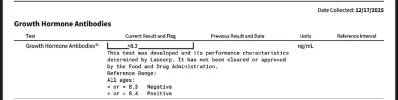
I don’t buy it. Antibodies were a cadaver HGH problem. Dirty process, wrong era. Recombinant HGH is clean, identical, and your body handles broken proteins all day long. Otherwise you’d be dead by breakfast.
Couple of misconceptions here.
rHGH (Somatropin) is much cleaner than cadaver growth hormone in that it’s “purer” GH, but
early formulations still caused a lot of aggregates to form, triggering antibodies and the loss of effectiveness, sometimes lasting long enough that the growth window for a short child was lost. This was a well documented problem in the early 2000s:
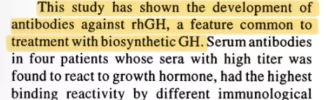
In fact, because pharma hadn’t yet done much work to protect against aggregates forming,
1st generation rHGH formulations produced almost the same level of immunogenicity as the last generation of highly purified cadaver GH.
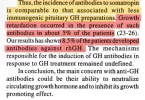
You don’t hear about it now, from medical sources, because pharma has gotten very good at formulating and controlling storage conditions to prevent aggregation. The FDA is psychotic about making sure it’s not a problem.
Somatropin didn’t change. The rHGH molecule is still the same as it was in 2003.
The reason rHGH immunogenicity fell off the map is because excipient formulations were carefully designed to prevent aggregation.
UGL does basically nothing to prevent aggregation. To do so, you’d have to start with using a specific amount of water in order to even known how much of each excipient in the “recipe” would be needed, not the random amounts we all use.
How often does pharma GH become visibly cloudy? How about UGL?
Every label on pharma Somatropin has dire warnings to not use cloudy GH.
It’s not because it’ll kill you, or even cause any noticeable symptoms. It’s because aggregates can build an immunity to rHGH with potentially terrible consequences for someone, like a growth stunted child who loses their chance, or an adult who produces very low or no GH, and becomes very frail and sick if rHGH stops working.
Someone using rHGH as a PED is very unlikely to know if it’s working as it should or lost 75% of its effectiveness over time. IGF-1 response is all over the place. Is it me? Is this batch bunk? Is it my e2?
Because it’s not life shattering like real GH deficiency,
even if immunity unknowingly develops, how would the UGL user know?
In medical treatment they know when rHGH starts losing efficacy because
children start growing slower (“losing height velocity”). Adult GH deficiency patients start accumulating fat quickly, lipids get progressively worse.
With UGL it’s practically all down to feels as to how well it’s working.
We know
aggregates are the main driver of rHGH immunogenicity. It happened early on with pharma rHGH.
We know UGL aggregates frequently, often it’s so bad we can literally see it (and 90% of the time we can’t).
Modern pharma rHGH doesn’t because of the protective excipient formulations. They’re not adding 5, 8, 10 ingredients in precise amounts for no reason.
Is there something special about UGL aggregation that means it doesn’t cause loss of efficacy even though aggregation in pharma rHGH clearly does?
It’s like holding up a gallon of pasteurized milk from the grocery store and saying “no one gets sick from drinking milk” as evidence drinking it straight from the farmers bucket is the same.