European Union

Re: Contagion

[ame=http://www.youtube.com/watch?v=6UGDTtqklSo]IMF advisor says we face a Worldwide Banking Meltdown - YouTube[/ame]
 
Re: Contagion

9616


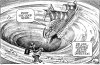
KAL's cartoon | The Economist
 

Attachments

  • 20111008_WWD000.jpg
    20111008_WWD000.jpg
    250.3 KB · Views: 16
Re: Contagion

[ame=http://www.youtube.com/watch?v=1Zpp3BNUgGM]Keiser Report: Ground Zero of Financial Terrorism (E195) - YouTube[/ame]
 
Re: Contagion

Europe is now leveraging for a catastrophe
Europe is now leveraging for a catastrophe - FT.com

October 23, 2011 5:21 pm
By Wolfgang Münchau

It is time to prepare for the unthinkable: there is now a significant probability the euro will not survive in its current form. This is not because I am predicting the failure by European leaders to agree a deal. In fact, I believe they will. My concern is not about failure to agree, but the consequences of an agreement. I am writing this column before the results of Sunday’s European summit were known. It appeared that a final agreement would not be reached until Wednesday. Under consideration has been a leveraged European financial stability facility, perhaps accompanied by new instruments from the International Monetary Fund.

A leveraged EFSF is attractive to politicians for the same reason that subprime mortgages once appeared attractive to borrowers. Leverage can have different economic functions, but in these cases it simply disguises a lack of money. The idea is to turn the EFSF into a monoline insurer for sovereign bonds. It is worth recalling that the role of those monolines during the bubble was to insure toxic credit products. They ended up as a crisis amplifier.

Technically, the EFSF monoline insurer would provide a first-loss tranche insurance for government bonds up to an agreed percentage. It sounds like a neat idea, until the recipients of the insurance realise their sovereign bonds have turned into hard-to-value structured products. One of the factors that will make them hard to value is the incalculable probability that France might lose its triple A rating. In that case, the EFSF would automatically lose its own triple A rating – which is derived from that of its guarantors. The EFSF’s yields would then rise, and the value of the insurance would be greatly reduced. The construction could ultimately collapse.

Leveraging also massively increases the probability of a loss for the triple A-rated member states, who ultimately provide the insurance. If a recipient of the guarantee were to impose a relatively small haircut – say 20 per cent – the EFSF and its guarantors would take the entire hit. Under current arrangements, they would only lose their share of the haircut.

The simple reason why there can be no technical quick fix is that the crisis is, at its heart, political. The triple A-rated countries have left no doubt that they are willing to support the system, but only up to a certain point. And we are well beyond that point now. If Germany continued to reject an increase in its own liabilities, debt monetisation through the European Central Bank and eurobonds, the crisis would logically end in a break-up. There is no way the member states of the eurozone’s periphery can sustainably service their private and public debts, and adjust their economies at the same time.

Each of Germany’s red lines has some justification on its own. But together they are toxic for the eurozone. The politics is not getting any easier. The behaviour of the Bundestag underlines the political nature of the crisis. Last month’s ruling of Germany’s constitutional court strengthened the role of parliament. But it also reduced the autonomy of the German chancellor, who now has to seek prior approval by the Bundestag’s budget committee before negotiating in Brussels. This power shift will not prevent agreements, such as the one currently negotiated, but it will make it harder to co-ordinate policy in the European Council on an ongoing basis.

The way eurozone leaders have been handling the crisis ultimately vindicates the German constitutional court’s conservatism in its definition of what constitutes a functioning democracy. Policy co-ordination among heads of state is both undemocratic and ineffective. A monetary union may require more than just a eurobond and a small fiscal union. It may require a formal, if partial, transfer of sovereignty to the centre – that includes the rights to levy certain taxes, impose regulation in product, labour and financial markets, and to set fiscal rules for member states.

Under normal circumstances, European electorates would not accept such a massive transfer of sovereignty. I would not completely exclude the possibility that they might accept it if the alternative was a breakdown of the euro. Even then, I would not bet on such an outcome. Current policy is leading us straight towards this bifurcation point, which may only be a few weeks or months away.

The biggest danger now is the large number of politicians drawing red lines in the sand, and the lack of even a single EU authority willing and capable of cutting through them. Given the multiple uncertainties, there is no way to attach any precise probabilities to any scenarios. But clearly, the chance of a catastrophic accident is bigger than merely non-trivial. The main consequences of leverage will be to increase that probability.
 
Re: Contagion

In today’s Financial Times, George proposes a seven-point plan to save the eurozone; see below.

My seven-point plan to save the eurozone
George Soros

1) Member states of the eurozone agree on the need for a new treaty creating a common treasury in due course. They appeal to European Central Bank to co-operate with the European financial stability facility in dealing with the financial crisis in the interim – the ECB to provide liquidity; the EFSF to accept the solvency risks.

2) Accordingly, the EFSF takes over the Greek bonds held by the ECB and the International Monetary Fund. This will re-establish co-operation between the ECB and eurozone governments and allow a meaningful voluntary reduction in the Greek debt with EFSF participation.

3) The EFSF is then used to guarantee the banking system, not government bonds. Recapitalisation is postponed but it will still be on a national basis when it occurs. This is in accordance with the German position and more helpful to France than immediate recapitalisation.

4) In return for the guarantee big banks agree to take instructions from the ECB acting on behalf of governments. Those who refuse are denied access to the discount window of the ECB.

5) The ECB instructs banks to maintain credit lines and loan portfolios while installing inspectors to control risks banks take for their own account. This removes one of the main sources of the current credit crunch and reassures financial markets.

6) To deal with the other major problem – the inability of some governments to borrow at reasonable interest rates – the ECB lowers the discount rate, encourages these governments to issue treasury bills and encourages the banks to keep their liquidity in the form of these bills instead of deposits at the ECB. Any ECB purchases are sterilised by the ECB issuing its own bills. The solvency risk is guaranteed by the EFSF. The ECB stops open market purchases. All this enables countries such as Italy to borrow short-term at very low cost while the ECB is not lending to the governments and not printing money. The creditor countries can indirectly impose discipline on Italy by controlling how much Rome can borrow in this way.

7) Markets will be impressed by the fact that the authorities are united and have sufficient funds at their disposal. Soon Italy will be able to borrow in the market at reasonable rates. Banks can be recapitalised and the eurozone member states can agree on a common fiscal policy in a calmer atmosphere.
 
Re: Contagion

Whipsaw Traps
Hussman Funds - Weekly Market Comment: Whipsaw Traps - October 31, 2011

October 31, 2011
John P. Hussman, Ph.D.

Last week was a scorching "risk-on" week for the markets, as a putative "solution" to Europe's debt problems and a positive print for third-quarter GDP convinced investors that all pressing economic concerns have vanished. We observed very little expansion of trading volume, which is characteristic of markets where short sellers are forced to cover while existing holders raise their offers and reduce their size. For our part, Thursday was difficult, as our largely defensive holdings were clearly out-of-favor, bank stocks (which we continue to avoid) shot higher on short covering, and option volatility declined as investors abandoned the desire to defend against losses.

I suppose it's needless to say that we shared neither the market's enthusiasm nor its confidence in the sudden view that everything has been fixed (more on that below). At the same time, as I noted last week, speculation can take on a life of its own when there is a pause in fresh concerns, so we're not inclined to "fight" the recent advance by raising our line of defense (which would expend option premium on higher-strike put options). The benefit of holding the existing line is that we won't get another crush in near-the-money option premium if the market advances further (which has contributed to a few percent of discomfort in recent weeks). The downside is that a sharp reversal lower won't benefit us much until the market loss exceeds about 3-5%. So we remain defensive here, but as a concession to the speculative inclinations of investors, we are not putting up a contrarian fight.

Beyond that, however, we don't have the evidence here to establish a material positive exposure or "go long" - at least not at present. Current market conditions cluster among a set of historical observations that might best be characterized as a "whipsaw trap." Though last week's rally triggered several widely-followed trend-following signals (for example, a break through the 200-day moving average on the S&P 500), the broader ensemble of data suggests a high likelihood of a failed rally. In this particular bucket of historical observations, less than 30% of them enjoyed an upside follow-through over the next 6 weeks. Some recent examples from this bucket include the weeks ended 11/3/00, 12/7/01 and 2/1/08. These were points that followed snap-back rallies that were actually good selling opportunities in what turned out to be violent bear market declines.

That said, about 30% of the observations in the current bucket did enjoy a positive follow-through. So while the expected return/risk profile of the market remains negative here, we have to be somewhat more tentative about taking a "hard" defensive position. As always, we'll respond to new evidence as it arrives.
 
Re: Contagion

The Rise of a Euro Doomsayer
http://www.nytimes.com/2011/11/18/business/global/the-rise-of-a-euro-doomsayer.html

By LANDON THOMAS Jr.
Published: November 17, 2011

LONDON — The euro zone was unraveling, just as he had long predicted, yet Bernard Connolly, Europe’s most persistent prophet of doom, still faced a skeptical audience.

“The current policy of lending plus austerity will lead to social unrest,” Mr. Connolly told investors and policy makers at a conference held this spring in Los Angeles by the Milken Institute, arguing the case that Greece, Italy, Portugal and Spain could not simply cut their way to recovery.

“And one should not forget that of the four countries we are talking about, all have had civil wars, fascist dictatorships and revolutions. That is history,” he concluded, his voice rising above the chortles and gasps coming from the audience and the Europeans on his panel. “And that is the future if this malignant lunacy of monetary union is pursued and crushes these countries into the ground.”

Mr. Connolly has been warning for years that Europe was heading for disaster. As an E.U. economist in the early 1990s, he helped design the common currency’s framework, but he was later dismissed after he expressed turncoat views. In 1998, just months before the euro’s introduction, he predicted that at least one of Europe’s weakest countries would face a rising budget deficit, a shrinking economy and a “downward spiral from which there is no escape unaided. When that happens, the country concerned will be faced with a risk of sovereign default.”

Now, as the European debt crisis that began in Greece threatens to engulf even France along with Italy and Spain, Mr. Connolly’s longstanding proposition that the foisting of a common currency upon so many disparate countries would end in ruin is getting a much wider hearing.

Hedge funds looking to bet on a euro zone breakup scour his research reports for insights.

Longer-term investors who listened to his decade-long recommendations to steer clear of the bonds of Greece, Italy, Portugal and Spain are congratulating themselves for not falling into the trap that bankrupted MF Global, the investment firm run until recently by Jon S. Corzine, the former Goldman Sachs executive and New Jersey governor.

And central bankers outside the euro zone are among his most faithful readers.

In 2008, Mark Carney, the governor of the Canadian central bank, cited the British-born Mr. Connolly, along with the far more prominent Nouriel Roubini of New York University and the Harvard economist Kenneth S. Rogoff, as having been among the few who foresaw the global financial crisis. Mervyn A. King, the governor of the Bank of England, who has become increasingly vocal about the euro zone’s problems, is also a longtime follower.

Nicolas Carn, an independent research analyst and money manager who worked previously as chief investment strategist for the London-based hedge fund Odey Asset Management, is one of his biggest fans. “Bernard has influenced me a great deal,” Mr. Carn said. “He has shaped my views on Europe and contributed significantly to my investment performance.”

To be sure, Mr. Connolly was not the only analyst who raised early warning flags about the euro project. Economists like Martin Feldstein of Harvard and Paul Krugman, a Princeton economist who writes an op-ed column for The New York Times, have been longtime critics, as were many experts in euro-skeptic Britain. But few have gone on to devote more or less their entire professional career to exposing Europe’s monetary fault lines.

Unlike many critics of the euro, Mr. Connolly, 61, plies his trade mostly in private, eschewing cable television programs, opinion pages and policy journals. He represents a new breed of independent analyst who has come increasingly to the fore since the financial crisis broke in 2008.

As investment banks have cut down on staff and remain constrained by their banking and government relationships, independent analysts like Mr. Connolly, who are mostly pessimistic in outlook, have become highly popular for hedge fund investors who wager large sums of money betting against the currencies, bonds and banks of countries heading for trouble.

Mr. Connolly, who used to work for AIG Financial Products, the banking arm of the giant insurance company American International Group, until it went into government receivership, now operates out of a nondescript office in New York, where he is said to pound out as much as 20,000 words of analysis a week.

Like those of other such analysts scattered around the globe, his insights do not come cheap. While the price Mr. Connolly charges is not public, analysts of his stature command, in some cases, as much as $100,000 for a full array of services, including regular meetings and phone calls along with written reports.

And like most of them, Mr. Connolly — the Oxford-educated son of a bus driver from Manchester — guards his privacy zealously. He declined numerous requests to comment for this article. People who know him say that his public reticence is also fed by a lingering anxiety that officials in Brussels will exact some form of revenge.

The origins of that fear as well as the anger and passion that drive him date to 1995, when he took a leave from his job to write “The Rotten Heart of Europe,” an excoriating history of the failure of the euro’s predecessor, the European Exchange Rate Mechanism.

In Britain, where suspicions of common European economic policy ran very high, the book was a hit for its attacks on the architects of the European common currency, including Jacques Delors, the former head of the European Commission, and Jean-Claude Trichet, the French finance official who would go on to run the European Central Bank for eight years.

The book was greeted less enthusiastically in Brussels; Mr. Connolly was told not to return from leave to reclaim his position. Moreover, he was the subject of an investigation by the European Commission into whether he had disclosed any proprietary information in his book. Investigators found that he had not.

In 2005, while working at A.I.G. and at a time when Greek, Portuguese and Irish bonds were trading at rates barely higher than Germany’s, Mr. Connolly persuaded a small group of hedge funds and independent investors to bet on a euro zone crack-up.

They did so by buying the credit-default swaps of what he saw as the most vulnerable European countries. When fears that those countries would default took off in 2008 and 2009, sending the values of those swaps skyward, they were able to sell out — reaping large profits.

“It took a while, but we finally were able to monetize Bernard’s views on Europe,” said James Aitken, who worked with him at A.I.G. and described his job then as translating Mr. Connolly’s arcane musings into actual investment strategies.

While other investors have also profited from following Mr. Connolly’s advice, Mr. Aitken says that Mr. Connolly’s true passion is to try to prevent the social and political train wreck he fears is just around the corner.

“He is anguished,” said Mr. Aitken, who runs his own research service for investors, called Notes from a Small Island, from his home in London. “He sees where this is going and is warning against the human tragedy.”

Yra Harris, a trader on the Chicago Mercantile Exchange, is another of Mr. Connolly’s supporters in the investment world. “Bernard is like no one I have ever met,” he said, citing his work as inspiration for some recent profits he made selling Italian bond futures.

Mr. Harris is so convinced that Mr. Connolly’s views should find a wider audience that he and a colleague have offered to pay Mr. Connolly’s publisher $75,000 to reissue 25,000 copies of the out-of-print “Rotten Heart.” (A used hardback now sells for $440.85 on Amazon.)

“I will pay out of my pocket because he has meant so much to me,” Mr. Harris said. “Each time I talk to him, it’s like I’ve been to Harvard for four years.”

 
Re: Contagion

[ame=http://www.youtube.com/watch?v=bdob6QRLRJU]Farage: What gives you the right to dictate to the Italian people? - YouTube[/ame]
 
Re: Contagion

Greek bond losses put role of CDS in doubt
Greek bond losses put role of CDS in doubt - FT.com

Earlier this year, Deutsche Bank quietly decided to reduce its exposure to Italian government bonds. But it did not do that by simply selling debt; instead it achieved this partly by buying protection against sovereign default with credit derivatives contracts. That duly enabled the doughty German giant to report that its exposure to Italian sovereign bonds had dropped an impressive 88 per cent during the first half of the year – at least, when measured on a net basis – from €8bn to less than €1bn.

So far, so sensible; or so it might seem. But there is a crucial catch. These days, it is becoming less clear whether those sovereign CDS contracts really offer effective “insurance” against default. And that in turn raises a more unnerving question: if the exposures of the large European banks were measured in gross, not net, terms, just how much more vulnerable might they be to sovereign shocks? Or, to put it another way, could the problems now hanging over eurozone banks and bond markets be about to get worse, due to the state of the sovereign CDS sector?

The issue that has sparked this debate is, of course, Greece. In October, eurozone leaders announced that they intended to ask investors to swap any holdings of existing Greek sovereign bonds for new bonds, with a 50 per cent haircut. Logic might suggest that a loss that painful should count as a default. If so, logic would also imply that it merits a CDS pay-out.

After all, the whole point of credit derivatives – at least, as they have been sold to many investors in recent years by banks’ sales teams – is that they are supposed to provide insurance for investors against the risk of a bond default. And there is a well developed mechanism in place, created by the International Swaps and Derivatives Association, to make such pay-outs in a smooth manner. That has already been activated over six dozen times for corporate CDS; just last Friday, for example, the process was activated for Dynegy, a corporate entity which recently declared bankruptcy.

But Greece, it seems, is different from Dynegy; at least, under ISDA rules. When the eurozone leaders announced their plans to restructure Greek bonds they failed to meet – or, more accurately, deliberately missed – the fine print of “default” under ISDA rules. Most notably, the standard ISDA sovereign CDS contract says that pay-outs can only be made when a restructuring is mandatory, or a collective action clause invoked. However, it seems that 90 per cent of Greek government bonds do not have collective action clauses; and the October 26 announcement presented the haircut as “voluntary”. Thus ISDA has concluded that “the exchange is not binding on all debt holders”, so the CDS cannot be activated – even though losses on Greek bonds may well be bigger than at Dynegy.

Many investors, unsurprisingly, are outraged; some observers, such as Janet Tavakoli, a consultant, conclude that the saga has exposed the CDS market as a sham, with ISDA acting in bad faith. But ISDA officials vehemently deny this – and insist that the blame lies with eurozone leaders, and their determination to manipulate the fine print of the rules. “The obsession with avoiding a credit event [to activate CDS contracts] is, in our view, misguided,” the lobby group declares in a recent, unusually pugnacious, statement. After all, ISDA officials add, the published value of outstanding Greek CDS contracts is “only” $3.7bn. Since that is partly collateralised, ISDA thus concludes – ironically – that even if that October 26 announcement had actually activated the CDS contracts, it would have barely affected the markets at all.

ISDA may well be right; given the magnitude of the turmoil now shaping the eurozone financial system, $3.7bn is barely a rounding error. But the crucial question now is what happens to the wider sovereign CDS market – and banks. It is unclear how far eurozone banks have used CDS to hedge their exposures to eurozone debt. However, the published level of outstanding sovereign CDS for Italy and France is more than $40bn, and the Bank for International Settlements recently suggested that US banks have now extended over $500bn worth of protection to eurozone counterparties on Italian, French, Irish, Greek and Portuguese sovereign and corporate debt.

For the moment, nobody is questioning the value of those hedges against corporate risk; the corporate CDS still appears to work relatively well. But the longer that the wrangle about Greece continues, the harder it will be for banks to argue that sovereign CDS is a good hedge for their counterparty or credit risk. If so, it is a fair bet that banks such as Deutsche (among others) will redouble efforts actually to sell those eurozone bonds – or demand collateral from sovereign entities for derivatives trades. Indeed, behind the scenes, these efforts are already quietly starting. It is not a comforting thought; least of all when a mood of panic is afoot in Europe’s debt markets.
 
Re: Contagion

[ame=http://www.youtube.com/watch?v=PCi2MN1J3Mo]Gordon Chang: The Reasons For China's Imminent Bust - YouTube[/ame]
 
Re: Contagion

[ame=http://www.youtube.com/watch?v=wfKbwofLsEo]Interview w/Reggie Middleton: Is Bank of America going Bust? (Part 1) - YouTube[/ame]
 
Re: Contagion

[ame=http://www.youtube.com/watch?v=dofV-rCps_8]Interview w/Reggie Middleton: Is Bank of America going Bust? (Part 2) - YouTube[/ame]
 
Re: Contagion

Well, this was to be expected, but so soon. Italy paid close to 8% for 2Y!!! But, no matter. And 6-months almost doubled within 2 months. They said there was good demand for them. LMAO

Are you lining up targets when it comes time to pull the trigger.


Italy forced to pay record interest rates at auction
BBC News - Italy forced to pay record interest rates at auction

Italy has been forced to pay record interest rates in a 10bn euro ($13bn; £9bn) auction of treasury bills.

The rate of interest for the new debts due to be repaid in six months was 6.504%, compared with 3.535% in the last comparable sale on 26 October.

The rate for two-year borrowing was 7.814%, up from 4.628% last time.

The Bank of Italy stressed that demand for the bonds had been high, with demand for the debts outstripping supply by 50%.


Euro rescue fund’s impact in doubt
Euro rescue fund’s impact in doubt - FT.com

A plan to boost the firepower of the eurozone’s €440bn rescue fund could deliver as little as half what the bloc’s leaders had hoped for because of a sharp deterioration in market conditions over the past month, according to several senior eurozone government officials.

European leaders hailed a scheme to offer insurance on losses for investors buying troubled eurozone bonds as a means of leveraging the €250bn spare capacity of the rescue fund four or five fold, to more than €1,000bn.

But the dramatic spike in borrowing costs for Italy since the summit is likely to force the European Financial Stability Facility to sweeten the deal offered to investors, which will limit the number of bonds the insurance would cover.

Klaus Regling, head of the EFSF, earlier this month said that overcoming investor concerns with improved guarantees would mean the fund was likely to have only three to four times the firepower – an admission that underlined the challenge European leaders face in steadying sovereign debt markets.

But three senior eurozone officials said even this lower target may be difficult to reach, and expect the eventual firepower to be between two and three times the remaining buying capacity of the fund. “It is falling well short of its billing,” said one. Concerns over leverage will be a key item on the agenda of eurozone finance ministers meeting on Tuesday.

These officials are also pessimistic about the prospects of a second source of leverage, a co-investment vehicle designed to entice investors from emerging markets. One said the idea was given a such a tepid reception by China and Brazil that is may struggle to amass funds.

No concrete pledges to the fund will be announced by eurozone finance ministers, but it remains an active option for the EFSF. One eurozone official argued pledges could only be expected to come once the exact terms of the vehicle’s use were settled.

Leveraging the EFSF’s dwindling resources was the main element of a grand plan unveiled in October to create “firewalls” that stop fallout from Greece spreading to European banks and its largest economies, particularly Italy.

But the rise in Italian and Spanish borrowing costs to painfully high levels has underscored the severity of the crisis and reopened the debate over more radical alternatives to boost the clout of the rescue fund. An added worry is the risk of a possible French downgrade, which would significantly sap the strength of the EFSF, as the fund is built on guarantees from “AAA” rated countries.

Alternative options include fresh guarantees or injections of money, the use of the EFSF as a bank, or steps to bring forward the European Stability Mechanism, Europe’s permanent bail-out fund, so that it runs alongside the EFSF instead of immediately replacing it.

Given the highly volatile markets and uncertainty over future European Central Bank interventions, it is almost impossible to predict the value of bonds the EFSF will eventually be able to insure.

The EFSF is still confident that investors will be lured by a guarantee against a loss of between 20 to 30 per cent, and officials point out that it is on track in setting out the terms of the different options to leverage resources.
 
Back
Top