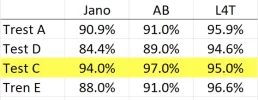
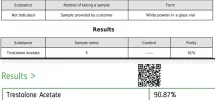
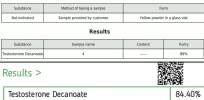
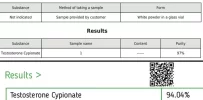
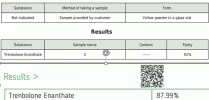
You seem to have a notion that a higher number is more accurate, whereas I am trying to figure out where the difference is coming from. All labs may be correct, with different results, if they each are reporting something differently. A vendor was kind enough to send raws to AB, Jano and L4T which does provide insight into the process.
View attachment 378553
The first thing to acknowledge is that AB and Jano uses LC/MS whereas L4T uses NMR. NMR is insensitive, meaning it is a best case scenario, because it can't detect impurities when the purity drops.
And as expected, we see that L4T is consistently above Jano and AB in purity. Is the purity wrong? No, it is just the nature of the test being executed.
Now, when purity is actually good, you see consensus between all 3 labs. (Test C). The fact that there is no consensus between the other labs and L4T for other samples does validate the fact that the other raws are impure.
Now as purity starts to drop, as seen in both Jano and AB, they start to diverge, (Test D and Tren E), with Jano dropping quicker.
Could they be measuring something different due to a slightly different reference standard? Could AB be averaging it out? Smoothing it? Lagging? Less sensitive due to equipment? I am not arguing that either lab is right, i am trying to figure out where the difference is coming from. Is one a raw figure and the other smoothed?
I can understand that vendor selling raws or oils, would prefer the lab that gives a better figure. This vendor for instance, shops around and goes to a different lab to get better results when results are poor, then ignores the poor reports.
If AB was more active, it could be as simple as buying the reference sample from them and Jano and testing at a 3rd party lab. Or we could simply ask them about their testing process. Unfortunately, it's hard enough making payment for their services.