
Ghoul
Member
Ive ran 20iu and still the same shoe size……
crazy how it effects people differently
What’s your IGF-1 and age?

MESO-Rx
Anabolic Steroids

Follow along with the video below to see how to install our site as a web app on your home screen.
Note: This feature may not be available in some browsers.
Ive ran 20iu and still the same shoe size……
crazy how it effects people differently
Also forgot to mention my natural igf was about 220. I don’t feel anything from hgh no matter the dose other than a rise of 15bpm resting hrOne thing I wanted to clarify for my own peace of mind was whether a normal range IGF-1 could be deceptive somehow, and a high enough rHGH dose could still cause acromegaly. The answer is no. Without systemic IGF-1 at supraphysiological levels, you could be on 20iu/day for 10 years and it’s not happening. Local tissue IGF-1 production and GH direct effects can’t cause it.
You could almost argue a lower IGF-1 response, so you’re still under Z score 3 with a higher dose of rHGH, might give you better results than if you’re a hyperresponder and 2iu gets you an IGF-1 @ 600. We might be cheering for the wrong thing. This might be from the days of just being relieved because a nice high number proved the rHGH is real.
With a higher dose of rHGH and just “mid” IGF-1, you’d have plenty of free GH for muscle IGF-1 production (where it really matters) and fat lipolysis. Systemic IGF-1 makes a lot of things grow we don’t really want to.
Hard to say for muscle growth - In all reality I don't think too too much. With the exceptions of two times I might believe it did, but both were with increase in steroid doses, so ultimately hard to say how much it contributed. One of these times was 7iu and another 10. But I have used 4-10 iu consistently for 3-4 years, different brands.Obviously this topic has been talked to death, however im interest in "case studys" meaning individual experiences.
Do we actually have members here who noticed any growth? Because i never heard of anyone personally experiencing tissue growth/acromegalia
So please state:
1. What dosage of HGH you take/took?
2.For how long
3. If you noticed any growth or if you DIDNT notice any growth.
4. If you want to: how old you are
I'm not sure that there is any realistic way to measure muscle growth as a direct result of HGH administration particularly as it's almost always used in conjunction with AAS so it becomes a matter of what is doing what.Hard to say for muscle growth - In all reality I don't think too too much. With the exceptions of two times I might believe it did, but both were with increase in steroid doses, so ultimately hard to say how much it contributed. One of these times was 7iu and another 10. But I have used 4-10 iu consistently for 3-4 years, different brands.
Other growth - I have noticed facial and jaw growth to the point where what was a "perfect smile" now has teeth that do not align well. Could possibly be AAS contributing also, but GH likely.
One of my close friends feet grew 1 size (legit, all this old shoes do not fit) in one year on 4iu.

I never got it tested on the 20iu, only ran it 3 months cutting.What’s your IGF-1 and age?
Back when i ran the 20iu none of this z score stuff was talked about.I never got it tested on the 20iu, only ran it 3 months cutting.
Im 32.
Im on 10 iu right now and getting blood tests in December, so i will see where i am at.
Whats your opinion of running higher ius for short periods of time, 3months for bulking? Would it still have the chance to cause figure changes?

Do u know that’s not normal, most people sleep like a rock on Hghhow you feel on 20iu per day? Can you normally sleep at night? When I am at 6iu for over 2-3 months I have very bad side effects cannot sleep, my hands are very wired just wondering how is 20 iu like
Do u know that’s not normal, most people sleep like a rock on Hgh

I really don’t know what’s normal now to be honestDo u know that’s not normal, most people sleep like a rock on Hgh
Thanks! Very informing. There is however one thing i stilk dont understand with beeing out of your range.Acromegaly has nothing to do with IU.
I’m going to try and break this down as simply as I can. Because despite not “personally” witnessing acromegalic changes, what I’m going to say is 100% certain, backed up with a mountain of evidence in medical literature building over the last 50 years.
If some decide acromegaly is a “myth”, “blown out of proportion”, or the classic “this doesn’t apply to me because the study subjects weren’t 43.5 year old 5’ 7” bodybuilders who injected rHGH between 7:12-7:19AM.” then IDGAF.
Suffer and don’t say you weren’t warned,
Acromegaly has nothing to do with IU.
It’s only caused by IGF-1. IGF regulates cellular growth. And we know people using the same IU have IGF-1 levels all over the place. 2iu doesn’t mean you’re safe, and 10iu doesn’t mean you’re at risk.
It’s all about the Z score, how far above you are normal IGF-1 for your age. Without fail even those with a pituitary tumor squeezing out a ton of growth hormone, when IGF-1 is knocked down with meds to normal appropriate levels, acromegaly stops progressing.
Specifically how far above the upper limit of normal you are FOR YOUR AGE.
Acromegaly is insidious. The average time to diagnosis is 7 years. 60% of the time it’s first identified by a DENTIST, EYE DOCTOR, or SLEEP APNEA SPECIALIST, since they’re trained to look for it.
The lowest Z score acromegaly is typically diagnosed at is 3.5.
It could take 2iu or 15iu to reach 3.5.
At a continuous Z 3.5:
Soft tissue always changes first. By 1 year at that level, your organs have changed sufficiently organomegaly can be seen on an MRI. Even the slowest moving acromegaly has unmistakable facial features an acromegaly specialist can visually identify after 12-24 months of Z 3.5, But almost no one else around you os likely to notice anything that sets off alarm bells. Maybe your shoes and rings don’t fit anymore so you catch it early.
But according to the experts, it’s not until someone who knows what to look for, like a dentist who notices your fucking teeth don’t line up anymore, identifies acromegaly after 7-10 years of elevated IGF-1. Imagine how much soft tissue has grown, how much your nose has changed, how many god damn whacks in the face with the ugly stick you must’ve gotten by the time your JAW EXPANDS.
Acromegaly doesn’t happen below Z 3. At least after an exhaustive review, I can’t find a single case of it below Z 3.
By Z 4 it’s almost always pathological. The higher above that the faster the changes come on.
So check your Z. If it’s above 3 and you keep it elevated like that for over 6-12 months, you’re probably developing acromegaly. Maybe very slowly at the lower. Over 4 and it’s nearly certain you’ll be fucked up after two years, including skeletal changes that may cause permanent joint issues.
That’s the main reason labs have an adult IGF Z score. Endocrinologists don’t really need them. It’s to give primary care doctors a simple number that automatically adjusts with age that tells them if the rHGH treatment adult patient they’re monitoring between endo appointments is slipping into the danger zone.
Keep Z below 3 if you’re using rHGH long term. Below 2 if you feel safer staying in the physiological range.
Thats an interesting line of thought. Because it would be "great" if we could surpress systemic igf-1 levels and elevate autocrine igf-1 levels.One thing I wanted to clarify for my own peace of mind was whether a normal range IGF-1 could be deceptive somehow, and a high enough rHGH dose could still cause acromegaly. The answer is no. Without systemic IGF-1 at supraphysiological levels, you could be on 20iu/day for 10 years and it’s not happening. Local tissue IGF-1 production and GH direct effects can’t cause it.
You could almost argue a lower IGF-1 response, so you’re still under Z score 3 with a higher dose of rHGH, might give you better results than if you’re a hyperresponder and 2iu gets you an IGF-1 @ 600. We might be cheering for the wrong thing. This might be from the days of just being relieved because a nice high number proved the rHGH is real.
With a higher dose of rHGH and just “mid” IGF-1, you’d have plenty of free GH for muscle IGF-1 production (where it really matters) and fat lipolysis. Systemic IGF-1 makes a lot of things grow we don’t really want to.
Thanks! Very informing. There is however one thing i stilk dont understand with beeing out of your range.
Younger people have more igf1 receptors so shouldnt they be more sensitive to higher igf-1 levels?
For example, why can an igf-1 level of lets simply say 400 cause in a 60 year old acromegalia but not in a 25 year old?
Shouldnt it be exactly the opposite? As the 25 years old hae a lot more active receptors for the igf-1 to bind and therefore cause the tissue growth?

Is there a specific time after injection of HGH to get my z score checked? I always inject before bed and get my blood drawn around 9am.Cells / tissues are capable of a finite amount of normal growth. After 25, the body shifts from development / high cell turnover to conservation of this growth potential.
400 (physiological) IGF-1 z score 2:
Younger - more receptors, higher sensitivity.
Efficiently respond to IGF-1 with cell turnover, healing, and growth.
400 (supraphysiological) IGF-1 z score 4:
Older - fewer receptors, lower sensitivity.
Natural blunted IGF-1 response overwhelmed by potent IGF-1 signaling forcing abnormal growth that could not occur at normal (for age) IGF-1 levels.
Of course there is an acromegaly inducing, high Z score level of IGF-1 at every age, it just requires more at younger ages to overwhelm the limits of normal growth.
By 95, IGF-1 at 175 would cause acromegalic growth.
Is there a specific time after injection of HGH to get my z score checked? I always inject before bed and get my blood drawn around 9am.
Awesome thanks for the quick reply! Z score was sitting at 1 with 8iu. I just didn't want to go too high with my dose and look like sasquatch.No, just try to be consistent from test to test. IGF-1 does have a “peak” after injection but it’s small. After a couple of weeks IGF is a very stable number throughout the day. If you’re always testing around 9am you’re fine.
Awesome thanks for the quick reply! Igf was sitting at 1 with 8iu. I just didn't want to go too high with my dose and look like sasquatch.

Haha yes edited. Thank youI assume you mean Z
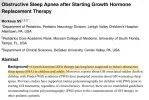
This is my problem. When I cut down to 200lbs I was still high body fat but quit snoring. I'm 180 now and have been on 8iu for two months. No one in my house is getting quality sleep due to my snoring. I finally realized it was the GH. :-(A lot of people on rHGH develop (or get worsening) sleep apnea.
TLDR airway narrows from water retention / tissue expansion, reducing airflow.
Short term water retention makes neck tissues swell.
Longer term tonsils and adenoids enlarge.
Lymph nodes can also increase in size (a kid being treated with rHGH recently had sudden death because of this.
View attachment 363380
This is my problem. When I cut down to 200lbs I was still high body fat but quit snoring. I'm 180 now and have been on 8iu for two months. No one in my house is getting quality sleep due to my snoring. I finally realized it was the GH. :-(


