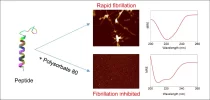

Most of the peptides (in this field) are far too small to be physically capable of forming prions. The peptides(well, mostly proteins) have to be certain size to achieve 'structural flexibility' to switch like that, must have the hydrophobic areas that could subsequently be exposed and be unstable enough that interaction with 'turned brethren' would overcome the barrier to enter a different state. But not too unstable otherwise it wouldn't pass to start with.No need to fear random prions appearing from some external source when you can worry about the functional equivalent forming in your very own peptide vials:
View attachment 310646
View attachment 310651
Transmissible Proteins: Expanding the Prion Heresy - PMC
The once-heretical concept that a misfolded protein is the infectious agent responsible for prion diseases is now widely accepted. Recent exciting research has led not only to the end of the skepticism that proteins can transmit disease but also to ...pmc.ncbi.nlm.nih.gov
I wonder if people think there's some scientific agency out there playing around with peptides the way the UGL community does, like a guardian angel, that would surely warn of the potential hazards of injecting our random concotions. And assuming, since there's no public campaign against it by the authorities, it must be safe.
At least that's my amateur take on it.
I just enjoy learning about these.
It's insanely interesting field of study.