It only took 15 years, but after hearing Donald Trump I heard the most honest thing I have ever heard a politician say. Things like this make me like the man. And no, what follows isn't a conspiracy theory but facts. And Donald Trump is right about Bush, and he is the only guy running in the GOP who seems to want to criticize the GOP and George W. Bush. Fuck it, if you want to vote Republican, vote Trump. I have a lot of respect for a guy who shames George W Bush Jr. on television for his negligence during 9/11 and the stupid idea to invade Iraq. I watched the CIA eat shit for this entire fiasco (and everything else people bitch about), but the CIA was absolutely right, they more than warned against 9/11 and they opposed the Iraq War. Despite what some guys may believe about the CIA, just know that they are people that work within an agency, that does everything in its power to help protect this homeland and our people, they provide lifesaving intel, and they (along with SOCOM) have JTFs conducting anti-terrorist operations all throughout the world to protect American people. So every time I see the CIA get slammed, I get a little bitchy about it. Even some of the negative
OP-ED CONTRIBUTOR
The Deafness Before the Storm
The Bush White House Was Deaf to 9/11 Warning
By KURT EICHENWALD
SEPTEMBER 10, 2012
IT was perhaps the most famous presidential briefing in history.
On Aug. 6, 2001, President George W. Bush
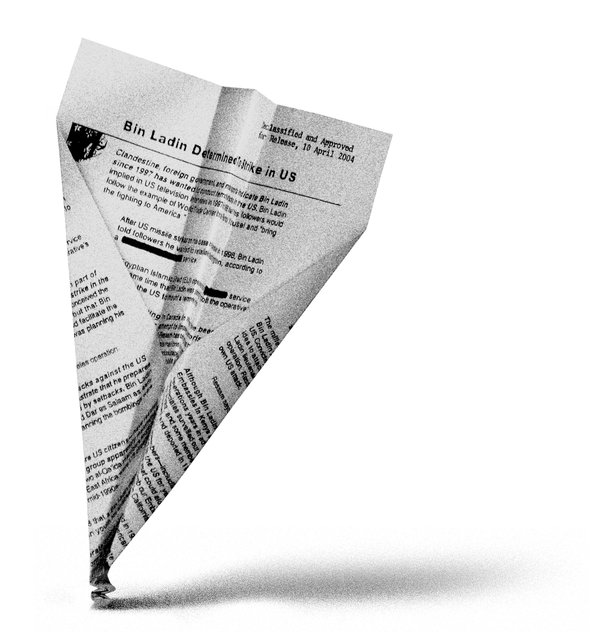
received a classified review of the threats posed by Osama bin Laden and his terrorist network, Al Qaeda. That morning’s “presidential daily brief” — the top-secret document prepared by America’s intelligence agencies — featured the now-infamous heading: “Bin Laden Determined to Strike in U.S.” A few weeks later, on 9/11, Al Qaeda accomplished that goal.
On April 10, 2004, the Bush White House declassified that daily brief — and only that daily brief
— in response to pressure from the 9/11 Commission, which was investigating the events leading to the attack. Administration officials dismissed the document’s significance, saying that, despite the jaw-dropping headline, it was only an assessment of Al Qaeda’s history, not a warning of the impending attack. While some critics considered that claim absurd, a close reading of the brief showed that the argument had some validity.
That is, unless it was read in conjunction with the daily briefs preceding Aug. 6, the ones the Bush administration would not release. While those documents are still not public, I have read excerpts from many of them, along with other recently declassified records, and come to an inescapable conclusion: the administration’s reaction to what Mr. Bush was told in the weeks before that infamous briefing reflected significantly more negligence than has been disclosed. In other words, the Aug. 6 document, for all of the controversy it provoked, is not nearly as shocking as the briefs that came before it.
JAVIER JAÉN BENAVIDES
The direct warnings to Mr. Bush about the possibility of a Qaeda attack began in the spring of 2001. By May 1, the Central Intelligence Agency told the White House of a report that “a group presently in the United States” was planning a terrorist operation. Weeks later, on June 22
, the daily brief reported that Qaeda strikes could be “imminent,” although intelligence suggested the time frame was flexible.
But some in the administration considered the warning to be just bluster. An intelligence official and a member of the Bush administration both told me in interviews that the neoconservative leaders who had recently assumed power at the Pentagon were warning the White House that the C.I.A. had been fooled; according to this theory, Bin Laden was merely pretending to be planning an attack to distract the administration from Saddam Hussein, whom the neoconservatives saw as a greater threat.Intelligence officials, these sources said, protested that the idea of Bin Laden, an Islamic fundamentalist, conspiring with Mr. Hussein, an Iraqi secularist, was ridiculous, but the neoconservatives’ suspicions were nevertheless carrying the day.
In response, the C.I.A. prepared an analysis that all but pleaded with the White House to accept that the danger from Bin Laden was real.
“The U.S. is not the target of a disinformation campaign by Usama Bin Laden,” the daily brief of June 29 read, using the government’s transliteration of Bin Laden’s first name. Going on for more than a page, the document recited much of the evidence, including an interview that month with a Middle Eastern journalist in which Bin Laden aides warned of a coming attack, as well as competitive pressures that the terrorist leader was feeling, given the number of Islamists being recruited for the separatist Russian region of Chechnya.
And the C.I.A. repeated the warnings in the briefs that followed. Operatives connected to Bin Laden, one reported on June 29, expected the planned near-term attacks to have “dramatic consequences,” including major casualties. On July 1, the brief stated that the operation had been delayed, but “will occur soon.” Some of the briefs again reminded Mr. Bush that the attack timing was flexible, and that, despite any perceived delay, the planned assault was on track.
Yet, the White House failed to take significant action. Officials at the Counterterrorism Center of the C.I.A. grew apoplectic. On July 9, at a meeting of the counterterrorism group, one official suggested that the staff put in for a transfer so that somebody else would be responsible when the attack took place, two people who were there told me in interviews. The suggestion was batted down, they said, because there would be no time to train anyone else.
That same day in Chechnya, according to intelligence I reviewed, Ibn Al-Khattab, an extremist who was known for his brutality and his links to Al Qaeda, told his followers that there would soon be very big news. Within 48 hours, an intelligence official told me, that information was conveyed to the White House, providing more data supporting the C.I.A.’s warnings. Still, the alarm bells didn’t sound.
On July 24, Mr. Bush was notified that the attack was still being readied, but that it had been postponed, perhaps by a few months. But the president did not feel the briefings on potential attacks were sufficient, one intelligence official told me, and instead asked for a broader analysis on Al Qaeda, its aspirations and its history. In response, the C.I.A. set to work on the Aug. 6 brief.
In the aftermath of 9/11, Bush officials
attempted to deflect criticism that they had ignored C.I.A. warnings by saying they had not been told when and where the attack would occur. That is true, as far as it goes, but it misses the point. Throughout that summer, there were events that might have exposed the plans, had the government been on high alert. Indeed, even as the Aug. 6 brief was being prepared, Mohamed al-Kahtani, a Saudi believed to have been assigned a role in the 9/11 attacks, was stopped at an airport in Orlando, Fla., by a suspicious customs agent and sent back overseas on Aug. 4. Two weeks later, another co-conspirator, Zacarias Moussaoui, was arrested on immigration charges in Minnesota after arousing suspicions at a flight school. But the dots were not connected, and Washington did not react.
Could the 9/11 attack have been stopped, had the Bush team reacted with urgency to the warnings contained in all of those daily briefs? We can’t ever know. And that may be the most agonizing reality of all.
Kurt Eichenwald, a contributing editor at Vanity Fair and a former
reporter for The New York Times, is the author of “500 Days: Secrets and Lies in the Terror Wars.”