

MESO-Rx
Anabolic Steroids

Navigation
Install the app
How to install the app on iOS
Follow along with the video below to see how to install our site as a web app on your home screen.
Note: This feature may not be available in some browsers.
More options
Style variation
Guest viewing limit reached
- You have reached the maximum number of guest views allowed
- Please register below to remove this limitation
- Already a member? Click here to login
You are using an out of date browser. It may not display this or other websites correctly.
You should upgrade or use an alternative browser.
You should upgrade or use an alternative browser.
Republicans 2016
- Thread starter Michael Scally MD
- Start date
Trump triples down on George W. Bush’s responsibility for 9/11
https://www.washingtonpost.com/news...own-on-george-w-bushs-responsibility-for-911/
Donald Trump says he doesn’t flat out blame former president George W. Bush that the Sept. 11 terror attacks happened on his watch. But he can think of three reasons why one could hold Bush responsible.
And, he might add, they are three things a President Trump would do very differently.
“You always have to look to the person at the top,” Trump said Saturday in a telephone interview. “Do I blame George Bush? I only say that he was the president at the time, and you know, you could say the buck stops here.”
So why might one consider Bush responsible?
No. 1: Bush’s immigration policy. “We had very weak immigration laws,” Trump said, adding that perhaps if Bush had had a Trump-style immigration policy, replete with “the strong laws that I’m wanting, these terrorists wouldn’t have been in the country.”
No. 2: People knew that the FBI, the National Security Council, and the CIA weren’t sharing information about potential threats. “They were not talking to each other,” Trump said. “If I’m president, I want to have my three most important agencies talking to each other and coordinating with each other.”
And No. 3: George Tenet, Bush’s director of central intelligence, “knew in advance that there would be an attack, and he said that.”
https://www.washingtonpost.com/news...own-on-george-w-bushs-responsibility-for-911/
Donald Trump says he doesn’t flat out blame former president George W. Bush that the Sept. 11 terror attacks happened on his watch. But he can think of three reasons why one could hold Bush responsible.
And, he might add, they are three things a President Trump would do very differently.
“You always have to look to the person at the top,” Trump said Saturday in a telephone interview. “Do I blame George Bush? I only say that he was the president at the time, and you know, you could say the buck stops here.”
So why might one consider Bush responsible?
No. 1: Bush’s immigration policy. “We had very weak immigration laws,” Trump said, adding that perhaps if Bush had had a Trump-style immigration policy, replete with “the strong laws that I’m wanting, these terrorists wouldn’t have been in the country.”
No. 2: People knew that the FBI, the National Security Council, and the CIA weren’t sharing information about potential threats. “They were not talking to each other,” Trump said. “If I’m president, I want to have my three most important agencies talking to each other and coordinating with each other.”
And No. 3: George Tenet, Bush’s director of central intelligence, “knew in advance that there would be an attack, and he said that.”
It is important to remember that amateurs built the Ark and it was the professionals that built the Titanic. [Ben Carson]
https://twitter.com/RealBenCarson/status/659777986854559744
https://twitter.com/RealBenCarson/status/659777986854559744
Ted Cruz and Marco Rubio Grow Apart as Their Ambitions Expand
http://www.nytimes.com/2015/11/02/u...bio-grow-apart-as-their-ambitions-expand.html
Mr. Cruz won without Mr. Rubio’s endorsement, and later confided to a Republican senator that he “resented” Mr. Rubio’s reluctance to endorse him. Now, the two Republican stars, biographically similar but stylistically opposite, are running for president, and Mr. Cruz is privately telling colleagues that he believes the race for the party’s nomination will boil down to a contest between himself and Mr. Rubio.
http://www.nytimes.com/2015/11/02/u...bio-grow-apart-as-their-ambitions-expand.html
Mr. Cruz won without Mr. Rubio’s endorsement, and later confided to a Republican senator that he “resented” Mr. Rubio’s reluctance to endorse him. Now, the two Republican stars, biographically similar but stylistically opposite, are running for president, and Mr. Cruz is privately telling colleagues that he believes the race for the party’s nomination will boil down to a contest between himself and Mr. Rubio.
Billionaire Acquires Rubio Pending Physical
http://www.newyorker.com/humor/borowitz-report/billionaire-acquires-rubio-pending-physical
NEW YORK (The Borowitz Report)—In the biggest free-agency acquisition of the 2016 Presidential contest, the billionaire investor Paul Singer has acquired Florida senator Marco Rubio for a rumored eight-figure sum, pending a physical.
Just hours after the deal was inked, Rubio was flown by private jet to Singer’s training facility in East Hampton, where the senator will submit to a series of gruelling drills before the deal is finalized.
“We are making a four-year deal with Marco, with an option for another four,” an associate of Singer’s said. “We like what we’ve seen of him on tape, but we want to be sure that he has what it takes to go the distance.”
According to those familiar with Singer’s physical workouts for political candidates, Rubio will submit to a number of demanding tests, in which the billionaire will bark commands and the senator will be measured for his reaction times and accuracy.
“You have to be in peak condition for these workouts,” the associate said. “Jeb got totally winded.”
Arriving at Singer’s training camp, Rubio said he was “excited and honored” to be a part of the Singer organization.
“I talked to a lot of other billionaires,” he told reporters. “Sheldon Adelson, and the Koch brothers, of course. But at the end of the day Mr. Singer’s scheme was the best fit. I’m looking forward to earning every dollar he paid for me.”
http://www.newyorker.com/humor/borowitz-report/billionaire-acquires-rubio-pending-physical
NEW YORK (The Borowitz Report)—In the biggest free-agency acquisition of the 2016 Presidential contest, the billionaire investor Paul Singer has acquired Florida senator Marco Rubio for a rumored eight-figure sum, pending a physical.
Just hours after the deal was inked, Rubio was flown by private jet to Singer’s training facility in East Hampton, where the senator will submit to a series of gruelling drills before the deal is finalized.
“We are making a four-year deal with Marco, with an option for another four,” an associate of Singer’s said. “We like what we’ve seen of him on tape, but we want to be sure that he has what it takes to go the distance.”
According to those familiar with Singer’s physical workouts for political candidates, Rubio will submit to a number of demanding tests, in which the billionaire will bark commands and the senator will be measured for his reaction times and accuracy.
“You have to be in peak condition for these workouts,” the associate said. “Jeb got totally winded.”
Arriving at Singer’s training camp, Rubio said he was “excited and honored” to be a part of the Singer organization.
“I talked to a lot of other billionaires,” he told reporters. “Sheldon Adelson, and the Koch brothers, of course. But at the end of the day Mr. Singer’s scheme was the best fit. I’m looking forward to earning every dollar he paid for me.”

Drinking beer with teen Muslim chicks, wow. Running for president must be fun!
Marco Rubio Would Like to Have a Beer With Malala, a Muslim Teen
Today, Senator Marco Rubio held a Q&A for “young professionals” at St. Anselm College in New Hampshire. That sounds very boring, and it probably mostly was, except that Rubio gave perhaps the most insane answer possible to the question, “Who would you like to have a beer with who is not a politician?”
His answer: Malala!!!
Marco Rubio Would Like to Have a Beer With Malala, a Muslim Teen
Today, Senator Marco Rubio held a Q&A for “young professionals” at St. Anselm College in New Hampshire. That sounds very boring, and it probably mostly was, except that Rubio gave perhaps the most insane answer possible to the question, “Who would you like to have a beer with who is not a politician?”
His answer: Malala!!!
Time for GOP panic? Establishment worried Carson or Trump might win
https://www.washingtonpost.com/poli...a88a6-895b-11e5-be8b-1ae2e4f50f76_story.html?
Less than three months before the kickoff Iowa caucuses, there is growing anxiety bordering on panic among Republican elites about the dominance and durability of Donald Trump and Ben Carson and widespread bewilderment over how to defeat them.
Party leaders and donors fear that nominating either man would have negative ramifications for the GOP ticket up and down the ballot, virtually ensuring a Hillary Rodham Clinton presidency and increasing the odds that the Senate falls into Democratic hands.
The party establishment is paralyzed. Big money is still on the sidelines. No consensus alternative to the outsiders has emerged from the pack of governors and senators running, and there is disagreement about how to prosecute the case against them. Recent focus groups of Trump supporters in Iowa and New Hampshire commissioned by rival campaigns revealed no silver bullet.
In normal times, the way forward would be obvious. The wannabes would launch concerted campaigns, including television attack ads, against the front-runners. But even if the other candidates had a sense of what might work this year, it is unclear whether it would ultimately accrue to their benefit. Trump’s counterpunches have been withering, while Carson’s appeal to the base is spiritual, not merely political. If someone was able to do significant damage to them, there’s no telling to whom their supporters would turn, if anyone.
“The rest of the field is still wishing upon a star that Trump and Carson are going to self-destruct,” said Eric Fehrnstrom, a former adviser to 2012 nominee Mitt Romney. But, he said, “they have to be made to self-destruct. . . . Nothing has happened at this point to dislodge Trump or Carson.”
https://www.washingtonpost.com/poli...a88a6-895b-11e5-be8b-1ae2e4f50f76_story.html?
Less than three months before the kickoff Iowa caucuses, there is growing anxiety bordering on panic among Republican elites about the dominance and durability of Donald Trump and Ben Carson and widespread bewilderment over how to defeat them.
Party leaders and donors fear that nominating either man would have negative ramifications for the GOP ticket up and down the ballot, virtually ensuring a Hillary Rodham Clinton presidency and increasing the odds that the Senate falls into Democratic hands.
The party establishment is paralyzed. Big money is still on the sidelines. No consensus alternative to the outsiders has emerged from the pack of governors and senators running, and there is disagreement about how to prosecute the case against them. Recent focus groups of Trump supporters in Iowa and New Hampshire commissioned by rival campaigns revealed no silver bullet.
In normal times, the way forward would be obvious. The wannabes would launch concerted campaigns, including television attack ads, against the front-runners. But even if the other candidates had a sense of what might work this year, it is unclear whether it would ultimately accrue to their benefit. Trump’s counterpunches have been withering, while Carson’s appeal to the base is spiritual, not merely political. If someone was able to do significant damage to them, there’s no telling to whom their supporters would turn, if anyone.
“The rest of the field is still wishing upon a star that Trump and Carson are going to self-destruct,” said Eric Fehrnstrom, a former adviser to 2012 nominee Mitt Romney. But, he said, “they have to be made to self-destruct. . . . Nothing has happened at this point to dislodge Trump or Carson.”
With Cruz, they’d lose
http://www.economist.com/news/unite...-peddles-self-serving-myth-about-presidential
THE presidential candidate who has most harmed American politics this year is Donald Trump, a bully who has prospered by inciting rage. Yet from the narrower perspective of the Republican Party, the most dangerous candidate of the 2016 pack may just be Senator Ted Cruz of Texas, who is rising in the polls by telling conservative activists a seductive but misleading story about how their party wins elections.
Since launching his presidential run, the 44-year-old Texan has built his campaign around a simple pitch: assuring the most conservative third of the Republican electorate, from born-again Christian voters to hardline members of the Tea Party, that they form a natural majority of the conservative movement, and indeed would decide general elections if they would only turn out and vote. In his telling, this stirring truth frightens a cowardly Republican establishment in Washington, which urges conservatives to run to the middle as “Democrats-lite”—whereupon, Mr Cruz argues, “We get whipped.” By way of proof, the first-term senator informs Republican crowds that in 2012, when the party nominated Mitt Romney, roughly half of all born-again Christian voters and millions of blue-collar conservatives stayed home.
New polls show Mr Cruz rising to second place behind Mr Trump in Iowa, which will hold the first contest of the presidential primary season on February 1st. Much of his surge is at the expense of Mr Trump’s fellow-outsider, the retired neurosurgeon Ben Carson. Dr Carson, a devout Christian whose memoirs are a staple for church book-clubs and home-school curriculums, led some Iowa surveys in October. But the doctor has been hurt by amateurish responses to the Paris terror attacks, including a breezy suggestion that a “great nation” like America should not be “afraid” to shoot down Russian planes over Syria, if need be.
Prayerful Republicans have won Iowa in the past and faded soon afterwards, it is true. But Mr Cruz sees openings. The 2016 presidential primary calendar is front-loaded with conservative, pious states, many in the South, allowing Cruz strategists to dream of swiftly dominating the “very conservative” lane of the race, while establishment rivals squabble among themselves. And as Mr Trump’s campaign has taken a more thuggish turn, Mr Cruz has gingerly distanced himself, saying that Republican candidates should remember that “tone matters”. What Mr Cruz will never do is criticise Mr Trump’s angriest supporters, for he hopes to inherit them one day. Instead he presents himself as angry America’s champion in Washington. He calls Barack Obama “an apologist for radical Islamic terrorism”, and has challenged the president to debate the wisdom of admitting Syrian Muslim refugees to America, a plan that Mr Cruz calls “lunacy”.
On November 20th Mr Cruz and six Republican rivals attended a presidential forum in Des Moines hosted by the Family Leader, a social-conservative outfit. A blizzard did not stop 1,200 locals from attending the hustings, which saw the politicians ranged around a mock Thanksgiving dinner table. The Family Leader’s boss, Bob Vander Plaats, set the tone by telling the gathering that “Satan was trying to disrupt our plans tonight” with the snowstorm and other wiles, but that this merely proved that the meeting would be “something special”. The crowd responded warmly to Mr Cruz, who offered stories about religion’s importance in his life, scorn for Mr Obama and exhortations for Christian conservatives to defy “Washington” and unite around a single candidate, or as he put it: “If the body of Christ rises up as one and votes our values, we can turn this country around.”
On paper, Mr Cruz makes an unlikely warrior against elitism. Before entering Texas politics, he was a debating champion at Princeton and a star student at Harvard Law School, later securing a high-flying post as a clerk at the Supreme Court. His wife, Heidi, worked at the National Security Council under President George W. Bush, then for Goldman Sachs, a bank. Supporters are unfussed. They praise Mr Cruz as a “fighter” who battled Democrats and also his own party leaders in Congress, notably when he forced a government shutdown in 2013 in what he called a bid to derail Obamacare. Fans do not care that other Republican senators angrily call the shutdown a doomed scheme whose purpose was to cast Mr Cruz as a grassroots hero. To the grassroots, being disliked in Washington is a character reference.
John Wacker, a manufacturing engineer, recalled being reluctant to put out campaign signs for Mr Romney in 2012 and for the Republican nominee in 2008, Senator John McCain. “They didn’t inspire me,” Mr Wacker explained, before praising Mr Cruz’s “charisma”. Several at the forum relished the prospect of the senator in a presidential debate with Hillary Clinton. “He’d eat her for lunch,” growled David, a campaign volunteer who declined to give his last name, citing his distrust of the press. As for Mr Vander Plaats, his organisation will endorse a candidate before Christmas. But he predicts in a telephone interview that Mrs Clinton is beatable “if we can choose someone who can inspire our base”, adding: “When we choose the mushy middle, we lose.”
Remember Barry Goldwater? He lost 44 states
Alas for Cruz fans, the senator’s story about a Republican voter strike in 2012 does not add up. Turnout fell among lots of groups in 2012, some of them Obama-friendly. Moreover, turnout actually rose in some of the most closely-fought states. Voting rates also remained pretty healthy among white Protestant evangelicals, who made up one in four of all voters according to exit polls, though they account for only 19% of the population. Conservative Cruz fans may not care, for now. His fable about how elections are won flatters them, after all. As Mr Cruz beamed in Des Moines: “The men and women in this room scare the living daylights out of Washington.” But it is a fable: no Republican has won the White House without hefty moderate support. Mr Cruz is a clever and eloquent man. All the more reason to beware him.
http://www.economist.com/news/unite...-peddles-self-serving-myth-about-presidential
THE presidential candidate who has most harmed American politics this year is Donald Trump, a bully who has prospered by inciting rage. Yet from the narrower perspective of the Republican Party, the most dangerous candidate of the 2016 pack may just be Senator Ted Cruz of Texas, who is rising in the polls by telling conservative activists a seductive but misleading story about how their party wins elections.
Since launching his presidential run, the 44-year-old Texan has built his campaign around a simple pitch: assuring the most conservative third of the Republican electorate, from born-again Christian voters to hardline members of the Tea Party, that they form a natural majority of the conservative movement, and indeed would decide general elections if they would only turn out and vote. In his telling, this stirring truth frightens a cowardly Republican establishment in Washington, which urges conservatives to run to the middle as “Democrats-lite”—whereupon, Mr Cruz argues, “We get whipped.” By way of proof, the first-term senator informs Republican crowds that in 2012, when the party nominated Mitt Romney, roughly half of all born-again Christian voters and millions of blue-collar conservatives stayed home.
New polls show Mr Cruz rising to second place behind Mr Trump in Iowa, which will hold the first contest of the presidential primary season on February 1st. Much of his surge is at the expense of Mr Trump’s fellow-outsider, the retired neurosurgeon Ben Carson. Dr Carson, a devout Christian whose memoirs are a staple for church book-clubs and home-school curriculums, led some Iowa surveys in October. But the doctor has been hurt by amateurish responses to the Paris terror attacks, including a breezy suggestion that a “great nation” like America should not be “afraid” to shoot down Russian planes over Syria, if need be.
Prayerful Republicans have won Iowa in the past and faded soon afterwards, it is true. But Mr Cruz sees openings. The 2016 presidential primary calendar is front-loaded with conservative, pious states, many in the South, allowing Cruz strategists to dream of swiftly dominating the “very conservative” lane of the race, while establishment rivals squabble among themselves. And as Mr Trump’s campaign has taken a more thuggish turn, Mr Cruz has gingerly distanced himself, saying that Republican candidates should remember that “tone matters”. What Mr Cruz will never do is criticise Mr Trump’s angriest supporters, for he hopes to inherit them one day. Instead he presents himself as angry America’s champion in Washington. He calls Barack Obama “an apologist for radical Islamic terrorism”, and has challenged the president to debate the wisdom of admitting Syrian Muslim refugees to America, a plan that Mr Cruz calls “lunacy”.
On November 20th Mr Cruz and six Republican rivals attended a presidential forum in Des Moines hosted by the Family Leader, a social-conservative outfit. A blizzard did not stop 1,200 locals from attending the hustings, which saw the politicians ranged around a mock Thanksgiving dinner table. The Family Leader’s boss, Bob Vander Plaats, set the tone by telling the gathering that “Satan was trying to disrupt our plans tonight” with the snowstorm and other wiles, but that this merely proved that the meeting would be “something special”. The crowd responded warmly to Mr Cruz, who offered stories about religion’s importance in his life, scorn for Mr Obama and exhortations for Christian conservatives to defy “Washington” and unite around a single candidate, or as he put it: “If the body of Christ rises up as one and votes our values, we can turn this country around.”
On paper, Mr Cruz makes an unlikely warrior against elitism. Before entering Texas politics, he was a debating champion at Princeton and a star student at Harvard Law School, later securing a high-flying post as a clerk at the Supreme Court. His wife, Heidi, worked at the National Security Council under President George W. Bush, then for Goldman Sachs, a bank. Supporters are unfussed. They praise Mr Cruz as a “fighter” who battled Democrats and also his own party leaders in Congress, notably when he forced a government shutdown in 2013 in what he called a bid to derail Obamacare. Fans do not care that other Republican senators angrily call the shutdown a doomed scheme whose purpose was to cast Mr Cruz as a grassroots hero. To the grassroots, being disliked in Washington is a character reference.
John Wacker, a manufacturing engineer, recalled being reluctant to put out campaign signs for Mr Romney in 2012 and for the Republican nominee in 2008, Senator John McCain. “They didn’t inspire me,” Mr Wacker explained, before praising Mr Cruz’s “charisma”. Several at the forum relished the prospect of the senator in a presidential debate with Hillary Clinton. “He’d eat her for lunch,” growled David, a campaign volunteer who declined to give his last name, citing his distrust of the press. As for Mr Vander Plaats, his organisation will endorse a candidate before Christmas. But he predicts in a telephone interview that Mrs Clinton is beatable “if we can choose someone who can inspire our base”, adding: “When we choose the mushy middle, we lose.”
Remember Barry Goldwater? He lost 44 states
Alas for Cruz fans, the senator’s story about a Republican voter strike in 2012 does not add up. Turnout fell among lots of groups in 2012, some of them Obama-friendly. Moreover, turnout actually rose in some of the most closely-fought states. Voting rates also remained pretty healthy among white Protestant evangelicals, who made up one in four of all voters according to exit polls, though they account for only 19% of the population. Conservative Cruz fans may not care, for now. His fable about how elections are won flatters them, after all. As Mr Cruz beamed in Des Moines: “The men and women in this room scare the living daylights out of Washington.” But it is a fable: no Republican has won the White House without hefty moderate support. Mr Cruz is a clever and eloquent man. All the more reason to beware him.
As Donald Trump and Ted Cruz Soar, G.O.P. Leaders’ Exasperation Grows
http://www.nytimes.com/2016/01/27/us/politics/ted-cruz-donald-trump-republican-establishment.html
http://www.nytimes.com/2016/01/27/us/politics/ted-cruz-donald-trump-republican-establishment.html
Noam Chomsky Says GOP Is 'Literally A Serious Danger To Human Survival’
http://www.huffingtonpost.com/entry/noam-chomsky-gop_us_56a66febe4b0d8cc109aec78
http://www.huffingtonpost.com/entry/noam-chomsky-gop_us_56a66febe4b0d8cc109aec78

coffeesudoku
New Member
Funny stuffBillionaire Acquires Rubio Pending Physical
Billionaire Acquires Rubio Pending Physical - The New Yorker
NEW YORK (The Borowitz Report)—In the biggest free-agency acquisition of the 2016 Presidential contest, the billionaire investor Paul Singer has acquired Florida senator Marco Rubio for a rumored eight-figure sum, pending a physical.
Just hours after the deal was inked, Rubio was flown by private jet to Singer’s training facility in East Hampton, where the senator will submit to a series of gruelling drills before the deal is finalized.
“We are making a four-year deal with Marco, with an option for another four,” an associate of Singer’s said. “We like what we’ve seen of him on tape, but we want to be sure that he has what it takes to go the distance.”
According to those familiar with Singer’s physical workouts for political candidates, Rubio will submit to a number of demanding tests, in which the billionaire will bark commands and the senator will be measured for his reaction times and accuracy.
“You have to be in peak condition for these workouts,” the associate said. “Jeb got totally winded.”
Arriving at Singer’s training camp, Rubio said he was “excited and honored” to be a part of the Singer organization.
“I talked to a lot of other billionaires,” he told reporters. “Sheldon Adelson, and the Koch brothers, of course. But at the end of the day Mr. Singer’s scheme was the best fit. I’m looking forward to earning every dollar he paid for me.”
Most Jews Will Refuse Cruz, Despite His Warm Embrace of Israel
Most Jews will refuse Cruz, despite his warm embrace of Israel - World News
On his first day as president, Ted Cruz will revoke the Iran nuclear deal. Then he will order the American Embassy in Tel Aviv to be moved to Jerusalem. After that he might call up Benjamin Netanyahu and tell him that the United States will no longer criticize Jewish settlements in the West Bank or press for a two-state solution to the Palestinian problem. It’s up to the Israelis to make their own decisions, Cruz will say.
Of course it’s hard to believe any president would choose to start his tenure by plunging America into an immediate confrontation with Iran or an acute crisis of confidence with China, Russia and the European Union, which is what would happen if Cruz unilaterally abrogates the Iran deal to which they are signatories. Nor would it seem sensible to inflame relations with Arab and Muslim countries by moving the embassy to Jerusalem at the very moment that Cruz would need them to counter the now unconstrained Iranian regime. But you never know: perhaps Cruz is a man of his word and crazy enough to try.
...
Most Jews will refuse Cruz, despite his warm embrace of Israel - World News
On his first day as president, Ted Cruz will revoke the Iran nuclear deal. Then he will order the American Embassy in Tel Aviv to be moved to Jerusalem. After that he might call up Benjamin Netanyahu and tell him that the United States will no longer criticize Jewish settlements in the West Bank or press for a two-state solution to the Palestinian problem. It’s up to the Israelis to make their own decisions, Cruz will say.
Of course it’s hard to believe any president would choose to start his tenure by plunging America into an immediate confrontation with Iran or an acute crisis of confidence with China, Russia and the European Union, which is what would happen if Cruz unilaterally abrogates the Iran deal to which they are signatories. Nor would it seem sensible to inflame relations with Arab and Muslim countries by moving the embassy to Jerusalem at the very moment that Cruz would need them to counter the now unconstrained Iranian regime. But you never know: perhaps Cruz is a man of his word and crazy enough to try.
...
Donald Trump accuses Ted Cruz of voter fraud, demands ‘new election’ in Iowa
By Dylan Stableford
15 hours ago
Two days after finishing second to Ted Cruz in the Iowa caucuses, Donald Trump is accusing the Texas senator of fraud and demanding that either a “new election” take place in the Hawkeye State or that its results be “nullified.”
“Ted Cruz didn’t win Iowa, he stole it,” Trump tweeted on Wednesday. “That is why all of the polls were so wrong and why he got far more votes than anticipated. Bad!”
Trump accused the Cruz campaign of misleading caucus-goers by circulating a false election-night rumor implying that retired neurosurgeon Ben Carson was planning to drop out of the race.
The Cruz campaign issued an apology to Carson on Tuesday, saying it should have clarified that Carson was, in fact, continuing his bid for the Republican nomination.
Trump also made mention of a deceptive mailer distributed by the Cruz campaign designed to shame Iowa voters into caucusing.
“Based on the fraud committed by Senator Ted Cruz during the Iowa Caucus, either a new election should take place or Cruz results nullified,” Trump tweeted.
“Reality has hit the reality star,” Cruz campaign spokesman Rick Tyler responded in a statement. “Since Iowa, no one is talking about Donald Trump. That’s why he’s popping off on Twitter. There are Twitter addiction therapy groups, and he should check in with his local chapter.”
The accusations stand in stark contrast to Trump’s concession speech, in which the brash billionaire struck a conciliatory tone.
“We finished second, and I want to tell you something,” he said late Monday in Des Moines. “I’m just honored. I’m really honored. And I want to congratulate Ted, and I want to congratulate all of the incredible candidates.”
On NBC’s “Today” show Wednesday, Trump said he was “semi-satisfied” with his second-place finish.
“I came in second, and nobody said it was a victory. It’s kind of strange,” he said. “I beat a lot of senators, a lot of governors. They do it professionally. I’ve never done this before. I’m not a professional politician, and I came in second. It was such a big story that I came in second. I don’t know why. I was actually semi-satisfied with it.”
Before a rally in New Hampshire on Tuesday, Trump admitted his decision to boycott Fox News’ GOP debate may have cost him in the caucuses.
“I think some people were disappointed that I didn’t go into the debate,” he told reporters.

By Dylan Stableford
15 hours ago
Two days after finishing second to Ted Cruz in the Iowa caucuses, Donald Trump is accusing the Texas senator of fraud and demanding that either a “new election” take place in the Hawkeye State or that its results be “nullified.”
“Ted Cruz didn’t win Iowa, he stole it,” Trump tweeted on Wednesday. “That is why all of the polls were so wrong and why he got far more votes than anticipated. Bad!”
Trump accused the Cruz campaign of misleading caucus-goers by circulating a false election-night rumor implying that retired neurosurgeon Ben Carson was planning to drop out of the race.
The Cruz campaign issued an apology to Carson on Tuesday, saying it should have clarified that Carson was, in fact, continuing his bid for the Republican nomination.
Trump also made mention of a deceptive mailer distributed by the Cruz campaign designed to shame Iowa voters into caucusing.
“Based on the fraud committed by Senator Ted Cruz during the Iowa Caucus, either a new election should take place or Cruz results nullified,” Trump tweeted.
“Reality has hit the reality star,” Cruz campaign spokesman Rick Tyler responded in a statement. “Since Iowa, no one is talking about Donald Trump. That’s why he’s popping off on Twitter. There are Twitter addiction therapy groups, and he should check in with his local chapter.”
The accusations stand in stark contrast to Trump’s concession speech, in which the brash billionaire struck a conciliatory tone.
“We finished second, and I want to tell you something,” he said late Monday in Des Moines. “I’m just honored. I’m really honored. And I want to congratulate Ted, and I want to congratulate all of the incredible candidates.”
On NBC’s “Today” show Wednesday, Trump said he was “semi-satisfied” with his second-place finish.
“I came in second, and nobody said it was a victory. It’s kind of strange,” he said. “I beat a lot of senators, a lot of governors. They do it professionally. I’ve never done this before. I’m not a professional politician, and I came in second. It was such a big story that I came in second. I don’t know why. I was actually semi-satisfied with it.”
Before a rally in New Hampshire on Tuesday, Trump admitted his decision to boycott Fox News’ GOP debate may have cost him in the caucuses.
“I think some people were disappointed that I didn’t go into the debate,” he told reporters.
Last edited:
COMMENTARY
Establishment Versus Populists Isn’t the Whole Story of the GOP Primary
By Emily Ekins
Establishment Versus Populists Isn't the Whole Story of the GOP Primary
This article appeared in The Federalist on February 3, 2016.
What is going on in the Republican primary? While the RealClearPolitics polling average in Iowa had Donald Trump leading Ted Cruz (28.65 percent to 23.9 percent), Cruz ultimately pulled ahead to win the Iowa caucuses Monday with 27.7 percent to Trump’s 24.3. Marco Rubio also surprised pundits with a last-minute surge exceeding his RCP polling average by 6 points (23.1 percent actual versus 16.9 percent).
The 2016 GOP primary has had the highest number of presidential candidates running for one party’s nomination at one time. It has showcased what pundits have described as a GOP civil war between “establishment” and anti-establishment or populist wings of the party. Interestingly, the high number of candidates in the race gives us a measurement tool to better understand the underlying structure of the race and the intra-party civil war.
Put This Theory to the Test
To identify clusters of presidential candidates who have attracted similar types of voters, I analyzed data collected in a November 2015 Cato/YouGov survey on criminal justice reform and policing that included questions on the election. Although this data doesn’t have the latest horserace numbers, it can still tell us about the race’s underlying dynamics.
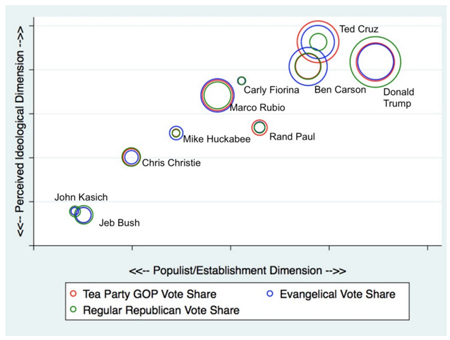
The survey asked all respondents—Democrat and Republican—if they would or would not consider voting for each of the Democratic and Republican presidential candidates. Using a variety of statistical tools, I found GOP candidates are likely competing alongtwo main dimensions in the primary: a populist/establishment dimension, and an ideological dimension. Rand Paul comes close to defining a third dimension, and stands apart from the other GOP candidates. I’ll explain.
Factor analysis conducted with principal component factor extraction with oblique rotation revealed two factors with eigenvalues greater than 1. The survey included a battery of questions asking respondents if they would or would not consider voting for each of the candidates. These variables, coded as 0/1, were included in the factor analysis.
I used a statistical test [1] (factor analysis) of all the GOP candidate variables to examine which candidates tend to attract similar types of GOP voters. The test can also indicate if candidates are competing along one dimension (like establishment versus antiestablishment) or perhaps more. To be sure, this analysis is both an art and a science, and some subjective interpretation is necessary. The results indicate there are two statistically meaningful dimensions along which candidates are competing, but it can’t identify what they are—that’s up for interpretation.
Do You Value Ideology or Populism More?
As you can see in the chart, Donald Trump heads up one dimension (horizontal axis) and Ted Cruz leads the other dimension (vertical axis), while Jeb Bush and John Kasich are at the opposite end of the spectrums. These data seem to suggest that voters view Trump as the most anti-establishment/populist candidate and Cruz as the most conservative candidate.
In contrast, voters seem to view Bush and Kasich as more moderate candidates closer to the so-called GOP establishment. Paul stands out, probably because he is viewed as outside the Washington establishment but his libertarian streak makes him appear more moderate than Cruz. Notably, Rubio straddles both the anti-establishment and establishment wings.
These data provide some indication that if GOP voters ultimately value an outsider populist over the establishment and don’t care as much about ideology they go for Trump. But if at the end of the day they want an anti-establishment candidate who they view as also very conservative, perhaps they go for Cruz.
Iowa caucus-goers seem to have opted for the latter. For instance, the Iowa Entrance Poll found that among the plurality of caucus-goers who said they prioritized a candidate who shares their own values, 37 percent went for Cruz while only 5 percent went for Trump.
The Tea Party Isn’t In Trump’s Corner
Next in the chart, you will notice that the size of each candidate’s circles correspond to his or her vote share among Tea Party supporters (red), evangelicals (blue), and regular Republicans who don’t identify as either evangelical or Tea Party (green). These data show that Cruz does disproportionately better among Tea Party Republicans and Ben Carson among evangelical Republicans, and Trump does best among Republicans who don’t think of themselves as evangelical or Tea Party.
Again, even though these aren’t the latest numbers, recent polls continue to show Cruz getting disproportionate support from Tea Party supporters (and Tea Party Patriots Citizens Fund threw its support to Cruz hours before the Iowa caucus) and Trump doing best amongnon-evangelical, non-Tea Party working-class Republicans who are not that economically conservative.
The main difference since this survey was conducted is Carson’s decline. At least in Iowa, it appears Cruz benefited from Carson’s decline in the polls by disproportionately picking up his evangelical supporters (also see here).
Notably, Rubio appears to be the consensus candidate by appealing across the Tea Party, evangelical, and regular Republican groups and straddling the establishment and anti-establishment groups. This may help explain why he was capable of a last-minute six-point surge in Iowa (and a surge in online prediction markets).
Despite Rubio riding the 2010 Tea Party wave into the Senate, he has also attracted more moderate GOP voters. Perhaps then it is less surprising that he is the only GOP candidate out-polling both Hillary Clinton and Bernie Sanders in one-on-one match-ups.
The Libertarian Third Dimension
Paul sticks out as a candidate farther from the establishment but viewed as less conservative than Cruz, Rubio, Trump, and Carson. Statistical tests indicated Paul doesn’t fit well with the other Republicans, but instead he and Sanders could perhaps structure another dimension.
This may not be a statistical anomaly. The survey asked several questions measuring a person’s preference for individual autonomy, for instance if respondents agreed or disagreed that “a person should be allowed to do dangerous and self-destructive things, as long as they don’t put others at risk.” Only Sanders and Paul supporters were significantly above average in answering these questions. These two candidates, who draw disproportionately from younger voters, seem to represent the millennial generation’s libertarian penchant for individual autonomy.
Without more Democratic candidates competing for the nomination, it was not possible to conduct an analogous analysis among them. That being said, if more candidates were running it’s very likely we’d find similar divisions among Democrats, with Sanders leading the political outsider wing and Clinton leading the insider.
In sum, GOP voters seem to view their presidential candidates almost in rank order from those most aligned to least aligned with the Washington establishment. However, voters do not seem to think that more anti-establishment candidates are necessarily more conservative. Ideology and anger seem to be competing considerations for GOP voters in this primary cycle.
It remains to be seen whether a candidate primarily representing ideology, anger, or compromise will ultimately prevail.
To read more about the survey see here.
[1] Factor analysis conducted with principal component factor extraction with oblique rotation among variables measuring support for presidential candidates revealing two factors among GOP candidates with eigenvalues greater than 1.
Establishment Versus Populists Isn’t the Whole Story of the GOP Primary
By Emily Ekins
Establishment Versus Populists Isn't the Whole Story of the GOP Primary
This article appeared in The Federalist on February 3, 2016.
What is going on in the Republican primary? While the RealClearPolitics polling average in Iowa had Donald Trump leading Ted Cruz (28.65 percent to 23.9 percent), Cruz ultimately pulled ahead to win the Iowa caucuses Monday with 27.7 percent to Trump’s 24.3. Marco Rubio also surprised pundits with a last-minute surge exceeding his RCP polling average by 6 points (23.1 percent actual versus 16.9 percent).
The 2016 GOP primary has had the highest number of presidential candidates running for one party’s nomination at one time. It has showcased what pundits have described as a GOP civil war between “establishment” and anti-establishment or populist wings of the party. Interestingly, the high number of candidates in the race gives us a measurement tool to better understand the underlying structure of the race and the intra-party civil war.
Put This Theory to the Test
To identify clusters of presidential candidates who have attracted similar types of voters, I analyzed data collected in a November 2015 Cato/YouGov survey on criminal justice reform and policing that included questions on the election. Although this data doesn’t have the latest horserace numbers, it can still tell us about the race’s underlying dynamics.
The survey asked all respondents—Democrat and Republican—if they would or would not consider voting for each of the Democratic and Republican presidential candidates. Using a variety of statistical tools, I found GOP candidates are likely competing alongtwo main dimensions in the primary: a populist/establishment dimension, and an ideological dimension. Rand Paul comes close to defining a third dimension, and stands apart from the other GOP candidates. I’ll explain.
Factor analysis conducted with principal component factor extraction with oblique rotation revealed two factors with eigenvalues greater than 1. The survey included a battery of questions asking respondents if they would or would not consider voting for each of the candidates. These variables, coded as 0/1, were included in the factor analysis.
I used a statistical test [1] (factor analysis) of all the GOP candidate variables to examine which candidates tend to attract similar types of GOP voters. The test can also indicate if candidates are competing along one dimension (like establishment versus antiestablishment) or perhaps more. To be sure, this analysis is both an art and a science, and some subjective interpretation is necessary. The results indicate there are two statistically meaningful dimensions along which candidates are competing, but it can’t identify what they are—that’s up for interpretation.
Do You Value Ideology or Populism More?
As you can see in the chart, Donald Trump heads up one dimension (horizontal axis) and Ted Cruz leads the other dimension (vertical axis), while Jeb Bush and John Kasich are at the opposite end of the spectrums. These data seem to suggest that voters view Trump as the most anti-establishment/populist candidate and Cruz as the most conservative candidate.
In contrast, voters seem to view Bush and Kasich as more moderate candidates closer to the so-called GOP establishment. Paul stands out, probably because he is viewed as outside the Washington establishment but his libertarian streak makes him appear more moderate than Cruz. Notably, Rubio straddles both the anti-establishment and establishment wings.
These data provide some indication that if GOP voters ultimately value an outsider populist over the establishment and don’t care as much about ideology they go for Trump. But if at the end of the day they want an anti-establishment candidate who they view as also very conservative, perhaps they go for Cruz.
Iowa caucus-goers seem to have opted for the latter. For instance, the Iowa Entrance Poll found that among the plurality of caucus-goers who said they prioritized a candidate who shares their own values, 37 percent went for Cruz while only 5 percent went for Trump.
The Tea Party Isn’t In Trump’s Corner
Next in the chart, you will notice that the size of each candidate’s circles correspond to his or her vote share among Tea Party supporters (red), evangelicals (blue), and regular Republicans who don’t identify as either evangelical or Tea Party (green). These data show that Cruz does disproportionately better among Tea Party Republicans and Ben Carson among evangelical Republicans, and Trump does best among Republicans who don’t think of themselves as evangelical or Tea Party.
Again, even though these aren’t the latest numbers, recent polls continue to show Cruz getting disproportionate support from Tea Party supporters (and Tea Party Patriots Citizens Fund threw its support to Cruz hours before the Iowa caucus) and Trump doing best amongnon-evangelical, non-Tea Party working-class Republicans who are not that economically conservative.
The main difference since this survey was conducted is Carson’s decline. At least in Iowa, it appears Cruz benefited from Carson’s decline in the polls by disproportionately picking up his evangelical supporters (also see here).
Notably, Rubio appears to be the consensus candidate by appealing across the Tea Party, evangelical, and regular Republican groups and straddling the establishment and anti-establishment groups. This may help explain why he was capable of a last-minute six-point surge in Iowa (and a surge in online prediction markets).
Despite Rubio riding the 2010 Tea Party wave into the Senate, he has also attracted more moderate GOP voters. Perhaps then it is less surprising that he is the only GOP candidate out-polling both Hillary Clinton and Bernie Sanders in one-on-one match-ups.
The Libertarian Third Dimension
Paul sticks out as a candidate farther from the establishment but viewed as less conservative than Cruz, Rubio, Trump, and Carson. Statistical tests indicated Paul doesn’t fit well with the other Republicans, but instead he and Sanders could perhaps structure another dimension.
This may not be a statistical anomaly. The survey asked several questions measuring a person’s preference for individual autonomy, for instance if respondents agreed or disagreed that “a person should be allowed to do dangerous and self-destructive things, as long as they don’t put others at risk.” Only Sanders and Paul supporters were significantly above average in answering these questions. These two candidates, who draw disproportionately from younger voters, seem to represent the millennial generation’s libertarian penchant for individual autonomy.
Without more Democratic candidates competing for the nomination, it was not possible to conduct an analogous analysis among them. That being said, if more candidates were running it’s very likely we’d find similar divisions among Democrats, with Sanders leading the political outsider wing and Clinton leading the insider.
In sum, GOP voters seem to view their presidential candidates almost in rank order from those most aligned to least aligned with the Washington establishment. However, voters do not seem to think that more anti-establishment candidates are necessarily more conservative. Ideology and anger seem to be competing considerations for GOP voters in this primary cycle.
It remains to be seen whether a candidate primarily representing ideology, anger, or compromise will ultimately prevail.
To read more about the survey see here.
[1] Factor analysis conducted with principal component factor extraction with oblique rotation among variables measuring support for presidential candidates revealing two factors among GOP candidates with eigenvalues greater than 1.
Last edited:
Fact check: Cruz distorts Rubio’s immigration stance
Robert Farley, FactCheck.org
Fact check: Cruz distorts Rubio’s immigration stance
6 hours ago
Facebook
Robert Farley, FactCheck.org
Fact check: Cruz distorts Rubio’s immigration stance
6 hours ago
- Fox News Sunday the day before the Iowa caucuses, in whichCruz ended up placing first and Rubio third.
Cruz, Jan. 31: Now, I will talk about substance. So, for example, on the question of amnesty, it is a fact that right now, Marco Rubio advocates amnesty for 12 million people here illegally. He advocates legalization and citizenship for everyone here illegally. He even advocates amnesty for criminals who are here illegally.
It is also a fact that Marco has said when he went on Spanish television with Jorge Ramos that he would not revoke President Obama’s illegal executive amnesty on the first day in office. He said you can’t do that overnight. That’s going to take time. If I’m elected president, I will rescind every single one of President Obama’s illegal executive orders on day one.
It’s true that Rubio once co-sponsored and supported S. 744, the Border Security, Economic Opportunity, and Immigration Modernization Act, the so-called Gang of Eight Senate immigration bill that included a “path to citizenship” for those currently in the country illegally. Rubio’s later rejectionof the bill has been well-documented. But we were interested in Cruz’s claim that Rubio “advocates legalization and citizenship for everyone here illegally” and “even advocates amnesty for criminals who are here illegally.”
AMNESTY FOR CRIMINALS?
Cruz’s claim that Rubio “advocates legalization and citizenship for everyone here illegally” is not accurate. The Gang of Eight bill would only have provided a path to legalization for those who had been living in the U.S. since Dec. 31, 2011. It also would have required those seeking permanent legal residency to demonstrate an average income of at least 125% of the federal poverty level while in provisional status, with some exceptions. And it would have excluded anyone who had committed a felony or three or more misdemeanors. The Congressional Budget Officeestimated that as a result of the Gang of Eight bill “about 8 million unauthorized residents would initially gain legal status under the bill, but that change in status would not affect the size of the U.S. population.” That amounts to a majority of the people estimated to be living in the U.S. illegally, but not “everyone,” as Cruz said.
As backup for the claim that Rubio “advocates amnesty for criminals who are here illegally,” the Cruz campaign pointed to a story on the conservative website Breitbart.com that highlighted comments Rubio made in a Jan. 17interview on NBC’s Meet the Press. The host, Chuck Todd, asked Rubio about the estimated 11 million currently living in the country illegally and whether he was “still for finding a way for them to legally stay in the United States.”
Rubio began his response by saying, “If you’re a criminal alien, no, you can’t stay.”
Todd asked him to define criminal alien.
“A felon,” Rubio responded. “I mean, a felon, someone who’s committed a crime, a non-immigration-related — and that’s what I’ve talked about in the past … I don’t think you’re gonna round up and deport 12 million people.”
So, Brian Phillips, a spokesman for the Cruz campaign told us via email, “Rubio would only deport convicted felons. That leaves a whole lot of people who commit crimes still in the country.”
But that’s not the sum of Rubio’s public record on the issue.
In his 2015 book, “American Dreams: Restoring Economic Opportunity for Everyone,” Rubio said more generally that those who have committed “serious crimes” will “have to leave” (see page 50).
Rubio, from American Dreams, 2015: First, those here illegally must come forward and be registered. If they have committed serious crimes or have not been here long enough, they will have to leave. With the new E-Verify system in place, they are going to find it difficult to find a job in any case. Second, those who qualify would be allowed to apply for a temporary nonimmigrant visa. To obtain it they will have to pay an application fee and a fine, undergo a background check and learn English. Once they receive this work permit, they would be allowed to work legally and travel. To keep it, they will have to pay taxes. They would not qualify for government programs like Obamacare, welfare or food stamps. And if they commit a crime while in this status, they would lose their permit. Third and finally, those who qualify for a nonimmigrant visa will have to remain in this status for at least a decade. After that, they would be allowed to apply for permanent residency if they so choose. Many who qualify for this status will choose to remain in it indefinitely. But those who choose to seek permanent residency would have to do it the way anyone else would, not through any special pathway.
The Gang of Eight Senate immigration bill, S. 744 — which Rubio voted for but later backed away from — http://www.ncsl.org/documents/statefed/S744SectionbySection.pdfRegistered Provisional Immigrant status from those convicted of felonies, three or more misdemeanors, certain foreign offenses or unlawful voting.
Rubio’s campaign noted that Rubio also supported a failed amendment to the Gang of Eight bill sponsored by Sen. John Cornyn that would have gone even further to preclude from residency anyone who had committed misdemeanor offenses including domestic violence, child abuse and neglect, assault resulting in bodily injury, the violation of a protection order, or driving while intoxicated. Theamendment also would have excluded from residency anyone convicted of three or more misdemeanors other than minor traffic offenses. (See page 4427 of the Congressional Record.) Cruz also voted in favor of the amendment.
So one could argue that Rubio’s plan would allow those convicted of some misdemeanor crimes to obtain legal residency, but Cruz’s blanket claim that Rubio “advocates amnesty for criminals who are here illegally” omits the criminal exceptions that Rubio has outlined.
ON OBAMA’S EXECUTIVE ACTIONS
Cruz went on to say that Rubio would not immediately rescind Obama’s “illegal executive amnesty.”
Cruz, Jan. 31: It is also a fact that Marco has said when he went on Spanish television with Jorge Ramos that he would not revoke President Obama’s illegal executive amnesty on the first day in office. He said you can’t do that overnight. That’s going to take time. If I’m elected president, I will rescind every single one of President Obama’s illegal executive orders on day one.
Again, Cruz has painted with too broad a brush. There are two main executive actions that Obama has taken with regard to immigration enforcement — one related to so-called DREAMers, who were young when they were brought to the U.S. by their parents who themselves entered illegally, and another issued two years later that sought to protect from deportation as many as 5 million adults in the country illegally. Rubio has a different position on each.
It’s true that Rubio said he would not immediately revoke Obama’s Deferred Action for Childhood Arrivals policy, which allows immigrants who came to the U.S. when they were 15 years old or younger and have been illegally living in the country since June 15, 2007, among other stipulations, to remain in the U.S. legally for two years. That’s the position Cruz highlighted when he referred to Rubio’s October 2015 interview with Fusion’s Jorge Ramos.
Ramos, Oct. 29, 2015: Would a President Rubio revoke deferred action and the executive action by President Barack Obama that would benefit more than 4 million people, undocumented immigrants, in this country?
Rubio: Well, we have two executive actions. The first was DACA, which applies to young people that arrived in this country at a very young age before they were adults. And I don’t think we can immediately revoke that. I think it will have to end at some point. And I hope it will end because of some reform to the immigration laws. It cannot be the permanent policy of the United States. But I’m not calling for it to be revoked tomorrow, or this week, or right away.
Cruz and Rubio have a difference of opinion on that. Cruz has said he would deport so-called DREAMers.
But as Rubio went on to say in the same Fusion interview, there was another executive action announced by Obama in 2014 — Deferred Action for Parents of Americans and Lawful Permanent Residents — that would allow immigrants who have lived in the U.S. illegally for more than five years and are parents of U.S. citizens or lawful permanent residents to lawfully remain in the U.S. temporarily without the threat of deportation. According to Obama’s action, they would have to register and pass criminal and national security background checks and start paying taxes, but they would be allowed to stay and work in the U.S. without fear of deportation for three years at a time. The policy hasn’t gone into effect, however, as it has beenblocked in federal court.
In the Fusion interview, Rubio said he would immediately revoke that Obama executive action.
Rubio, Oct. 29, 2015: There is a new executive action that applies to adults, to a broader population of people. And that, I believe, is the wrong approach. I would revoke it because it’s hurting our efforts to reform our immigration laws. It’s adding credibility to the argument that we cannot do immigration reform because the federal government is not serious about enforcing immigration laws and preventing a future illegal immigration crisis.
Again, Cruz’s overly general comment about Rubio balking at the immediate revocation of Obama’s immigration actions ignores Rubio’s different stances on two separate executive actions.
Rubio's accomplishments? Santorum can't name them
By Eugene Scott, CNN
Updated 8:51 AM ET, Thu February 4, 2016
Washington (CNN) - Days after endorsing Marco Rubio for president, Rick Santorum said "it's hard" to name a significant accomplishment the Rubio has had in the Senate.
"If you look at being a minority in the United States Senate in four years where nothing got done, I guess it's hard to say that there are accomplishments when nothing was done," Santorum said Thursday on MSNBC's "Morning Joe." "Tell me what happened in those four years that was an accomplishment for anybody."
RELATED: Rick Santorum drops presidential bid, endorses Marco Rubio
The former Pennsylvania senator ended his presidential campaign earlier this week after fairing poorly in the Iowa caucuses. Despite failing to name any Senate accomplishments, Santorum said Rubio has "tremendous potential and gifts."
"He spent four years in the United States Senate being frustrated like everybody else that nothing got done and then you can't point to him and say well nothing got done therefore he has no accomplishments," Santorum said.
But South Carolina Sen. Tim Scott, who also endorsed Rubio earlier this week, said the Florida senator is the candidate best prepared to lead the country.
Rubio's life story has given him "real ideas" to help the least privileged in society, Scott said Thursday on CNN's "New Day."
"He inspires a new generation of voters. Here's a guy who has a wonderful life story, but who also knows how to create a political agenda based on the reality that so many people are suffering through," he said. "Folks who are stuck and mired in poverty can look to the leadership of Marco Rubio to help solve some of the challenges that we haven't been able to solve in 50 years."
Scott said Rubio, the son of a bartender who immigrated from Cuba, is the candidate best positioned to help working-class Americans fulfill their goals. Scott mentioned growing up in poverty and being attracted to Rubio's ideas to help more Americans ascend to the middle class.
"The reality of it is the American Dream is still alive. It is still healthy. We need a president who helps us get there and that guy is Marco Rubio," he said.
By Eugene Scott, CNN
Updated 8:51 AM ET, Thu February 4, 2016
Washington (CNN) - Days after endorsing Marco Rubio for president, Rick Santorum said "it's hard" to name a significant accomplishment the Rubio has had in the Senate.
"If you look at being a minority in the United States Senate in four years where nothing got done, I guess it's hard to say that there are accomplishments when nothing was done," Santorum said Thursday on MSNBC's "Morning Joe." "Tell me what happened in those four years that was an accomplishment for anybody."
RELATED: Rick Santorum drops presidential bid, endorses Marco Rubio
The former Pennsylvania senator ended his presidential campaign earlier this week after fairing poorly in the Iowa caucuses. Despite failing to name any Senate accomplishments, Santorum said Rubio has "tremendous potential and gifts."
"He spent four years in the United States Senate being frustrated like everybody else that nothing got done and then you can't point to him and say well nothing got done therefore he has no accomplishments," Santorum said.
But South Carolina Sen. Tim Scott, who also endorsed Rubio earlier this week, said the Florida senator is the candidate best prepared to lead the country.
Rubio's life story has given him "real ideas" to help the least privileged in society, Scott said Thursday on CNN's "New Day."
"He inspires a new generation of voters. Here's a guy who has a wonderful life story, but who also knows how to create a political agenda based on the reality that so many people are suffering through," he said. "Folks who are stuck and mired in poverty can look to the leadership of Marco Rubio to help solve some of the challenges that we haven't been able to solve in 50 years."
Scott said Rubio, the son of a bartender who immigrated from Cuba, is the candidate best positioned to help working-class Americans fulfill their goals. Scott mentioned growing up in poverty and being attracted to Rubio's ideas to help more Americans ascend to the middle class.
"The reality of it is the American Dream is still alive. It is still healthy. We need a president who helps us get there and that guy is Marco Rubio," he said.
coffeesudoku
New Member
GOP race is crazy right now
Similar threads
- Replies
- 5
- Views
- 425


- Replies
- 32
- Views
- 2K


- Replies
- 7
- Views
- 230
Sponsors
Latest posts
-
Anyone take HGH in the morning but eat right away?
- Latest: PrairieSteel
-
-

-

