Qingdao Sigma Chemical Co., Ltd (International, US, EU, Canada and Australia domestic

Aggregates form over time. The less time between reconstitution and use the better. Or the less time between filtering and use is better.

Since you're using a vial every 3 days, I'd reconstitute however many vials would fit into a 10ml syringe. Draw them all into the syringe, remove needle and attach filter, reattach needle.

Then backfill an insulin syringe just before you use it. Once you do it a few times it only takes seconds. Then whatever aggregates grow in syringe are filtered out and there's not enough time for new ones to form in the insulin syringe,

If that's too much work, just filter a few vials at a time (draw into syringe, attach filter, inject back into vial) and use however you normally would, or backfill a bunch of insulin syringes in advance from the filtered syringe,
Right now for the GH I just mix up two vials and backfill it all into pins. I could almost fit a kit into a 10ml. I’m guessing I could do the same with a 3ml for hcg and Tirz. Would there be any problem loading a slin pin with GH, Tirz and hcg if you are immediately using it. How is back loading with the bigger syringes seems like it would be hard to push .2ml accurately or without shooting it all the way to the tip.
 
Hmm... Can't help with any info on that especially as Yun suffered a bust stateside.. Maybe just keep hitting multiple trackers to see if any info pops up
That's what I was about to say if it's a Yun express package I wouldn't hold my breath. Mine was China post and usps claims my package has now left Cali. Praying it is my new years promo and not a seizure letter I'm tracking lmfao.
 
Right now for the GH I just mix up two vials and backfill it all into pins. I could almost fit a kit into a 10ml. I’m guessing I could do the same with a 3ml for hcg and Tirz. Would there be any problem loading a slin pin with GH, Tirz and hcg if you are immediately using it. How is back loading with the bigger syringes seems like it would be hard to push .2ml accurately or without shooting it all the way to the tip.

No absolutely do not mix peptides in the same container, syringe or otherwise.

All you are doing is is creating more points for peptides to adhere to each other, forming unique aggregates, effectively creating millions of random new drug molecules, which, at the least will inactivate a certain amount of the peptides and trigger more of an immune reponse.

The FDA has warned about this reckless practice with unknown consequences. There are no pharma drugs that include multiple peptides. The few that have considered combining two, none of which are approved, used polymers to ensure they couldn't stick to each other.

People need to get over the notion that if they inject something and they don't feel anything bad happen within a day it must be fine.
 
Do we have any measurable data on real life implications from aggregates aka double blind studies?

Double blind implies in humans.

So your question is do we have double blind studies in which humans were intentionally injected with protein aggregates, something every organization involved in the development and regulation of pharmaceuticals knows are harmful?

We have plenty of animal studies demonstrating the damage protein aggregates cause.

It's now the main area of focus related to peptide/protein drug safety. Above everything else, from initial development, production, packaging, and onwards, since there are dozens of factors involved that can cause aggregation. (PH, physical stress, temperature, interactions with surfaces like glass or plastic, etc).
 
Last edited:
We have plenty of animal studies demonstrating the damage protein aggregates cause.
Do we have any measurable data on animals then? That n subjects were injected with aggregate containing solutions and a non acceptable percentage suffered serious damage and/or developed an immunological adverse response?

In addition is there actual measurable data that gives us a cause and effect correlation between factors that cause aggregates and their end result? P.x. physical stress causes % much aggregates +/-5 Celsius that much etc
 
Ahhhh sonofabitch!

Haven't needed to order anything for many months. Haven't been on here either.

Sent in an order for peptides a few days ago, didn't hear back, thought I'd check this thread to see what their CNY plan was and BOOM!

Hopes and dreams destroyed.

I was really looking forward to trying PT141
I'm not too crazy about pt141. I do get the constant erections. It doesn't enhance sex in any way that i can notice. I get immediately flush right after, my lady finds it hilarious. And I get a quesy kinda feeling that lingers for a bit.

The next day I still get the erections but none of the bad so that's cool I guess.

My lady enjoys it, she says it makes her clit really sensitive and it'll last for 2 days.

How does that help me?!?!?

LoL. Nah it's cool. I'll use it from time to time. Will I re-up when my stash runs low? Only if she wants.
 
Do we have any measurable data on animals then? That n subjects were injected with aggregate containing solutions and a non acceptable percentage suffered serious damage and/or developed an immunological adverse response?

In addition is there actual measurable data that gives us a cause and effect correlation between factors that cause aggregates and their end result? P.x. physical stress causes % much aggregates +/-5 Celsius that much etc

I really appreciate the intelligent, sincere questions you're asking, instead of the insane, confrontational, baseless responses I sometimes get from others.

Sharing what I've learned helps me organize my thoughts on this subject, and forces me to stay sharp. I'm not looking to "win" an argument. I'd love for someone to demonstrate the contrary, ie, aggregates are harmless. But at this point, if that was proven or even strongly hinted at, it means the FDA, Pharma, and nearly every scientist involved in protein based drugs is wrong.

It's a very complex topic, and there's a ton of scientific literature available, much of it is impenetrable for most people, as the audience is other pharma scientists.. So I'll go over the docs I've collected and choose the ones that will answer them in the clearest way possible.

All peptides are unique in terms of aggregation and the impact of that aggregation.

It all falls under the category of "Managing known risks that are difficult to quantify:"

In the meantime, let me try to sum up what applies generally with certainty,

What causes aggregation?

Dozens of factors. From PH, concentration of the peptide, the interface between the protein and other surfaces (including air), physical shock, heat, contamination and the nature of the peptide itself, Some are naturally prone to forming aggregates, others not so much.

Why should we care?

From most certain to least certain:

-Aggregated peptides don't work.

When they clump up, it's just wasting peptide that should be doing something, resulting in unintended underdosing.

-Local immune reactions.

The immune system, especially in subcutaneous tissue, recognizes these clumps like they would dirt getting into a cut. They attack the foreign material causing pain and inflammation. The bigger they are, the worse this site reaction is.

-Immunogenic reaction

Vaccines are a type of peptide/protein drug that are designed to make this happen intentionally, "Spike" proteins are attached to small molecules or plastic or other foreign matter designed to attract the immune system, like large aggregates do, and with a vaccine, where this effect a desired, the immune system learns the "shape" of the protein so it can recognize it and get rid of it quickly in the future,

When this happens due to aggregation of a peptide drug it's undesirable, and the short version is the drug gets removed from your body faster than you want it to, reducing, or even eliminating its effectiveness. Like a vaccine, this can be short term (requiring a "booster shot"), and the drug will be fully effective after a break, or the "immunity" to the drug can last a lifetime. This has happened with numerous drugs, in some cases leading to death because there were no other available treatments.

Individual factors also play into this, with some people reacting and developing immunity and others not.

This happens with growth hormone. The treatment protocol when GH stops working is to take a break, see if the antibodies go down and try again. The other thing that's tried is using a different brand. Since all pharma brands are Somatropin, the only differences are the excipients (used to control aggregation) and, by extension, how much aggregation a formula has. The hope is a different brand will trigger less of an immune response.

-Aggregates cause "cross immunogenicity" to your body's natural proteins.

Since the immune system "learns" to recognize certain proteins as the enemy, the random proteins formed in aggregation can resemble a protein that's naturally present in the body. Then your immune system starts to attack it. You don't need to be a scientist to know that's bad.

It's not mere theory. It's happened in clinical trials for protein drugs, turning healthy volunteers critically ill and causing them to suffer for a lifetime. This was what set off alarm bells about immunogenicity and aggregation. From then on, many steps had to be taken proving aggregation and immunogenicity would not be an issue before allowing any human trials of new peptides. If ANYTHING is changed in the manufacturing process or even packaging, like using a different pre filled syringe, that can induce aggregation, the FDA requires it be proven safe from immunogenicity again. That's how important it is,

- Aggregated proteins cause neurodegeneration and other diseases.

This is the most speculative risk. We know people with severe neurodegeneration have bodies filled with aggregated proteins. Just like pharma proteins aggregate, so can natural proteins, The amount of natural aggregates in our bodies are kept low by various mechanisms, including the immune system. That amount stays low and stable in healthy people,, then if something happens, and they start to increase unchecked, numerous organs develop disease, especially the brain.

There are several suspected causes. One that's been discovered is that certain aggregates, "fibrils" can, on rare occasions, form into a shape that can reshape other proteins into itself, like a mold, which then reshape more proteins, and so on, until there are so many they start doing severe damage. It takes years or decades for this to be noticed, and only during an autopsy,

The speculative risk here is: "What if one of the random aggregates formed from a UGL produced or unapproved peptide combination is one of these "self replicating fibrils?".

One of the safety measures required when developing a new peptide is running a computer simulation that calculates all the possible aggregates that could form from a protein drug breaking down, its excipients, and packaging. Then the relative risk to health from all those millions of possibilities is assessed, and if any are high risk something has to be done to remove the possibility of them ever forming. If it can't be eliminated, the project is cancelled.

Now, add multiple peptides in a single vial or syringe, and the possibilities go from millions to trillions of aggregates, none of which have been assessed for risk,

So that's why I advocate minimizing aggregation where we can, using simple steps, like the right dilution ratio, pharma BAC, not combining, and filtering. It's not about eliminating risk, but reducing it.


I'll post some of the studies regarding demonstrated harms in animals and human cells in vitro (petri dish) shortly,

If anyone has a question regarding anything I've asserted here I'm happy to go into more detail and provide the research papers I used to come to my conclusions.
 
Last edited:
Thanks for the answer.

I have just barely scrapped the whole subject and I am trying to "quantify" (if that is even possible) the probability of aggregates causing serious implications versus the standard medical guidelines, that we know, are somewhat driven by possible legal implications and/or are directed to the gen pop aka soccer moms.

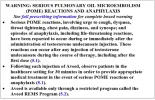
One such example is the need of Testosterone Undecanoate (AVEED) for TRT to be administered strictly and only by trained medical personnel, due to it's minute, yet real possibility according to its medical insert, to cause pulmonary micro embolisms

1738331693571.webp

We do know that our little sub culture has zero reported issues so far from Test U usage
 
Back
Top