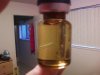
Has this Test crashed?

Have you already punctured the vial cap with a needle?

I ask bc I've had two patients recently whom developed some nasty infections bc of the heating process.

If that vail has been punctured do NOT place it in "hot water" to reverse this precipitation. That's bc water can enter the vial and contaminate the contents.

The safest means of reheating a punctured vial is by using DRY HEAT such as an oven. Temps of around 140 seem to work best.

Regs
Jim

Good to know. I will use dry heat now. Microwave?
 
@Dr JIM no I have not punctured the vile yet. It was this way when I received it so I haven't messed with it. I don't have any experience with crashed gear so I was hesitant to do anything.

Should I use the dry heat method you described? Or is using the tap water method ok?
 
Have you already punctured the vial cap with a needle?

I ask bc I've had two patients recently whom developed some nasty infections bc of the heating process.

If that vail has been punctured do NOT place it in "hot water" to reverse this precipitation. That's bc water can enter the vial and contaminate the contents.

The safest means of reheating a punctured vial is by using DRY HEAT such as an oven. Temps of around 140 seem to work best.

Regs
Jim
how long would you heat it at 140f?

I assume put a needle in it while in the oven?
 
Dry would be safer/smarter. I agree with him but i have never had any trouble nor thought about that. I also drink that water. Now the last place i lived i hated even showering with that shit.
 
Hes saying put it in the oven..
.heres how I do it...I put the vial in the oven....no needle in it and every few min ill take it out and swirl it around and as soon as the crystals dissolve I take it out ...
 
Dry would be safer/smarter. I agree with him but i have never had any trouble nor thought about that. I also drink that water. Now the last place i lived i hated even showering with that shit.

Yea well I do hope it's not a diluent of the AAS you pinning bc
tap water is NOT at all sterile.

Although the EPA has enforceable rules and regulations regarding "pathogenic organisms", non-pathogenic bacteria are permissible in "low concentrations". (I'll spare you the finer details about how this is qualified by the EPA, but it's available at WATER.EPA.gov if interested)

The EPA rules are designed primarily to diminish the spread of communicable diseases when these bacteria are ingested thru DRINKING WATER.

However it's important to remember ALL bacteria are "pathogenic" (or potentially disease causing) when injected.

Regs
Jim
 
Yea well I do hope it's not a diluent of the AAS you pinning bc
tap water is NOT at all sterile.

Although the EPA has enforceable rules and regulations regarding "pathogenic organisms", non-pathogenic bacteria are permissible in "low concentrations". (I'll spare you the finer details about how this is qualified by the EPA, but it's available at WATER.EPA.gov if interested)

The EPA rules are designed primarily to diminish the spread of communicable diseases when these bacteria are ingested thru DRINKING WATER.

However it's important to remember ALL bacteria are "pathogenic" (or potentially disease causing) when injected.

Regs
Jim


I was just agreeing with you, and saying i would use dry heat now that it has been brought to my attention. Thank you for doing so. I think thats how you took it, but not sure.
 
how long would you heat it at 140f?

I assume put a needle in it while in the oven?

It really depends upon the degree of precipitation present but 30 minutes is adequate inn most instances.

Venting the vial is only necessary if the vapor temp of the contents is exceeded.

However recall I'm suggesting dry heat primarily for vials that have already been vented bc of prior puncture.

For intact vials I'd prefer hot water, below boiling, bc non-tempered glass is more resistant
to breakage in this instance.
 
It really depends upon the degree of precipitation present but 30 minutes is adequate inn most instances.

Venting the vial is only necessary if the vapor temp of the contents is exceeded.

However recall I'm suggesting dry heat primarily for vials that have already been vented bc of prior puncture.

For intact vials I'd prefer hot water, below boiling, bc non-tempered glass is more resistant
to breakage in this instance.

Thank you for elaborating @Dr JIM. As always you've been very helpful!
 
I'll also mention although some have reversed this process using a "microwave" it's not at all ideal, IMO.

Primarily bc microwave temps are very difficult to regulate and the vial glass can become VERY hot before the oil is heated OR the oil can become rapidly heated which would necessitate vial venting, less the vial crack and rupture.
 
Last edited:
@Dr JIM no I have not punctured the vile yet. It was this way when I received it so I haven't messed with it. I don't have any experience with crashed gear so I was hesitant to do anything.

Should I use the dry heat method you described? Or is using the tap water method ok?
-------------------------------------
Place it in a 4-6 inch deep cooking pot and heat to a temp below boiling after wrapping the vial in "cheese cloth" to diminish the impact effect from the vial bouncing around.

The latter can crack heated AAS vials with their thin walls.

It should require only 5-10 minutes but remove it occasionally ensuring ALL the precip has been reversed.

Wet heat is great bc it's more uniform, occurs thru conduction is easy to regulate the net effect also being it's FAST.
 
Ok, I heated it as @Dr JIM described above. It took about 10 minutes for all of the cloudy looking liquid to dissapate. There is still a few fiber looking objects in there that have stuck to the side of the vile. Not sure what they are?

Photo-0167_e1.jpg
 
Back
Top