Anyone not lift to failure and are happy with their results?

I'm not a bodybuilder, but I try to never train to failure. I do a lot of 2's, 3's and 5's with a lot of volume, but every set is 1-4 reps from failure. It's great for strength and I still put on decent size.
I agree with this... I almost never train to failure... heavy cardio days are tough for me because I add In a lot of super sets and run laps in between so that's as close to failure as I get... but I tend to stick with the 4x12 or similar depending on what I'm working... and yes.. very happy with my results ... strength and mass both
 
The point would be to accumulate volume.

How does one decide how much volume (at "moderate intensity" or a few to 4 reps from failure) is optimal, versus less sets but closer to failure? For example what about doing 10 x 5 or 15 x 5 rather than 5 x 5?

Is it something that just develops over time as what seems to work best for you?

I'm not trying say it's wrong etc just honestly trying to understand the rationale behind it.
 
How does one decide how much volume (at "moderate intensity" or a few to 4 reps from failure) is optimal, versus less sets but closer to failure? For example what about doing 10 x 5 or 15 x 5 rather than 5 x 5?

Is it something that just develops over time as what seems to work best for you?

I'm not trying say it's wrong etc just honestly trying to understand the rationale behind it.
I personally have found less to be better for muilding mass... perfect example is cutting... when I cut I work harder.. more reps.. but I actually lose mass... not a lot, but I feel over worked.... that being said, one of the biggest guys I know swears by 1 on 1 off... meaning he literally only lifts 3 days a week... 2 hours, all muscle groups... I think it comes down to muscle memory and genetics...
 
I personally have found less to be better for muilding mass... perfect example is cutting... when I cut I work harder.. more reps.. but I actually lose mass... not a lot, but I feel over worked.... that being said, one of the biggest guys I know swears by 1 on 1 off... meaning he literally only lifts 3 days a week... 2 hours, all muscle groups... I think it comes down to muscle memory and genetics...
Lol, thats terrible work ethic
 
I agree with this... I almost never train to failure... heavy cardio days are tough for me because I add In a lot of super sets and run laps in between so that's as close to failure as I get... but I tend to stick with the 4x12 or similar depending on what I'm working... and yes.. very happy with my results ... strength and mass both

I'm not as familiar with progression for bodybuilding, but it seems volume would be just as important for it.
 
How does one decide how much volume (at "moderate intensity" or a few to 4 reps from failure) is optimal, versus less sets but closer to failure? For example what about doing 10 x 5 or 15 x 5 rather than 5 x 5?

Is it something that just develops over time as what seems to work best for you?

I'm not trying say it's wrong etc just honestly trying to understand the rationale behind it.

Fatigue management is one variable. The more sets a total tonnage goal is exploded across the less fatigue will be generated.

5x5 @ 85% will be very challenging (about rpe 9), this will produce a lot of fatigue that has to eventually be dissipated.

There are ways to handle this, but you can produce less fatigue if you did something like 8x3 or even more sets with less reps per set (using the same weight at the same intensity of 85% you did in the 5x5) then you will produce way less fatigue because the effort needed to complete each set will be a lot lower.

There are other considerations too, if you train for strength sports then simply getting more sets in doing a movement with perfect technique where you are not grinding hard and forming bad habits in the majority of your working sets as a result of the effort needed to complete the set will absolutely be beneficial. You're basically getting more practice in this way, which is hugely beneficial for competition based sports.

I train for bodybuilding so I make ample use of high intensity techniques even on a high frequency setup, you just need to be realistic and pragmatic in it's application and it works nicely. But strength sports is a different beast entirely. Well, not really, but you get the idea. I'm a fan of waiting as long as possible before a lifter specializes training, which means most guys should be focusing on strength for a while before specifying training. The soviets had the same approach to specialization too when they were snatching medals like it was nothing.

 
I personally have found less to be better for muilding mass... perfect example is cutting... when I cut I work harder.. more reps.. but I actually lose mass... not a lot, but I feel over worked.... that being said, one of the biggest guys I know swears by 1 on 1 off... meaning he literally only lifts 3 days a week... 2 hours, all muscle groups... I think it comes down to muscle memory and genetics...
Cutting or bulking is all diet related man. Your thinking way way too much in to this. The total package is achieved thru working both your fast and slow twitch fibers to their full potential. Not working harder or doing more reps to cut:confused: the difference between a BB and a PL is the PL only works fast twitch fibers. The BB has to do both. IE: low, mid and high rep work. Can be achieved thru undulating periodization or having "off season" training and "competition" training. An old tactic that is tride and true is heavy compound movements in the offseason and more iso stuff mid to high rep stuff for the competition phase. Although compound movements should still be the dominant focus. Only thing that changes is rep schemes and pace
 
How does one decide how much volume (at "moderate intensity" or a few to 4 reps from failure) is optimal, versus less sets but closer to failure? For example what about doing 10 x 5 or 15 x 5 rather than 5 x 5?

Is it something that just develops over time as what seems to work best for you?

I'm not trying say it's wrong etc just honestly trying to understand the rationale behind it.

I train entirely for strength. I rarely go over 5 reps for anything. 10-15 sets of 2, 5 sets of 5, 5 sets of 3, etc.

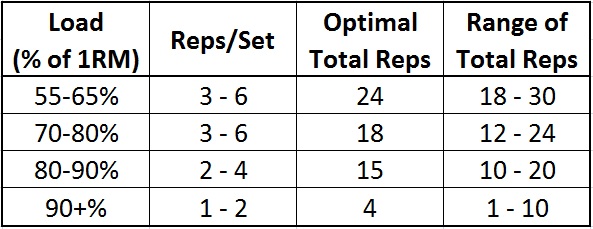
I generally like to use Prilepin's table for the most part.

optimum-rep-set-chart.jpg


Sometimes I go a little beyond on very high volume days.

There's definitely a science to it, there's tried and true rep ranges. How many sets is kind of individual. I mean I know the kind of volume I need to progress. I know I need 15-30 good, heavy reps on a given exercise. I'd call 15 borderline not enough, so 20-25 is my bread and butter for the most part. I also know that if I get too close to failure on squat, bench or deadlift too many sessions in a row I'll start to regress. When I'm pushing for progress it's something I really have to look out for and check my ego. It's the quality reps, smooth and fast in that sweet spot of intensity that drives the progress. Like I said four reps short of failure to one rep short of failure.

Another reason to avoid failure is it ingrains poor motor patterns. Smooth reps enforce perfect form, so when you go to max it's second nature.

I'm not sure what you can take away from this to apply to bodybuilding, but I hope it at least makes more sense. I'm not the best at explanations.
 
Fatigue management is one variable. The more sets a total tonnage goal is exploded across the less fatigue will be generated.

5x5 @ 85% will be very challenging (about rpe 9), this will produce a lot of fatigue that has to eventually be dissipated.

There are ways to handle this, but you can produce less fatigue if you did something like 8x3 or even more sets with less reps per set (using the same weight at the same intensity of 85% you did in the 5x5) then you will produce way less fatigue because the effort needed to complete each set will be a lot lower.

There are other considerations too, if you train for strength sports then simply getting more sets in doing a movement with perfect technique where you are not grinding hard and forming bad habits in the majority of your working sets as a result of the effort needed to complete the set will absolutely be beneficial. You're basically getting more practice in this way, which is hugely beneficial for competition based sports.

I train for bodybuilding so I make ample use of high intensity techniques even on a high frequency setup, you just need to be realistic and pragmatic in it's application and it works nicely. But strength sports is a different beast entirely. Well, not really, but you get the idea. I'm a fan of waiting as long as possible before a lifter specializes training, which means most guys should be focusing on strength for a while before specifying training. The soviets had the same approach to specialization too when they were snatching medals like it was nothing.

agreed. Strength and size do come hand and hand but training for one over the other is entirely different.
 
Explain what u mean... I'm slow

Total volume within the proper percentage of your max is what drives your strength progression. When you're a beginner you can just work up to one peak set to failure and progress. Eventually your progress will require longer time periods and more total volume.

For me I work up to a peak set every three weeks and the rest of the time I'm just doing a ton of volume work. Preferably I can add a few pounds every three weeks. Doesn't always happen and I'll have to look at why and try to get back on track.
 
Total volume within the proper percentage of your max is what drives your strength progression. When you're a beginner you can just work up to one peak set to failure and progress. Eventually your progress will require longer time periods and more total volume.

For me I work up to a peak set every three weeks and the rest of the time I'm just doing a ton of volume work. Preferably I can add a few pounds every three weeks. Doesn't always happen and I'll have to look at why and try to get back on track.
And thats why ppl who have ever PL carry a damn notebook. :D
I still do and its been a long damn time since i was all about the max poundage
 
And thats why ppl who have ever PL carry a damn notebook. :D
I still do and its been a long damn time since i was all about the max poundage

The info is vital for sure. I switched to a notepad app from actual notebooks a couple years ago for convenience and the data is backed up. Still the same thing though.
 
The info is vital for sure. I switched to a notepad app from actual notebooks a couple years ago for convenience and the data is backed up. Still the same thing though.
Ive been thinking of doing a full course PL program once i end this meadows program im on. Im a lil rusty so i will likely toss some ideas around in PM with you. The overrall strength aspect will have a positive impact on my overall goals. It wont be bench, dead, squat. More like maybe bench, bent row, FS. Ill need a lil help with the programming when the time comes. Can i count on you?
 
Ive been thinking of doing a full course PL program once i end this meadows program im on. Im a lil rusty so i will likely toss some ideas around in PM with you. The overrall strength aspect will have a positive impact on my overall goals. It wont be bench, dead, squat. More like maybe bench, bent row, FS. Ill need a lil help with the programming when the time comes. Can i count on you?

Of course. We'll come up with a good plan of attack for you. Just let me know.
 

Sponsors

Back
Top