myskamuska
New Member
If lyophilised HGH has been in the freezer overnight, is it still fine to use? Do you think it degraded?

MESO-Rx
Anabolic Steroids

Follow along with the video below to see how to install our site as a web app on your home screen.
Note: This feature may not be available in some browsers.
https://peptide.chatSo if im able to dissolved it, it should be good to go?
I would. The only thing is lost potency. The end result said to just refrigerate but nothing about any issue of contamination due to temp or moisture in a vial constituted or not.So if im able to dissolved it, it should be good to go?
So if im able to dissolved it, it should be good to go?
I think this test is for reconstituted HGH, not lyophilized. Don’t see any reason why a lyophilized peptide would degrade after freezing.

I think this test is for reconstituted HGH, not lyophilized. Don’t see any reason why a lyophilized peptide would degrade after freezing.


Just a correction: Glass transition could be at almost any temp, even room temp (very rarely). But with UGL, it’s totally unknown, and the vast majority of the time well below 0c / 32f.
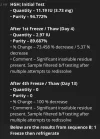
The initial screenshot detailing the freeze-thaw experiment which was posted by deadformat was conducted on an already reconstituted sample. So you can’t apply its results to lyophilized HGH.There is something called the “glass transition temperature”, and it’s not water freezing temp, but lower, and depends on the formulation of the lyophilized peptide.
“ Glass transition temperature (Tg) is the temperature where an amorphous material (like a freeze-dried protein) shifts from hard and glassy to soft and rubbery/mobile.”
Below Tg, molecules are basically “locked in place” and reactions/aggregation happen very slowly.
Above Tg, molecular motion jumps up, so the product can degrade or collapse much faster.”
Every time glass transition temperature is crossed, when the peptide is reconstituted, it shows more damage, mostly taking the form of increased aggregation.
This is why every lyophilized pharm rHGH has a warning to not freeze.
There’s a mountain of evidence supporting this. It’s why -80c is the universally recommended optimal peptide freezing temp by the companies that make them. -80c is far enough below any possible glass transition temp that the normal variations in freezer temp aren’t enough to cause what are effectively “freeze / thaw” cycles to occur. Unlike a household freezer, where the glass transition temp might be crossed a dozen times a day, doing just as much damage as if you put something in the freezer, thawed it, and refroze it many times a day.
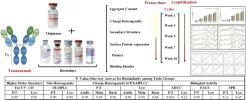
This illustration shows the impact on one lyophilized peptide, but the same applies to all. More aggregation, lower biological activity, two aspects of quality the testing available to us via Jano and the other labs are incapable of measuring accurately,
View attachment 365138
——-
“It is observed that both F/T and Lyo induce protein aggregation, which in turn causes perturbations in the biological potency of the mAb therapeutic.”
“The primary route of degradation induced by freeze–thawing is protein aggregation.”
Effects of Solution Conditions, Processing Parameters, and Container Materials on Aggregation of a Monoclonal Antibody during Freeze-Thawing
Freeze–thawing is a potentially damaging stress to which therapeutic proteins can be exposed deliberately during storage of bulk drug substance, and a…www.sciencedirect.com
“These effects became more extreme when the number of freeze-thaw cycles was increased from 1 to 3.”
“thermal behavior around Tg’, the glass-transition temperature of the excipient-rich phase after freezing, as a function of repeated freeze-thaw cycles.”
DSC reveals the excipient impact on aggregation propensity of pharmaceutical peptides during freezing
Pharmaceutical peptides are susceptible to aggregation in solution, making stabilization by addition of suitable excipients essential. To investigate …
The safest approach, without causing this “glass transition” aggregate inducing degradation, is to store in the coldest part of the refrigerator, or get a cheap -80c cryofreezer.
I spoke to one vendor who figured out their rHGH “cloudy” reconstitution problem was only affecting kits that he stored in the freezer.
Thank you sirThe initial screenshot detailing the freeze-thaw experiment which was posted by deadformat was conducted on an already reconstituted sample. So you can’t apply its results to lyophilized HGH.
In the first paper you mentioned, by Dash et al., the methods section of the paper mention repeatedly freezing and thawing samples in the F/T arm as well as repeatedly reconstituting and lyophilizing the samples in the lyo arm. So again, this can’t be applied to the original poster’s situation at all.
The second paper by Zäh et al. also experiments with repeated freezing and thawing of a solution, which we established above is nothing like the situation the poster is facing.
Not to mention that monoclonals are considerably different than other peptides and require their own considerations.
As for the glass transition temperature of lyophilized HGH, the papers I’ve found regarding the matter, although with different excipients each, both mention the Tg of lyophilized HGH that is devoid of any moisture to be WELL above room temperature, ranging from ~80 Celsius to ~126 Celsius depending on the ratio of HGH to sugars.
1. Solid state chemistry of proteins: I. glass transition behavior in freeze dried disaccharide formulations of human growth hormone (hGH) - PubMed
2. Stability of lyophilized human growth hormone - PubMed
So either way, moving a lyophilized vial of HGH from -20 Celsius to room temperature is nowhere near enough to cross the threshold.
All in all, I would say it’s totally fine to use the lyophilized vial after taking it out of the freezer.

If you keep it frozen until recon it's fine. You just don't want to freeze it, un-freeze/thaw it and then freeze it again.If lyophilised HGH has been in the freezer overnight, is it still fine to use? Do you think it degraded?
FridgeThere so much various answers anywhere for storage, dont know what to do for lyophilised vials.. Freezer ? Fridge ?
The initial screenshot detailing the freeze-thaw experiment which was posted by deadformat was conducted on an already reconstituted sample. So you can’t apply its results to lyophilized HGH.
In the first paper you mentioned, by Dash et al., the methods section of the paper mention repeatedly freezing and thawing samples in the F/T arm as well as repeatedly reconstituting and lyophilizing the samples in the lyo arm. So again, this can’t be applied to the original poster’s situation at all.
The second paper by Zäh et al. also experiments with repeated freezing and thawing of a solution, which we established above is nothing like the situation the poster is facing.
Not to mention that monoclonals are considerably different than other peptides and require their own considerations.
As for the glass transition temperature of lyophilized HGH, the papers I’ve found regarding the matter, although with different excipients each, both mention the Tg of lyophilized HGH that is devoid of any moisture to be WELL above room temperature, ranging from ~80 Celsius to ~126 Celsius depending on the ratio of HGH to sugars.
1. Solid state chemistry of proteins: I. glass transition behavior in freeze dried disaccharide formulations of human growth hormone (hGH) - PubMed
2. Stability of lyophilized human growth hormone - PubMed
So either way, moving a lyophilized vial of HGH from -20 Celsius to room temperature is nowhere near enough to cross the threshold.
All in all, I would say it’s totally fine to use the lyophilized vial after taking it out of the freezer.
How long can I keep it in the fridge lyophilized?Fridge
A dude in the forums found a couple kits he left in his closet for like 3 years, sent it in for testing and the purity had gone from roughly 98% to 96-97%.How long can I keep it in the fridge lyophilized?