Trenbolone Acetate vs Enanthate: Doses Are Not Equivalent, With Examples

pc1891

New Member
When I see people compare dosing for Trenbolone Enanthate (Tren E) and Trenbolone Acetate (Tren A), they often focus on the ester weight. Tren E is about 70.7% active trenbolone, while Tren A is 86.6%. Based on this, they suggest multiplying your Tren A dose by 1.225 (86.6 / 70.7) to get an equivalent Tren E dose. However, this approach is flawed because it ignores the half-lives of the esters.

If both compounds are injected at the same dose and frequency, the one with the longer half-life (Tren E at 11 days vs. Tren A at 2 days) will build up to a higher average steady-state concentration in the body. This happens because a longer half-life means slower clearance, allowing more accumulation over time.

With all other factors equal (dose, bioavailability, dosing interval, etc.), concentration increases as half-life increases. For example, if one person injects 50 mg of Tren A daily and another injects 50 mg of Tren E daily, the Tren E user will take longer to reach steady state but will end up with more than five times as much trenbolone in their system.

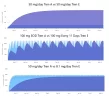
You can verify this on steroid plotter by plotting (image below):

50 mg, Trenbolone Acetate, Every day, Week 1 to Week 18, click Compare (not Accumulate)

50 mg, Trenbolone Enanthate, Every day, Week 1 to Week 18, click Compare (not Accumulate)

However, if the dosing frequency were adjusted proportionally to the half-life (e.g., dosing less often for the longer half-life ester to match release rates), the steady-state concentrations would be similar. For instance, if one person were to inject 100 mg Tren E every other day (same weekly dose as the previous example) and another person injected 100 mg Tren E every 11 days, to match the half-lives of the compounds, the average levels in the body over that time period would be comparable.

You can verify this on steroid plotter by plotting (image below):

100 mg, Trenbolone Acetate, Every other day, Week 1 to Week 18, click Compare (not Accumulate)

100 mg, Trenbolone Enanthate, Every 11 days, Week 1 to Week 18, click Compare (not Accumulate)

In summary, if you're using the same dose and schedule for both, Tren E would be far more potent, for both benefits and side effects, with about 6.18 times the trenbolone in your system at steady state compared to Tren A. A 50 mg/day injection of Tren A is equivelant to only about 8.1 mg/day of Tren E, again once steady state has been achieved for both.

You can verify this on steroid plotter by plotting (image below):

50 mg, Trenbolone Acetate, Every day, Week 1 to Week 18, click Compare (not Accumulate)

8.1 mg, Trenbolone Enanthate, Every day, Week 1 to Week 18, click Compare (not Accumulate)

The same goes for Nandrolone, but with Deca leading to about a 1.76 times higher concentration at steady state when compared to NPP, when using the same dose and schedule for both.

This would also apply to the different Test esters, though I haven't done the math on those yet. The closer the half-lives (i.e. Test C vs Test E) the closer the concentrations would be to each other.

If I've gotten anything wrong, please let me know.
Tren A vs Tren E.webp
 
I think there are a few flaws in your thought process here.

You compared both esters using the same dose and the same daily injection schedule.


Tren E has a much longer half-life (7–10 days) compared to Tren A (around 2 days). If you inject Tren E every day at the same mg as Tren A, it can’t clear between shots. The result is stacking and accumulation, so your plot shows way more Tren E in the system. That’s not higher potency, it’s overdosing by schedule.


Half-life only changes how long a drug stays in your body, not how strong each mg is.


Tren A and Tren E are the same hormone — the only difference is how quickly they build up and clear. Saying Tren E is six times stronger is wrong because that happens only if you inject both every day at the same dose, which makes no sense. If you do that, Tren E piles up for weeks since the old doses haven’t cleared yet. It looks stronger on paper, but that’s just your blood levels getting way higher than intended. It’s not stronger, you’re just dosing too often.


Used properly, Tren A (ED or EOD) and Tren E (2–3x/week) give almost the same results. The only real difference is timing: Tren A kicks in faster and clears faster; Tren E builds slower and feels smoother. The “6x stronger” thing is just a math glitch from dosing the long ester too frequently, not a real-world difference.


You also have to correct for ester weight (the part of the molecule that isn’t active hormone).

Per 100 mg, Tren A is about 86% active Tren, while Tren E is about 71%. So equal milligrams aren’t equal in active hormone.

In practice, 400 mg/wk of Tren A = 490–520 mg/wk of Tren E for the same actual Tren delivered.


And my first reaction was:
“but we can pin Tren E daily”
Sure, you can, but that just increases the dose rate compared to how slowly it clears. It stacks higher and higher, not because it’s more potent, but because you’re injecting faster than your body can get rid of it. That only proves that ED is the wrong injection interval for a long ester — not that Tren E is stronger.


Correct way to compare:
  • Match active mg/week (adjust for ester weight, E = A ×1.2–1.3, i think is the rough calculation)
  • Use proper pinning intervals (A = ED/EOD, E = 2–3x/week)
  • The result is similar overall levels and effects. Tren E is just smoother and slower to clear.

Quick conclusion:

Your 6× claim comes from dosing both esters every day at the same mg, which makes the long ester (Tren E) over-accumulate. That’s a scheduling artifact, not real potency. Once you correct for ester weight and use proper timing, 400 mg Tren A = 500 mg Tren E in real-world effect. The only true difference is the kinetics, Tren E builds and clears slower, that’s it.
 
I think there are a few flaws in your thought process here.

You compared both esters using the same dose and the same daily injection schedule.


Tren E has a much longer half-life (7–10 days) compared to Tren A (around 2 days). If you inject Tren E every day at the same mg as Tren A, it can’t clear between shots. The result is stacking and accumulation, so your plot shows way more Tren E in the system. That’s not higher potency, it’s overdosing by schedule.


Half-life only changes how long a drug stays in your body, not how strong each mg is.


Tren A and Tren E are the same hormone — the only difference is how quickly they build up and clear. Saying Tren E is six times stronger is wrong because that happens only if you inject both every day at the same dose, which makes no sense. If you do that, Tren E piles up for weeks since the old doses haven’t cleared yet. It looks stronger on paper, but that’s just your blood levels getting way higher than intended. It’s not stronger, you’re just dosing too often.


Used properly, Tren A (ED or EOD) and Tren E (2–3x/week) give almost the same results. The only real difference is timing: Tren A kicks in faster and clears faster; Tren E builds slower and feels smoother. The “6x stronger” thing is just a math glitch from dosing the long ester too frequently, not a real-world difference.


You also have to correct for ester weight (the part of the molecule that isn’t active hormone).

Per 100 mg, Tren A is about 86% active Tren, while Tren E is about 71%. So equal milligrams aren’t equal in active hormone.

In practice, 400 mg/wk of Tren A = 490–520 mg/wk of Tren E for the same actual Tren delivered.


And my first reaction was:
“but we can pin Tren E daily”
Sure, you can, but that just increases the dose rate compared to how slowly it clears. It stacks higher and higher, not because it’s more potent, but because you’re injecting faster than your body can get rid of it. That only proves that ED is the wrong injection interval for a long ester — not that Tren E is stronger.


Correct way to compare:
  • Match active mg/week (adjust for ester weight, E = A ×1.2–1.3, i think is the rough calculation)
  • Use proper pinning intervals (A = ED/EOD, E = 2–3x/week)
  • The result is similar overall levels and effects. Tren E is just smoother and slower to clear.

Quick conclusion:

Your 6× claim comes from dosing both esters every day at the same mg, which makes the long ester (Tren E) over-accumulate. That’s a scheduling artifact, not real potency. Once you correct for ester weight and use proper timing, 400 mg Tren A = 500 mg Tren E in real-world effect. The only true difference is the kinetics, Tren E builds and clears slower, that’s it.

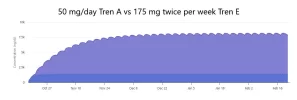
Even if you dose Tren A 50 mg ED vs Tren E 175 mg 2x per week (every 3.5 days), so 350 mg per week for each, but at the interval you say is more appropriate, you'd still have more than 6 times higher dose in your system at steady state for Enanthate vs Acetate, which is not much different from the every day same dosing for each in my original example, and definitely large enough to cause much higher side effects. That's, I think, a good think for people to understand when they make dosing decisions. And if I'm wrong, please I want to know for my and everyone else's sake.

Tren A vs Tren E 2.webp
 
Even if you dose Tren A 50 mg ED vs Tren E 175 mg 2x per week (every 3.5 days), so 350 mg per week for each, but at the interval you say is more appropriate, you'd still have more than 6 times higher dose in your system at steady state for Enanthate vs Acetate, which is not much different from the every day same dosing for each in my original example, and definitely large enough to cause much higher side effects. That's, I think, a good think for people to understand when they make dosing decisions. And if I'm wrong, please I want to know for my and everyone else's sake.

View attachment 355485
Let me try and and explain this more throughly:

You’re comparing:
Tren A: 50 mg every day
Tren E: 175 mg twice per week

That’s the same weekly total, 350 mg/week, but he says Tren E shows a much higher level on his graph, so it must be 6 times stronger.

Here’s why that’s wrong:

- Tren E stays in your body much longer.
When you inject it, it doesn’t leave quickly. Each new shot adds more Tren E before the last shot has even cleared. So your body has more total Tren E stored inside at any given moment.

- The graph ur showing measures how much total drug is sitting in the body, not how much is active and working right now.
Tren E’s line looks higher because a lot of the old injections are still hanging around, not because the hormone is stronger.

- What actually matters is how much active Trenbolone is released each day, not how much is sitting in storage waiting to be released.
Once both versions reach steady levels, Tren A and Tren E release about the same daily amount of active Trenbolone, they just release it at different speeds.

Tren A clears fast, so you inject more often.
Tren E clears slow, so you inject less often.
The body ends up with roughly the same active hormone over a week either way.

So the big purple area on his chart doesn’t mean Tren E is stronger.
It just means it piles up in your system more because it’s slow to leave. If you stopped injecting today, Tren E would take weeks to clear; Tren A would be mostly gone in a few days.

You have to think in terms of active mg and how much is currently active and building up and clearing.

Simply put:

Tren E looks higher on his graph because it stays in your system longer, not because it’s 6× stronger. The graph is showing how much total Tren is stored, not how much is active. When both are used properly, they give about the same results per week; Tren A just kicks in and clears faster, Tren E builds slower and lasts longer.
 
Steroid plotter is hot garbage. So many half lives are wrong on it. Many of their sources are questionable. The tren e source definitely gives no reason as to how they came up with 11 days. But then they put the other two enanthates, test e and primo e at 7 days. And I think it's wrong that they show tren e has having a longer half life than hex. Also half life can change based on the muscle injected, the bolus size, concentration, carrier oil, etc.

You'll have a much better time just saying they're close enough to be the same other than injection frequency and then adjust dose as needed based on your results and progress.
 
Steroid plotter is hot garbage. So many half lives are wrong on it. Many of their sources are questionable. The tren e source definitely gives no reason as to how they came up with 11 days. But then they put the other two enanthates, test e and primo e at 7 days. And I think it's wrong that they show tren e has having a longer half life than hex. Also half life can change based on the muscle injected, the bolus size, concentration, carrier oil, etc.

You'll have a much better time just saying they're close enough to be the same other than injection frequency and then adjust dose as needed based on your results and progress.
They don’t take into consideration time for peak saturation and active mg. That’s smth you have to do. They don’t assume that the tren e has to build up after every shot and then clear. Unlike tren ace which pretty much peaks and clears in 2 days.

Anyone with basic knowledge of their pharmaceutics knows Ace will be more potent than an enanthate ester at the same dose.
 
If this was the case no one would use tren ace. Also if you're looking to mitagate sides, ace is superior. Someone who has a bad reaction can stop and in a few days all the tren will be out. With E you could be dealing with sides for signifactly longer after your last pin.
 
They don’t take into consideration time for peak saturation and active mg. That’s smth you have to do. They don’t assume that the tren e has to build up after every shot and then clear. Unlike tren ace which pretty much peaks and clears in 2 days.

Anyone with basic knowledge of their pharmaceutics knows Ace will be more potent than an enanthate ester at the same dose.
I can see what you're saying, even though the concentration of Tren E in the body may be higher, it is being released more slowly, so the amount active trenbolone in the system at any time is relatively similar with either ester.
 
I can see what you're saying, even though the concentration of Tren E in the body may be higher, it is being released more slowly, so the amount active trenbolone in the system at any time is relatively similar with either ester.
Yes and it also doesn’t account for the long clearance of tren e. So when tren e is clearing, the active mg is way lower but the plotter doesn’t assume it’s clearing. It assumes it’s active both when its building up and clearing.

Ultimately weather you use a plotter or not. The active mg in tren ace is higher than tren e at the same dose. That’s just how it works. Enanthate ester weights more this taking more weight/space in the solution. It can never be more potent per mg.
 
Yes and it also doesn’t account for the long clearance of tren e. So when tren e is clearing, the active mg is way lower but the plotter doesn’t assume it’s clearing. It assumes it’s active both when its building up and clearing.

Ultimately weather you use a plotter or not. The active mg in tren ace is higher than tren e at the same dose. That’s just how it works. Enanthate ester weights more this taking more weight/space in the solution. It can never be more potent per mg.
I didn't think it was necessarily more potent per mg, just that you would end up with more mg in the body at any time, which would have a stronger effect, but I can see what you are saying, not all of that is active at the same time.
 
Actual answer:

The term you're trying to describe is called "Area-Under-Curve":

It's a measurement of total drug exposure over a time period.
You can use the half lives and dosing schedule to calculate exact values.

Total exposure to Tren A will always be greater given identical protocols due to ester weight.

BUT. We know that total exposure is not all that matters. Blood concentration makes an impact but there's no data on what that impact is (shorter, higher spikes vs steady concentrations)

1000001077.webp
 
Mg for mg TREN E builds up more in the body than TREN A.

350mg/w TREN E will give greater concentrations of hormone in the body than the equivalent TREN A dosage.

For the same mg dosage, TREN E is stronger than TREN A. Not 6 times stronger but a substantial percentage.

From n=1 results, 200mg TREN E split into 2x100mg shots, gave me better results than 3x70mg shots of TREN A with the difference being clear after about 6 weeks
 
Mg for mg TREN E builds up more in the body than TREN A.

350mg/w TREN E will give greater concentrations of hormone in the body than the equivalent TREN A dosage.

For the same mg dosage, TREN E is stronger than TREN A. Not 6 times stronger but a substantial percentage.

From n=1 results, 200mg TREN E split into 2x100mg shots, gave me better results than 3x70mg shots of TREN A with the difference being clear after about 6 weeks
Bruv we just explained, it’s scientifically impossible.

Tren E does not deliver more active tren per mg than Tren A.

Because acetate has a higher active hormone percentage.

Tren E appears “stronger” only if you pin both esters on the same schedule, which causes Tren E to accumulate more stored esterified hormone, not more active tren in circulation.

That’s a kinetics misunderstanding, not a potency phenomenon.

When you match for active mg and use appropriate injection frequencies (A ED/EOD, E 2–3×/week), real-world effect is similar; A simply peaks/clears faster while E builds smoother. His n=1 reflects accumulation behavior, not true mg-for-mg superiority.
 
When you match for active mg and use appropriate injection frequencies (A ED/EOD, E 2–3×/week), real-world effect is similar; A simply peaks/clears faster while E builds smoother. His n=1 reflects accumulation behavior, not true mg-for-mg superiority.
So you throw pharmacokinetics out the window in order to rationalize your dumbfuck argument.

Using the same amount per week (ester included) of Tren A and Tren E, the circulating concentration of the later is greater that the concentration of the former after both have hit their respective terminal half-lives.

In plain english, in the very possible case you can't comprehend simple facts: Xmg Tren E per week leads to higher circulating Tren than Xmg Tren A per week.

Savvy?
 
Last edited:
So you throw pharmacokinetics out the window in order to rationalize your dumbfuck argument.

Using the same amount per week (ester included) of Tren A and Tren E, the circulating concentration of the later is greater that the concentration of the former after both have hit their respective terminal half-lives.

In plain english, in the very possible case you can't comprehend simple facts: Xmg Tren E per week leads to higher circulating Tren than Xmg Tren A per week.

Savvy?
You’re confusing total hormone sitting in the body with active circulating tren actually hitting receptors. Tren E has more mass hanging around because it clears slower — a lot of that is still building and clearing, not active. That’s stored esterified hormone, not free tren doing work.

Basic reality:
  • Tren A has more active hormone per mg
  • Tren E only “looks higher” if you pin it like Ace and force accumulation
  • Accumulation ≠ potency — it’s just slower release + slower clearance

Match active mg and proper pinning for each ester and they feel the same — E just ramps slower and sticks longer. Your “E is stronger” take isn’t pharmacology, it’s misreading build-up as effect.

And yes, my point was literally based on pharmacokinetics — you’re arguing against PK while thinking you’re using it.

You’re measuring what’s sitting in the depot, not what’s circulating.

Savvy?
 
In plain english, in the very possible case you can't comprehend simple facts: Xmg Tren E per week leads to higher circulating Tren than Xmg Tren A per week.
You’re trying to argue pharmacokinetics while ignoring the most basic PK rule on earth — active mg matters. You can’t scream “circulating concentration!” and then pretend ester weight and active release don’t exist.

Tren E stacks more mass if you pin it like Ace, yes — because it’s still building and clearing, not because it’s delivering more active hormone per mg. You literally tossed out the core PK principle you’re trying to use as your argument. Long ester saturation ≠ higher potency. It just means you misapplied the dosing model and then congratulated yourself like you discovered gravity.


Try following the rules of the science you’re quoting — then come back.
 
You literally skipped the entire thread that thoroughly explained everything and then replied and called me a dumbass.

Says more about you than me.
 
Last edited:


Write out the mass balance. Then examine what determines the stabilized serum profile of API once 5 or 6 effective elimination half lives have been reached. A one compartment first order absorption plus elimination PK model is adequate for this analysis.

We are left with

Input - output = accumulation

What sets the output term for the elimination of free hormone?

Set the input term (normalized for ester weight) constant for free hormone.

Yes, of course, account for ester weight in the prodrug.

https://pmc.ncbi.nlm.nih.gov/articles/PMC3152312/figure/F3/
 
Last edited:

TABLE 9.4
Influence of Ka and KE on Cmax, tmax and AUC


Under control of flip flop kinetics, this table gives you the answer for serum AUC difference between TRE and TRA all else being equal for their extravascular admin.

Thus, the method of residuals enables resolution of the biexponential plasma level-time curve into its two exponential components. The technique works best when the difference between Ka and KE is large (Ka/KE ≥ 3). In some instances, the KE obtained after i.v. bolus of the same drug is very large, much larger than the Ka obtained by the method of residuals (e.g. isoprenaline) and if KE/Ka ≥ 3, the terminal slope estimates Ka and not KE whereas the slope of residual line gives KE and not Ka. This is called as flip-flop phenomenon since the slopes of the two lines have exchanged their meanings.
 
Last edited:

Sponsors

Back
Top