MESO "Specialized" Testing Group Fund

What tren issues, specifically?
I’m not sure if I’m following where we are heading either, or if there is a clear hypothesis. My best guess is correlating the presence of plastics with color of the sample and the level of toxicity it contains?

I don’t know enough regarding the tests and compounds to even know what type of conclusions we can ultimately reach. Im hoping someone can step in with a layman’s explanation for the projects direction.
 
I’m not sure if I’m following where we are heading either, or if there is a clear hypothesis. My best guess is correlating the presence of plastics with color of the sample and the level of toxicity it contains?

I don’t know enough regarding the tests and compounds to even know what type of conclusions we can ultimately reach. Im hoping someone can step in with a layman’s explanation for the projects direction.

Separate project guys
It's just a coincidence that i sent TRE400 for testing.
 
Separate project guys
It's just a coincidence that i sent TRE400 for testing.
I understand for your test, You are only concerned with the plastics regardless of the anabolic compounds. It’s more about the types of plastics and solvents being utilized. From The testing results it appears your assumption was right. So I assume, for you it’s now a matter of finding filters and solvents that are compatible to reduce or eliminate completely the leeching.

But I thought @dinfar1337 was looking at your test results and the presence of plastics for comparison to our original testing. It could be purely misunderstanding what’s happening but that’s my impression
 
Last edited:
I understand for your test, You are only concerned with the plastics regardless of the anabolic compounds. It’s more about the types of plastics and solvents being utilized. From The testing results it appears your assumption was right. So I assume, for you it’s now a matter of finding filters and solvents that are compatible to reduce or eliminate completely the leeching.

But I thought @dinfar1337 was looking at your test results and the presence of plastics for comparison to our original testing. It could be purely misunderstanding what’s happening but that’s my impression
It's almost impossible to find bottle top filters that don't use a leechable plastic. The one that are made of polypropylene (good plastic) are all non sterile, this introduce another big isse, the sterilization of the bottle top filter.

Now it's a trade off between: risking not properly sterilized filters with no plastic leeched or risk plastic leeched but assured sterilized filters lol

@Photon does Jano still has your BB sample with leeched plastic in it?
I want to send him a sample of TREN with high BB content filtered with syringe filter to see if there is leeched plastic in there or only bottle top filters are the one leeching.

But I believe he needs the BB with leeched plastic so that he can compare the peaks.
 
It's almost impossible to find bottle top filters that don't use a leechable plastic. The one that are made of polypropylene (good plastic) are all non sterile, this introduce another big isse, the sterilization of the bottle top filter.

Now it's a trade off between: risking not properly sterilized filters with no plastic leeched or risk plastic leeched but assured sterilized filters lol

@Photon does Jano still has your BB sample with leeched plastic in it?
I want to send him a sample of TREN with high BB content filtered with syringe filter to see if there is leeched plastic in there or only bottle top filters are the one leeching.

But I believe he needs the BB with leeched plastic so that he can compare the peaks.

Photon already found the matching peak and associated mass spectra. Match between his BB sample with contamination and TRE oil with same contamination.
So you just need to run the GCMS test. Photon can share the retention time.
 
Photon already found the matching peak and associated mass spectra. Match between his BB sample with contamination and TRE oil with same contamination.
So you just need to run the GCMS test. Photon can share the retention time.
Wanna do some nice testing Like same substance with different BB content and see if syringe filters leach as well?
 
It's almost impossible to find bottle top filters that don't use a leechable plastic. The one that are made of polypropylene (good plastic) are all non sterile, this introduce another big isse, the sterilization of the bottle top filter.

Now it's a trade off between: risking not properly sterilized filters with no plastic leeched or risk plastic leeched but assured sterilized filters lol

@Photon does Jano still has your BB sample with leeched plastic in it?
I want to send him a sample of TREN with high BB content filtered with syringe filter to see if there is leeched plastic in there or only bottle top filters are the one leeching.

But I believe he needs the BB with leeched plastic so that he can compare the peaks.

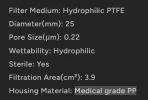
Syringe filters are PP with PTFE (Assuming you use PTFE).
PP is highly resistant to BB and BA.

Capsule filters come sterilized with good plastic (PP).

E.g
.2 PTFE Hydrophobic.
Sterile.
 
Last edited:
It's almost impossible to find bottle top filters that don't use a leechable plastic
So dumb question…would there be less leeching if there were only a point of use filter being utilized. Meaning I filter the oil myself before injecting rather than having the supplier filter the oil in larger quantities where it may have a longer exposure rate to the plastic filters. I don’t know how long filter an entire batch takes compared to filtering a syringe full.
 
So dumb question…would there be less leeching if there were only a point of use filter being utilized. Meaning I filter the oil myself before injecting rather than having the supplier filter the oil in larger quantities where it may have a longer exposure rate to the plastic filters. I don’t know how long filter an entire batch takes compared to filtering a syringe full.

Are you talking about buying unfiltered oil from vendors?
 
Syringe filters are PP with PTFE (Assuming you use PTFE).
PP is highly resistant to BB and BA.

Capsule filters come sterilized with good plastic (Some even better than PP).

E.g
.2 PTFE Hydrophobic.
Sterile.


Syringe Filters
KS-TEK
1758505774501.webp

COBETTER
1758505628558.webp

TISCH
1758505723408.webp
 
Are you talking about buying unfiltered oil from vendors?
Possibly…. If I know I have to filter the oil myself to reduce the amount of total contamination/toxicity, especially for compounds that are more prone to the leeching. I could see offering an unfiltered version.
If it doesn’t make a huge difference in the actual contamination values, than I say stay with status quo because people will probably be too lazy to filter at all.
 
Possibly…. If I know I have to filter the oil myself to reduce the amount of total contamination/toxicity, especially for compounds that are more prone to the leeching. I could see offering an unfiltered version.
If it doesn’t make a huge difference in the actual contamination values, than I say stay with status quo because people will probably be too lazy to filter at all.

Why buy from a vendor if you don't trust his brew setup?

But to answer your question,
Unfiltered is probably better imo.
Cheaper too, but very very unlikely to ever happen tho.
It would have to be a custom order in bulk, maybe a few hundred ML or more.
 
Why buy from a vendor if you don't trust his brew setup?

But to answer your question,
Unfiltered is probably better imo.
Cheaper too, but very very unlikely to ever happen tho.
It would have to be a custom order in bulk, maybe a few hundred ML or more.
First I don’t think anyone should blindly trust a vendor. That’s why we advocate for testing.

I completely get that unfiltered wouldn’t be offered mainstream. Because if 1 out of 20 customers don’t filter or use the wrong ones the amount of serious issues could add up quick. It would be a never ending blame game. Home brewing is an option too but I’m not convinced I could do it any better/safer.

I don’t know what an acceptable threshold, parts per million/however measured, would be for the amount of plastics. Im sure the best answer is zero but is that realistic? Having shown there is indeed leeching we need to press the vendors for a viable solution for reduction/elimination. The genie is out of the bottle now.
 
But I thought @dinfar1337 was looking at your test results and the presence of plastics for comparison to our original testing. It could be purely misunderstanding what’s happening but that’s my impression
i honestly cant answer you.

that is what im reading since jano labeled tren byproducts peaks 7-12. peak 3 also shows a toxic compound even tho its not related to tren


but our previous testing shows color isnt directly correlacted. even though some of those new peaks could add color. what im more interested in from our last project is how prone tren is to oxidation, it could and very likely is tren specific oxidation > quinones, pyrroles, quinoxalines, pyrazines which absorbs visible light and shifts the color from yellow > amber > red or brown.

those same byproducts can cause liver damge, dna damage & mutagenicity, oxidative stress & lung irritation(tren cough), blood toxicity, marrow suppresion & higher leukimia risk.

if those are truly findings related to tren byproducts caused by leeching plastics. which the janoshik testing says. it dosent matter what caused it, the matter is the findings of those byproducts from it.

its a different project and the peaks are from leeched plastic most likely, but these plastic additivites explains everything we hypothesized from old project + new project when looking at its effects on tren.

ofc we would have to do this same shit over and over on every compound...

sorry if i made it sound confusing i am still heavily invested in the old project aswell, it just didnt sit right with me how it ended lol. im defiently probably daydreaming haha


safe to say photons project is giving pretty good results already and we should pick it up, the tren testing isnt that relevant compared to its findings it could have on overall aas sterility. and how the leech from plastic could affect our health risks.

thanks for bringing it up @Photon

 
Last edited:
what im saying in simpler words:

this affect all aas, but tren is very volatile and prone to degradation. be it from my fart or plastics. and we could very well find milder or harsher side effects from other compounds.

since all vials stand out for long enough they basically all degrade the rubber stopper and get plastic leeches into it.

this isn't correlacted to tren color but the longer it has been standing the more color it gets xd

so fuck tren color its most likely bullshit but a decent thought(since other factors than the plastic leeches can play into color changes, even just brewing it too hot)
 
Last edited:
i honestly cant answer you.

that is what im reading since jano labeled tren byproducts peaks 7-12. peak 3 also shows a toxic compound even tho its not related to tren


but our previous testing shows color isnt directly correlacted. even though some of those new peaks could add color. what im more interested in from our last project is how prone tren is to oxidation, it could and very likely is tren specific oxidation > quinones, pyrroles, quinoxalines, pyrazines which absorbs visible light and shifts the color from yellow > amber > red or brown.

those same byproducts can cause liver damge, dna damage & mutagenicity, oxidative stress & lung irritation(tren cough), blood toxicity, marrow suppresion & higher leukimia risk.

if those are truly findings related to tren byproducts caused by leeching plastics. which the janoshik testing says. it dosent matter what caused it, the matter is the findings of those byproducts from it.

its a different project and the peaks are from leeched plastic most likely, but these plastic additivites explains everything we hypothesized from old project + new project when looking at its effects on tren.

ofc we would have to do this same shit over and over on every compound...

sorry if i made it sound confusing i am still heavily invested in the old project aswell, it just didnt sit right with me how it ended lol. im defiently probably daydreaming haha


safe to say photons project is giving pretty good results already and we should pick it up, the tren testing isnt that relevant compared to its findings it could have on overall aas sterility. and how the leech from plastic could affect our health risks.

thanks for bringing it up @Photon

The quinone you talk about is actually quite interesting because it's found in the light yellow vial and not dark red vial. I actually wonder if it's there's naturally or added as a yellow dye to turn stuff yellow..

Both raws are supposed to be the same but yet the gcms results are not. Honestly I doubt we'll find the answer to this but the goal is to at least ensure we don't get plastic in future vials.
 
naturally
i think its most likely already there possibly from plastic leeches. i looked every byproduct up and its just another common found product from plastic.

also janoshik commented you had peak 3 contamination from plastic aswell in yellow vial.

filtering the oil is hopeless tho as the damage already could have been done..

now im more interested in what can be done to prevent this so the project makes sense.

also as sampei mentions, interesting to see if its the oil degrading rubber or its from bottle top filters. and which one leaks the most plastic into our solution.
 
i think its most likely already there possibly from plastic leeches. i looked every byproduct up and its just another common found product from plastic.

also janoshik commented you had peak 3 contamination from plastic aswell in yellow vial.

The yellow dye stuff is peak 8, ..1,4-Naphthoquinone, 6-acetyl-2,5,8-trihydroxy. Google for Naphthoquinone, it's used in dyes to turn stuff yellow

@Photon @dinfar1337 Could one re-filter (at home) that TRE400 to remove the Benzenemethanamine?

No u can't filter out what's been dissolved. Same as how you came filter out your raws from the oil using a syringe filter.
 
Last edited:
Back
Top