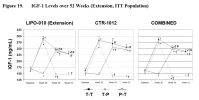
No known cases of acromegaly from Tesa (though treatment guidelines say stop if IGF exceeds ULN consistently).
Unlike rHGH, Tesa leaves the hypothalamus-pituitary axis feedback loop intact (mostly). So when IGF starts to get too high, GH production is reduced.
In the real world this means for most people on Tesa, IGF maxes out around the upper limit of normal or slightly above, and can't go any higher.
Also, because the Tesa increased release of GH follows the natural pulse pattern, not continuous high levels like rHGH, GH receptors don't downregulate, especially in adipose cells, so the fat loss effects of Tesa is as effective for lipolysis as a high dose of rHGH that would cause very high IGF.
In other words you can lose the same amount of fat with Tesa that would require a dose of rHGH that would put IGF into riskier supra-physiologic ranges.
So a much safer risk profile for long term use if fat lipolysis is your main goal, though lower IGF means growth / recovery isn't as much as rHGH would provide with elevated IGF, albeit with additional risk.