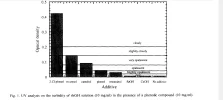
As determined by various methodologies, most of the phenolic compounds caused rhGH aggregation, especially at high concentrations. Stress studies under freezing, high-temperature incubation, and agitation suggest that the destabilizing influence of the compounds tested increases in the order of benzyl alcohol < phenol × resorcinol < catechol < meta-cresol < 2-chlorophenol. Non-aromatic alcohols, except 2,6-dimethylcyclohexanol, have a much less adverse effect. Determination of the thermal transition temperature by microcalorimetry studies also reflected this trend. From our study, we conclude: (1) the phenolic additive-induced rhGH aggregates were held by non-covalent forces; (2) no significant physical binding occurred between the protein and these compounds; (3) the aggregation tendency of the phenolic compounds failed to correlate with their hydrogen bonding strength; (4) the presence of a phenolic additive caused conformational changes in rhGH's structure; (5) the effect of these phenolic compounds on rhGH aggregation decreased at high and low pHs.