Does natural GH production bounce back well?

I’m 46 and minor tweaks are starting to take longer to heal and I remember Sly Stallone saying “GH scrubs the years off your joints and body”

I love doing martial arts so tweaks and minor injuries are quite common.

So I am interested in something that could make the body resilient to injury and heal from tweaks like a much younger person.

My main concern is would using GH have a long term effect on my natural GH production?

My IGF-1 levels are actually at the top of the natural range, if that makes a difference to if I’d even benefit from moderate GH use.

Can you guys link to studies on how natural production bounces back as well as your own bloods?

I wouldn’t want to use GH year round, not just from the cost perspective but from being dependent on an injection daily - I plan to travel to more undeveloped places in the near future and don’t want to be dependent on too much medication.

@Type-IIx I see you posted this, if you could provide more that’d be awesome

“RhGH (Somatropin; recombinant human growth hormone) does not chronically suppress GH secretion. A bolus generally suppresses GH secretion for ~ 1 day (22 hr +/-) with some escape from suppression in many users (some reduced GH secretion).”

Thanks
 
Studies have shown that the use of exogenous HGH can lead to a temporary suppression of endogenous IGF-1 production, as the body adjusts to the increased levels of HGH. However, once exogenous HGH use is discontinued, endogenous IGF-1 production typically returns to baseline levels within several weeks to months. But as always, that’s not guaranteed.
 
From what I understand the above ^ is correct. Ive done quite some reading about somatropin, though have never used it. If your IGF-1 levels are near top reference I suppose some valuable advice would be to do your blood work first (seems like you already have) and include tests for cancer (CBC, Tumor markers, blood proteins, PSA, etc.). It can be a little arduous to test for this using routine blood work, just do some reading beforehand make sure to educate yourself. Just try to make sure you don’t have abnormally high predisposition for cancer(s). IGF-1 will literally* grow a preexisting carcinoma. Good luck and good health on your journey!
 
From what I understand the above ^ is correct. Ive done quite some reading about somatropin, though have never used it. If your IGF-1 levels are near top reference I suppose some valuable advice would be to do your blood work first (seems like you already have) and include tests for cancer (CBC, Tumor markers, blood proteins, PSA, etc.). It can be a little arduous to test for this using routine blood work, just do some reading beforehand make sure to educate yourself. Just try to make sure you don’t have abnormally high predisposition for cancer(s). IGF-1 will literally* grow a preexisting carcinoma. Good luck and good health on your journey!
I didn’t know that about endogenous IGF-1, this blood test was 2 years ago.

It was actually about 10% over the limit.

What tumour markers should I ask for?

I get a CBC every 6 months. It is always in range… although that doesn’t rule out illness ? The ranges are large. PSA is always ok.

It sounds like I need an IGF-1 retest.

I just read it correlates with quite a lot of cancers

 
Last edited:
There are so many individual tests done usually after a Complete Blood Count has returned an abnormal result. If you follow me, a physician would order those labs done, observe said results and see that one of those are abnormal… which could be a simple inflammatory response, or it could be indication of cancer. The marker tests are innumerable and specific, depending on what the individual thinks is affected with cancer… These substances tested for, which are also called biomarkers, can be made by the tumor. They can also be made by healthy cells in response to the tumor. Tumor marker tests check to see if you have these substances in your body and in what amounts. Tumor markers are often proteins. In addition, certain genetic changes are now being used as tumor markers. Like in breast cancer I believe* Progesterone and Estradiol would be abnormal which are normal parts of blood work we check all the time, and now you can see how hard it can get to nail down if something is ACTUALLY cancer on blood work. Apologies for over complicating this if I am but here are a few examples: (CA = Cancer Antigen) CA 125 is ovarian cancer; CA 15-3 is breast cancer; PSA is prostate; CEA is Colorectal cancer; AFP is liver cancer screen and so on & on. Around here many androgens are obviously testosterone derived and thus 5-alpha Reduce to DHT, a stronger androgen activated in the prostate and I believe the scalp. I would suggest as an older male to monitor this one specifically. This is why 5ar blocking agents work to resolve hair loss issues (finasteride, dutasteride). Look at family history as well, what do you recent ancestors pass away from particularly the men? Pardon me for asking, mean no offense just illustrating the concept.
 
From what I understand the above ^ is correct. Ive done quite some reading about somatropin, though have never used it. If your IGF-1 levels are near top reference I suppose some valuable advice would be to do your blood work first (seems like you already have) and include tests for cancer (CBC, Tumor markers, blood proteins, PSA, etc.). It can be a little arduous to test for this using routine blood work, just do some reading beforehand make sure to educate yourself. Just try to make sure you don’t have abnormally high predisposition for cancer(s). IGF-1 will literally* grow a preexisting carcinoma. Good luck and good health on your journey!
I’ve just dug out that blood test, it was when the UK health service had messed up my TRT - by testosterone gel (I’ve since gone private and onto injections)

So my testosterone had been twice the normal limit for about 12 months (which I didn’t know and didn’t want)

Date of test December 2020:

Testosterone was lower at 170% of the normal limit.

IGF-1 was “borderline raised” at 32.7 nmol/L. The top of the uk reference range for age 44 is 29.0.

Haemotocrit was raised at 0.525, top of normal is 0.50 here.

Everything else was fine.

He put “not planning any pituitary imaging at present”.
 
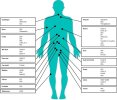
Here is a relevant graph relating each region to the specific marker(s) tested for. This is quite useful if anyone else wants to consult it for whatever reason, I think this information could realllllly help a lot of guys, preemptively.21E10D74-76E3-42B4-8ACB-378F467749A0.jpeg
 
Last edited:
Here is a relevant graph relating each region to the specific marker(s) tested for. This is quite useful if anyone else wants to consult it for whatever reason, I think this information could realllllly help a lot of guys, preemptively.View attachment 254708
Excuse me but how can this chart be helpful. Genuinely interested I have mild anxiety about my health and can go down rabbit holes. These are things I can have checked.
 
Excuse me but how can this chart be helpful. Genuinely interested I have mild anxiety about my health and can go down rabbit holes. These are things I can have checked.
Sure, I totally understand. Please don’t over freak out or anything though, I’m sure you are all plenty healthy and health-conscious if you’re on here reading. That is just a graph that represents different biomarkers for cancers based on specific regions of the body, that’s all! If abnormalities are found upon initially doing labs then one could investigate further, and select one or multiple the selections listed on that graph to screen for specific cancer(s).
 
Got it. yeah no I won’t freak out I appreciate it. No abnormalities in labs so no need going on a witch hunt for something. Thanks for sharing this
 
I was always under the impression that after using HGH when you stop there is no rebound on your natural IGF levels. I have just recently been doing more research on HGH bc I’m thinking about finally giving it a go and starting at 2iu and going up to 4iu after a month
 
id be interested in anecdotes of gh levels and IGF returning back to normal..

dont think any studies have been done on how much and how long suppression lasts... all I have seen is data on doping and ratio of gh "isomers"returning to baseline 4 days later iirc, dont know if levels have been done in healthy people. I think alot of bro science is based off of that.

also interested by what mechanism gh suppression would be minimal/short vs LH and FSH for example.

even more interesting would be GHRH levels pre and post GH use.

fortunately lower IGF/GH has benefits at least.
 
L
id be interested in anecdotes of gh levels and IGF returning back to normal..

dont think any studies have been done on how much and how long suppression lasts... all I have seen is data on doping and ratio of gh "isomers"returning to baseline 4 days later iirc, dont know if levels have been done in healthy people. I think alot of bro science is based off of that.

also interested by what mechanism gh suppression would be minimal/short vs LH and FSH for example.

even more interesting would be GHRH levels pre and post GH use.

fortunately lower IGF/GH has benefits at least.
donyou think running Hgh for 3 months at 2iu would even be worth any benefits? Or just stick with AAS
 
I was always under the impression that after using HGH when you stop there is no rebound on your natural IGF levels. I have just recently been doing more research on HGH bc I’m thinking about finally giving it a go and starting at 2iu and going up to 4iu after a month

I can't recall any specific studies but it's not like nuking your testicles with 500 mg testosterone/wk.

2-4 IU/d should be fine after discontinuation.
 
L

donyou think running Hgh for 3 months at 2iu would even be worth any benefits? Or just stick with AAS
far from an expert. but depends on goals I think.. if have some nagging injury maybe worth it. takes 3 months to start seeing benefits for most part other than possible sleep or wellbeing, so not really worth it unless want to loose a tiny bit of belly fat maybe.
 
Its honestly a great question, and a question I'm still trying to find the answer to myself. Its a question i need a definitive answer to before I start GH myself . Have heard anecdotal reports of IGF1 recovering after a few weeks, to a few months.

Obviously it varies by dosage use, length of time used, individual response, probably baseline IGF levels before starting it (for instance if you were on the lower side of the IGF range before starting the GH and ran the GH a while and discontinued, I'd imagine you'd be back to the lower end of the reference range, or perhaps even lower than before you had originally started)

The only way to really know is through bloodwork. I'm still trying to find more anecdotal reports with supported bloodwork to really get a good idea on how long it takes for IGF to bounce back
 
Its honestly a great question, and a question I'm still trying to find the answer to myself. Its a question i need a definitive answer to before I start GH myself . Have heard anecdotal reports of IGF1 recovering after a few weeks, to a few months.

Obviously it varies by dosage use, length of time used, individual response, probably baseline IGF levels before starting it (for instance if you were on the lower side of the IGF range before starting the GH and ran the GH a while and discontinued, I'd imagine you'd be back to the lower end of the reference range, or perhaps even lower than before you had originally started)

The only way to really know is through bloodwork. I'm still trying to find more anecdotal reports with supported bloodwork to really get a good idea on how long it takes for IGF to bounce back
I’m surprised there isn’t that many reports or ppls labors floating around these forums and the internet
 
Back
Top