Panama papers

Still no high profile dudes.
Just some old dudes with record .

This scandal remind back in 07 .

None of the high profiles bankers went to jail for those shity deals that pushed economy to collapse .
But tax payers took care of it. Like always.
I want to see those white collar luck up .
 
Last edited:
I doubt the leak has much to do with high profile bankers. More than likely it has everything to do with shoring up loopholes slightly less wealthy people might use to protect their assets. Look for a bill named after the Panama Papers in a congress near you. More than likely it will have even more restrictions on the transfer of cash internationally. Makes me want to buy more bits.
 
More than likely it will have even more restrictions on the transfer of cash internationally. Makes me want to buy more bits.
Obama set the stage a couple of weeks ago when he said government couldn't allow everyone to have a "Swiss bank account" in their pocket. And now the Panama Papers. I'm surprised there was no movement in bitcoin price. The obvious killer use case for a decentralized, pseudonymous, censorship-resistant blockchain cryptocurrency is store of value.
 

It wouldn't be surprising if Americans are the minority of individuals who used Mossack Fonsecca for offshore services. No conspiracy. Why? The simple explanation: Nevada, Wyoming and Delaware.

Other explanations:

My preliminary research suggest the reason we don't see many US interests implicated is due to them mostly doing business with Mossack Fonsecca's competition, mainly CSC and CT Corp • /r/PanamaPapers
 
Don't know about buying justice, but the ability to evade taxes is certainly a desirable, if not required, skill for people with wealth in this world. If wealth wasn't mobile, the governments would take it all. Anyway, McClatchy HAS released some of the Americans involved (pay special attention to the link at the end of the article):


Here Are Some Of The Americans In The "Panama Papers"
^^^
Heather Lowe, director of government affairs at Global Financial Integrity, said:

“I would expect the US to be highlighted for both prominent Americans who are using offshore companies and because Mossack Fonseca had what appears to be a network office in the state of Nevada,”

She added: “It is extremely easy, and legal, to create an anonymous company in any state in the US, but a few states are well-known for being open for anonymous business – Nevada, Delaware and Wyoming.”


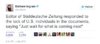
Matthew Ingram on Twitter: Editor of Süddeutsche Zeitung responded to the lack of U.S. individuals in the documents, saying "Just wait for what is coming next"

Mathew Ingram on Twitter
 

Attachments

  • suddeutsche-zeitung-americans.jpg
    suddeutsche-zeitung-americans.jpg
    28.4 KB · Views: 30
This is gettig interesting !
You think that if they go by name ; they likely wold pick/release name by the most or less profitable dudes !
 
Panama is the new Switzerland.
Actually, the United States is the new Switzerland. Panama may turn out to be a nice scapegoat:

Everyone from London lawyers to Swiss trust companies is getting in on the act, helping the world’s rich move accounts from places like the Bahamas and the British Virgin Islands to Nevada, Wyoming, and South Dakota.

How ironic—no, how perverse—that the USA, which has been so sanctimonious in its condemnation of Swiss banks, has become the banking secrecy jurisdiction du jour,” wrote Peter A. Cotorceanu, a lawyer at Anaford AG, a Zurich law firm, in a recent legal journal. “That ‘giant sucking sound’ you hear? It is the sound of money rushing to the USA.
Source: The World’s Favorite New Tax Haven Is the United States (January 27, 2016)
 
Sorry about the missing twitter content. It never seems to display correctly here.

Shots Fired: Wikileaks Accuses Panama Papers' Leaker Of Being "Soros-Funded, Soft-Power Tax Dodge"

Tyler Durden on 04/05/2016 23:44 -0400

Earlier today, for the first time we got a glimpse into some of the American names allegedly contained in the "Panama Papers", largest ever leak. "Some", not all, and "allegedly" because as we said yesterday, "one can't help but wonder: why not do a Wikileaks type data dump, one which reveals if not all the 2.6 terabytes of data due to security concerns, then at least the identities of these 441 US-based clients. After all, with the rest of the world has already been extensively shamed, it's only fair to open US books as well."

The exact same question appeared in an interview conducted between Wired magazine and the director of the organization that released the Panama Papers, the International Consortium of Investigative Journalists, or ICIJ, Gerard Ryle.

This is what Ryle said:

Ryle says that the media organizations have no plans to release the full dataset, WikiLeaks-style, which he argues would expose the sensitive information of innocent private individuals along with the public figures on which the group’s reporting has focused. “We’re not WikiLeaks. We’re trying to show that journalism can be done responsibly,” Ryle says. He says he advised the reporters from all the participating media outlets to “go crazy, but tell us what’s in the public interest for your country.”​

Question aside about who it is that gets to decide which "innocent private individuals" are to be left alone, Wikileaks clearly did not like being characterized as conducting "irresponsible" journalism - and to the contrary, many in the public arena have called for another massive, distributed effort to get to the bottom of a 2.4TB treasure trove of data which a handful of journalists will simply be unable to dig through - and moments ago, on Twitter, accused the ICIJ of being a "Washington DC based Ford, Soros funded soft-power tax-dodge" which "has a WikiLeaks problem."


Moments later, in a subsequent tweet it added that the "Putin attack was produced by OCCRP which targets Russia & former USSR and was funded by USAID & Soros."


And so, a new contest is born: one between the "old" source of mega leaks, and the new one. We wonder if and when Edward Snowden and/or Glenn Greenwald will also chime in.

But we are far more interested if now, that there appears to be a war brewing between Wikileaks and ICIJ, who what "information" will be released next, and whether whatever comes out will put the entire Panama Papers project in a different perspective, one which, as even Bloomberg has hinted, may have been to benefit the last remaining global tax haven around, the United States itself, as well as the most notorious provider of "tax haven" services in in said country: Rothschild.

full article
 
Panama Papers Leak Casts Light on a Law Firm Founded on Secrecy

By KIRK SEMPLE, AZAM AHMED and ERIC LIPTON
APRIL 6, 2016

Excerpt:

But several tax experts pointed out that Panama, in its refusal to comply with international transparency standards, is in esteemed company: the United States.

Foreign nations have had trouble getting information about accounts their citizens hold in America as well.

“Panama isn’t the real story,” said Matt Gardner, the executive director of the Institute on Taxation and Economic Policy, a research group based in Washington. “This leak is giving a window into a much broader world, but it should be understood as giving a window into how things work in the U.S. as well.”

Read more: http://www.nytimes.com/2016/04/07/w...s-light-on-a-law-firm-founded-on-secrecy.html
 
Panama Papers Reveal Clinton’s Kremlin Connection
John and Tony Podesta aren’t fooling anyone

By John R. Schindler • 04/07/16 1:00pm

Panama Papers Reveal Clinton’s Kremlin Connection

gettyimages-519458340.jpg

Democratic presidential candidate Hillary Clinton. (Photo: Jeff Swensen/Getty Images)

The revelations of the so-called Panama Papers that are roiling the world’s political and financial elites this week include important facts about Team Clinton. This unprecedented trove of documents purloined from a shady Panama law firm that arranged tax havens, and perhaps money laundering, for the globe’s super-rich includes juicy insights into how Russia’s elite hides its ill-gotten wealth.

Almost lost among the many revelations is the fact that Russia’s biggest bank uses The Podesta Group as its lobbyist in Washington, D.C. Though hardly a household name, this firm is well known inside the Beltway, not least because its CEO is Tony Podesta, one of the best-connected Democratic machers in the country. He founded the firm in 1998 with his brother John, formerly chief of staff to President Bill Clinton, then counselor to President Barack Obama, Mr. Podesta is the very definition of a Democratic insider. Outsiders engage the Podestas and their well-connected lobbying firm to improve their image and get access to Democratic bigwigs.

Which is exactly what Sberbank, Russia’s biggest financial institution, did this spring. As reported at the end of March, the Podesta Group registered with the U.S. Government as a lobbyist for Sberbank, as required by law, naming three Podesta Group staffers: Tony Podesta plus Stephen Rademaker and David Adams, the last two former assistant secretaries of state. It should be noted that Tony Podesta is a big-money bundler for the Hillary Clinton presidential campaign while his brother John is the chairman of that campaign, the chief architect of her plans to take the White House this November.

Sberbank (Savings Bank in Russian) engaged the Podesta Group to help its public image—leading Moscow financial institutions not exactly being known for their propriety and wholesomeness—and specifically to help lift some of the pain of sanctions placed on Russia in the aftermath of the Kremlin’s aggression against Ukraine, which has caused real pain to the country’s hard-hit financial sector.

It’s hardly surprising that Sberbank sought the help of Democratic insiders like the Podesta Group to aid them in this difficult hour, since they clearly understand how American politics work. The question is why the Podesta Group took Sberbank’s money. That financial institution isn’t exactly hiding in the shadows—it’s the biggest bank in Russia, and its reputation leaves a lot to be desired. Nobody acquainted with Russian finance was surprised that Sberbank wound up in the Panama Papers.

Although Sberbank has its origins in the nineteenth century, it was functionally reborn after the Soviet collapse, and it the 1990s it grew to be the dominant bank in the country, today controlling nearly 30 percent of Russia’s aggregate banking assets and employing a quarter-million people. The majority stockholder in Sberbank is Russia’s Central Bank. In other words, Sberbank is functionally an arm of the Kremlin, although it’s ostensibly a private institution.

Certainly Western intelligence is well acquainted with Sberbank, noting its close relationship with Vladimir Putin and his regime. Funds moving through Sberbank are regularly used to support clandestine Russian intelligence operations, while the bank uses its offices abroad as cover for the Russian Foreign Intelligence Service or SVR. A NATO counterintelligence official explained that Sberbank, which has outposts in almost two dozen foreign countries, “functions as a sort of arm of the SVR outside Russia, especially because many of its senior employees are ‘former’ Russian intelligence officers.” Inside the country, Sberbank has an equally cosy relationship with the Federal Security Service or FSB, Russia’s powerful domestic intelligence agency.

Ukraine has pointed a finger at Sberbank as an instrument of Russia’s aggression against their country. In 2014, Ukraine’s Security Service charged Sberbank with “financing terrorism,” noting that its branches were distributing millions of dollars in illegal aid to Russian-backed separatists fighting in eastern Ukraine. Kyiv’s conclusion, that Sberbank is a witting supporter of Russian aggression against Ukraine, is broadly supported by Western intelligence. “Sberbank is the Kremlin, they don’t do anything major without Putin’s go-ahead, and they don’t tell him ‘no’ either,” explained a retired senior U.S. intelligence official with extensive experience in Eastern Europe.

In addition, Ukrainian intelligence has alleged that the FSB collaborated with Sberbank in the bombings of two of the bank’s branches in Kyiv, Ukraine’s capital, in June 2015. The attacks caused no casualties but got major coverage in Russian state media as “proof” of Ukraine’s instability and violent anti-Russian nature. Although the notion that Russian spies would plant bombs as a provocation, what the Kremlin terms provokatsiya, may sound outlandish to those unacquainted with espionage, in fact Russian spies have been doing such things since tsarist times. What I’ve termed “fake terrorism” is a longstanding Kremlin core competency, and it can only be pulled off with logistical support, including with finances.

Predictably, Sberbank has blown off the Panama Papers revelations as nothing of consequence, but the fact that they are an arm of the Kremlin and they do plenty of shady things in many countries is a matter of record. As is the fact that the Podesta Group is their lobbyist in America.

Among the Sberbank subsidiaries that the Podesta Group also represents are the Cayman Islands-based Troika Dialog Group Limited, the Cyprus-based SBGB Cyprus Limited, and the Luxembourg-based SB International. As reported this week by the Organized Crime and Corruption Reporting Project, a consortium of journalists exploring the Panama Papers leak, Sberbank and Troika Dialog are used by members of Mr. Putin’s inner circle to shift public funds into sometimes questionable private investments. In other words, this is top-level money laundering of a brazen kind. As the OCCRP stated plainly, “Some of these companies were initially connected to the Troika Dialog investment fund, which was controlled and run by Sberbank after the bank bought the Troika Dialog investment bank. Troika and Sberbank declined to comment.”

Adding to shadiness of all this, the Podesta Group is playing along with the useful charade that Sberbank is simply a private financial institution, rather than the state-owned bank that it is, since that would require the lobbyists to register as agents of the Russian government under the Foreign Agent Registration Act.

John and Tony Podesta aren’t fooling anyone with this ruse. They are lobbyists for Vladimir Putin’s personal bank of choice, an arm of his Kremlin and its intelligence services. Since the brothers Podesta are presumably destined for very high-level White House jobs next January if the Democrats triumph in November at the polls, their relationship with Sberbank is something they—and Hillary Clinton—need to explain to the public.

 
Back
Top