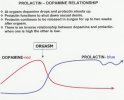
It's not a myth, it's the average (mean & mode) response to see a libido increase, but there is interindividual variation due to factors including E2 => PRL synthesis - as pointed out above, prolactin can suppress libido (the solution is mitigating excess aromatization).
Test (and its 5a-reductase product, DHT) is responsible primarily for the sex-related difference in libido.
All androgens (synonym: AAS) have a class effect of increasing libido (androgenicity refers in part to augmenting male secondary sexual characteristics); and women consistently experience this (because their background androgen exposure is lower & more sensitive to novel stimuli, probably).
Naturally, we all know individual women that are hornier than a lot of men (these are outliers, nearer to the upper-right portion of the bell curve). If you can visualize or think in terms of population-wide normal distributions ("bell curves", two functions plotted for men & women) and draw generalizations (i.e., the "stereotypical male vs female sex drive"), you can start to think more clearly about relative outliers (>+3 standard deviations). Hormones (e.g., during the menstrual cycle, the late follicular phase just prior to ovulation is characterized by high LH & T, low PROG & declining E2, increasing FSH) and dopamine metabolism/function are likely contributors to their relatively high libido.