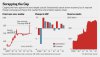
Impact of Swiss National Bank Decision to Remove Cap on CHF-EUR Exchange Rate

Millard

Member
Staff member
10+ Year Member
20+ Year Member
Swiss franc's ascent will hurt home economy, but also raises uncertainties for global business

Jan. 16, 2015

By PAN PYLAS, Associated Press

LONDON (AP) — A 30 percent swing in a blink of an eye is not uncommon in the stock market. In the world of currencies, it can seem as rare as Halley's Comet.

But that's what happened to the Swiss franc on Thursday — a stunning move that is likely to hurt the Swiss economy, inject uncertainty in financial markets and even darken the global outlook.

Within minutes of the Swiss National Bank's announcement it was ditching a policy to limit the rise of the currency, the franc had rocketed by about a third against the euro and the dollar. Unprecedented, said analysts.

Though it has since shed some of those gains, the Swiss franc remains sharply higher and that spells a host of problems....

Source: http://www.usnews.com/news/business...ncs-staggering-ascent-to-be-felt-far-and-wide
 
I spoke to my friend when the Swiss pegged their currency and questioned if this was part of a global currency war. I am no way familiar with this type of "gambling" but knew it to be dangerous by the ability to highly leverage a wager. Someone lost a shit load, but SOMEONE made a boat load!

Swiss Franc Bets Turned on a Dime
http://www.wsj.com/articles/swiss-franc-bets-turned-on-a-dime-1421453922

When Simon Mammon turned on his computer at 4:30 a.m. Thursday to check his trading portfolio, the owner of the Simon Sips cafe in Midtown Manhattan was just in time to see his bet on the Swiss franc implode.

The trade—a wager that the franc would weaken against the euro—had fluctuated by about $40 over the previous three weeks. That morning, it plunged by thousands of dollars after the http://quotes.wsj.com/SNBN.EBannounced it would no longer prevent the franc from rising, instantly sending the currency up 30% against the euro after three years of stability.

“I was literally still in bed,” said Mr. Mammon, 51 years old. “I’m trying to understand why all of a sudden it was down $2,500. When I looked away and looked back again it was five or six times that.”

Mr. Mammon—who says he had juiced his bets by borrowing 20 times the amount of his original investment—sustained losses that day “well into the five figures.” He was far from alone among retail, or individual, investors hit by the giant swing in the Swiss franc against the euro and dollar. Some of them had staked large sums using just tiny amounts of cash. It was a rare event that revived long-standing investor complaints about the retail foreign-exchange market.

Investors and analysts say the fallout is a major black eye for an industry that has struggled to escape a bad reputation—as a haven for unsound practices that is frequented by unscrupulous operators and novice traders who unwittingly amplify the risk of losing their stakes by using huge sums of borrowed money, or leverage.

“Historically, a lot of the FX brokers have been notoriously shady,” said Larry Tabb, founder and chief executive of the Tabb Group, a research firm. The industry “has come a long way…in creating a reputable product.”

Retail traders span the globe, from New York to Tuscaloosa, Ala., to Kuala Lumpur. Lively communities fill online message boards devoted to currency trading; one thread about the euro-dollar trade contains over 950,000 posts dating back 11 years.

Of the estimated four million retail foreign-exchange traders world-wide, the majority are in Europe and Asia, with only 150,000 in the U.S., according to data from Citigroup Inc. Most are male, with a median age of 35.

Just 30% achieve monthly positive returns, the data showed. About two-thirds of U.S. clients at http://quotes.wsj.com/FXCMInc., the broker that was rescued Friday by a $300 million loan fromhttp://quotes.wsj.com/LUKCorp. , lose money each quarter, according to filings.

Some experts believe the losses suffered by “mom and pop” investors will bring more scrutiny to this corner of the $5 trillion-a-day foreign-exchange market, where risk is high and rewards elusive.

Brokers allow traders to place bets of as much as 50 times their initial deposits in the U.S., quickly magnifying small currency moves into sizable gains or losses. In Europe and parts of Asia, leverage can reach 200 to 1, or higher.

“This is certainly going to spark regulator review, specifically regarding leverage,” said Richard Repetto, an analyst at Sandler O’Neill + Partners.

A spokesman for the Commodity Futures Trading Commission, FXCM’s primary regulator in the U.S., said the agency is reviewing the company’s situation but declined to elaborate.

This past week, some firms in Russia and New Zealand also faced woes, stopping trading or going into insolvency. Many retail traders said they experienced problems processing trades and withdrawing their money at other retail brokerages, as well.

The news hit in the middle of the night for San Francisco-based Joshua Garrison, a former broker at FXCM. He now trades for his own firm, PoseidonFX, which offers research and trading tips to retail investors who are members of the site.

His firm had just, on Wednesday, made a bet that the euro would rise against the Swiss franc, after seeing the franc approach its cap of 1.20 to the euro. It was a wager they had made before without issue, he said.

Around 1:30 a.m. Pacific time, Mr. Garrison got a call from PoseidonFX’s co-founder, Alex Boyd, another former FXCM broker. Mr. Boyd was in a panic after getting the alert that the trade was going haywire.

It took four minutes for them to confirm they had unwound the trade, compared with the typical seconds. “We had to keep checking and refreshing” the computer screen, Mr. Garrison said.

Their broker, CitiFX Pro, a unit of Citigroup, sent an email two hours later advising clients they might revise the executed trades to reflect worse pricing than they initially received. If that happens, their losses could grow to $50,000, Mr. Garrison says.

Duane Sloan, 49, a certified public accountant and former mayor of Wildwood, N.J., placed a bet through Toronto-based broker Oanda Corp. at 3:47 a.m. Thursday morning that the franc would rise against the yen. He was trading about 16,000 francs at 50-to-1 leverage.

Fighting insomnia, he said he had looked at the chart of the two currencies on his iPhone and reckoned the franc was due to tick higher. His account balance went from $361 to $2,703 in the space of an hour.

“To be completely honest, it was luck,” Mr. Sloan said.

When he tried to close out the trade on his phone, he initially was unable to, because the broker had halted any transactions tied to the Swiss franc, he said. About 15 minutes later, “I could walk away and count myself lucky,” Mr. Sloan said.
 
Last edited:
If it walks like a duck and quacks like a duck . . .
http://www.themoneyillusion.com/?p=28393

Whenever something really bizarre happens some people look for deep explanations. Conspiracy theories. There must be inside information. Etc., etc. Sorry, but sometimes the obvious explanation is the right one.

Yesterday I read dozens of comments from pundits all over the world on the SNB’s surprise abandonment of the currency peg. Every single one thought it was a stupid move. The markets thought it was a stupid move. I thought it was a stupid move.

Many of the theories I see commenters putting forward are based on public information. Keep in mind that everyone knew the ECB was likely to do QE. That was already priced into the euro/dollar exchange rate. And the markets still expect deflation in the eurozone, despite the recent depreciation of the euro caused by expectations of QE.

The explanation for the SNB move is quite simple—stupidity. It’s stupid to throw away 3 1/3 years of credibility. I won’t even say “hard-earned credibility,” as it was pathetically easy to peg the SF for 3 1/3 years. The SNB will now miss their price level target. (Actually they were already going to miss it—the currency was too strong at 1.2.) They’ve also thrown away one of their most powerful monetary policy tool, exchange rates. They will now rely more on QE, exactly what they were trying to avoid with the currency peg. Even if they thought the SF needed to be a bit stronger for some bizarre reason, why not appreciate it by 5% and then re-peg? Why let the SF rise by more than 15% against a currency that is itself plunging into deflation? That makes no sense.

I sometimes receive back channel communication from very-well informed people in Europe. Believe me, just as with the earlier nonsense in Sweden, there is no “rational explanation.” People are appalled.

But there is a lesson here. Just as war is too important to leave to the generals, monetary policy is too important to leave to the central bankers. Once again we see the markets are way ahead of the central bankers. One more example of why we need market monetarism. Let markets determine the money supply, interest rates and exchange rates. Peg your currency to NGDP futures prices. And if you are not going to do that, then for God’s sake level target SOMETHING.

PS. After writing this post I came across a Tyler Cowen post that speculates the SNB might know something we don’t know. I could not disagree more strongly. There are very few secrets in the world of central banking. The Swedes didn’t know something we don’t know a few years ago when they foolishly tightened to stop “bubbles.” Nor did the ECB when they tightened monetary policy sharply in 2011. Nor did the BOJ when they tightened in 2000 and again in 2006. Tyler says the following:

The Swiss central bank, had it continued the peg, probably would have had a balance sheet larger than Swiss gdp. But does this matter?”

Actually, growth of the balance sheet slowed sharply after they adopted the 2011 peg. Without the peg they’ll have to rely on QE. So Tyler’s worry about the size of the balance sheet is actually an argument for keeping the peg. (And/or also an argument for a higher inflation target in Switzerland.)

PS. If you’ve ever wanted to boss me around, here’s your chance. (If MF or Ray get the job, I’ll shoot myself.)
 
WO-AV164_SNB_16U_20150115184536.jpg

Surge of Swiss Franc Triggers Hundreds of Millions in Losses

http://www.wsj.com/articles/swiss-franc-move-cripples-currency-brokers-1421371654

Banks, brokers and individual investors were left with hundreds of millions of dollars in losses a day after an unexpected surge in the Swiss franc sent shock waves through markets.

http://quotes.wsj.com/FXCMInc., a major U.S. retail foreign-exchange broker, emerged as the biggest victim so far and had to be rescued by an emergency $300 million lifeline from investment firm http://quotes.wsj.com/LUKCorp.

Shares of FXCM, one of the largest retail currency brokers in the world, were suspended on the New York Stock Exchange on Friday after the company said client losses on Swiss franc trades threatened to put it in violation of regulatory capital rules.

The two-year loan, with an initial interest rate of 10%, is “designed to maintain FXCM’s financial strength and allow it to prosper going forward,” said Leucadia Chief Executive Richard Handler .

FXCM didn’t respond to a request for comment.

Other firms were hit when the Swiss currency jumped by nearly 30% against the euro and 18% against the dollar in the minutes following the http://quotes.wsj.com/SNBN.EB’s decision to stop reining in the value of the franc against the euro.

Citigroup Inc. and http://quotes.wsj.com/DBK.XEAG will each lose about $150 million on the franc’s appreciation, said people familiar with the firms. Goldman Sachs Group Inc. said Friday that the franc’s move will be immaterial to its earnings. Losses at http://quotes.wsj.com/BARC.LNPLC will be in the tens of millions of dollars, people familiar with the bank said.

Among hedge funds suffering losses: Discovery Capital Management LLC, a South Norwalk, Conn., firm that manages $14.7 billion, and Comac Capital LLP, which oversees $1.2 billion in London. Comac was down roughly 8%, according to a person familiar with the firm.

Losses could be reversed, but the setbacks are the latest for Discovery and Comac. Comac has been roughly flat the past two years, while Discovery ended last year down more than 3% in its flagship fund, after largely recovering from a double-digit-percentage loss early in 2014, according to people familiar with the firms. Bloomberg News earlier reported Comac’s loss.

Meanwhile, staff for members of the Financial Stability Oversight Council, a group of senior U.S. regulators, spoke by phone Friday to discuss the market’s reaction and the impact on specific financial institutions, according to a person familiar with the call. The discussion didn’t suggest there was an immediate threat to the financial system, this person said.

FXCM was founded in 1999 as one of the first currency brokerage firms to serve retail customers. In recent years, the company has expanded by acquiring weaker rivals, as a yearslong period of modest swings in foreign-exchange markets led to reduced trading and industry consolidation.

At the center of this week’s turmoil, analysts said, was the use by FXCM clients of borrowed money, or leverage. FXCM kept lower margin requirements, or the amount held as collateral for a loan, than its competitors, analysts said, a practice that enabled traders to boost returns by using borrowed money.

For years, foreign-exchange brokerages that catered to mom-and-pop investors operated outside significant oversight and were magnets for potential fraud. That all changed with the 2010 Dodd-Frank financial-overhaul law, which for the first time gave the Commodity Futures Trading Commission regulatory authority over the brokerages.

FXCM was among several firms that fought CFTC efforts to limit leverage at 10 to 1, saying in a March 2010 letter the proposal would have a “devastating impact on the retail [foreign-exchange] industry” and “drive it largely overseas.” The letter was signed by FXCM Chief Executive Drew Niv and eight other brokerage CEOs. The limit eventually was set at 50 to 1, meaning an investor could borrow $50 for every dollar put in.

On Thursday, a unit of Chicago-based exchange and clearinghouse operator CME Group Inc. tripled margin requirements for traders using futures tied to the Swiss franc, according to an advisory notice it sent to clearing members and risk managers.

Rick Smallwood, 43 years old, a technology consultant living in Belize, began trading in Swiss francs last summer at FXCM. He said he held a stop-loss order that aimed to benefit from the franc’s depreciation but would cap his losses if the franc appreciated beyond 0.97 francs per dollar. A stop-loss order is placed with a broker to sell a security when it reaches a certain price. The franc traded Wednesday at 1.02 per dollar.

News of the Swiss National Bank’s decision broke early Thursday morning in Belize. By the time Mr. Smallwood had finished his morning coffee, the franc had soared past his stop-loss order, exposing him to losses. FXCM sold off his position, a dollar amount he puts in the five figures, at 0.88 francs on the dollar.

Mr. Smallwood, who doesn’t use any leverage on his account, typically limits his positions to 1% of his total assets. He said he lost close to 5% of his account on the franc trade.

Mr. Smallwood, who said he is shifting his assets around to other brokers and other markets, blamed the problems at FXCM in part on other traders who use borrowed money in a bid to bolster returns.

“A lot of currency brokers are becoming insolvent because they’re letting people lever up so much,” he said. “There are people who trade responsibly that are exposed to more risk.”

On Friday, both the dollar and euro gained about 2% against the franc, after ending Thursday down 21% and 23%, respectively.

FXCM went public on Dec. 3, 2010, raising $211 million at $14 a share. But FXCM’s shares performed poorly. The stock fetched $12.63 at Thursday’s close and was down about 70% in after-hours trading Friday, at $3.75.

Matthew Wilhelm, principal at Lucid Markets Trading Ltd., an electronic-trading firm, sold 481,228 shares of FXCM in November, according to SEC filings. In June 2012, FXCM purchased a 50% controlling stake in Lucid Markets for $176 million, and Mr. Wilhelm received 5,284,045 shares as part of that deal, according to SEC filings. He didn’t return calls seeking comment.

Another big stockholder of FXCM has also sold large amounts of shares in recent months. Michael Romersa, one of the firm’s founding partners and a former executive, sold 236,193 shares from Dec. 19 to Jan. 9, according to SEC filings.

“I wanted the cash, so I sold some,” Mr. Romersa said. “I’m 68 years old. What am I going to wait for, until I’m 78?”

 
One fund manager alone (Marko Dimitrijevic) lost $830 million - more than 1/3 of his company's assets:

“The losses will be in the billions -- they are still being tallied,” said Mark T. Williams, an executive-in-residence at Boston University specializing in risk management. “They will range from large banks, brokers, hedge funds, mutual funds to currency speculators. There will be ripple effects throughout the financial system.”

Citigroup, the world’s biggest currencies dealer, lost more than $150 million at its trading desks, a person with knowledge of the matter said last week. Deutsche Bank lost $150 million and Barclays less than $100 million, people familiar with the events said, after the Swiss National Bank scrapped a three-year-old policy of capping its currency against the euro and the franc soared as much as 41 percent that day versus the euro. Spokesmen for the three banks declined to comment.

Marko Dimitrijevic, the hedge fund manager who survived at least five emerging-market debt crises, is closing his largest hedge fund, which had about $830 million in assets at the end of the year, after losing virtually all its money on the SNB’s decision, a person familiar with the firm said last week.

...

Pain from wrong-way bets may not be limited to just the financial industry.

“We’re just hearing about financial institutions now,” Philip Guarco, global head of fixed-income strategy at JPMorgan Private Bank, said in an interview on Bloomberg Television. “Remember what happened back in 2009, when the dollar rallied? You actually had major corporates in Mexico and Brazil, where the treasury departments were taking positions in FX. So we haven’t heard the end of it yet.”
Source: Bank Losses From Swiss Currency Surprise Seen Mounting
 
Another guess at why the SNB did what it did:

There are lots of theories as to why the central bank chose to act, but there is one that was clearly underappreciated — the role of Swiss local government in lobbying for dividend payments.

The SNB is unlike other central banks because it is not in fact owned by the Swiss government but is a listed company with shareholders that include Swiss administrative regions, know as cantons, as well other public bodies and private individuals.

Source: Here Are The Behind-The-Scenes Politics In The Decision To Let The Swiss Franc Cause Market Chaos
 
http://www.nysun.com/editorials/the-doughty-swiss/89007/
Editorial of The New York Sun | January 17, 2015

Congratulations to the doughty Swiss, we say. The decision of their central bank to remove the cap on its currency, allowing it to soar against the Euro, is causing the foreign exchnge markets to be struck with the dreaded turbulence. It may well make things difficult for Switzerland in the short run. But it was a vote of no confidence in the quantitative easing that the European Central Bank is about to undertake. It may have put some starch into the Germans, to whom the ECB just bowed by saying it will do its quantitative easing without making taxpayers responsible for losses.

All other virtues of this drama aside, what a paroxysm of panic it has produced at the Financial Times, which has declared that “Thursday’s action in the Swiss franc defies the reach of hyperbole.” We haven’t heard such a primal scream from the FT since Prime Minister Thatcher cut taxes (at that juncture the Wall Street Journal consoled its competitor with an editorial called “Cheer Up, Lads”). The FT calls the Swiss National Bank’s move “a poor advertisement for Swiss reliability.” It suggests the Swiss demarche is “all the more remarkable” because the currency is “prized for its stability.”

We’re not sure “stability” is the word we’d have used for either the Swiss franc or the euro, or, for that matter, the dollar. The latter has lost more than 78% of its value since the start of the century (this morning it was worth but a 1,280th of an ounce of gold). A long-term chart of the Swiss franc shows that it (and the Euro) have kept pace with the dollar in this decline. Gold hasn’t changed its policies once during this period. Its quantity hasn’t changed a whole lot; it’s still inert; and hasn’t anybody found any world-shaking new industrial uses for the silent money. Not even the FT can blame the instability on gold.

The bitter truth is that all the sturm and drang over the Swiss franc is a feature of the age of fiat money. The exclamations of horror that have greeted the decision of one tiny country to stop playing the same game as the bigger countries testify to nothing so much as the absurdity of the fiat system. We’ve never understood the virtues of any country running down the value of its money. We’ve long felt that one country or another — Switzerland, Israel, Britain . . . someone — just ought to stop issuing its currency by fiat and return to a classical system. Wouldn’t it be something if it turns out that Switzerland has taken the first step.
 
The Swiss Declare War
By Bionic Mosquito
Tuesday, January 20, 2015

Well, that is what one might conclude after the events of the last week. As is well-known, the Swiss National Bank decided to remove the peg/floor in the exchange rate for the Franc against the Euro. This move was made suddenly, with no announcement or even a hint beforehand.

There is so much wailing and gnashing of teeth in the financial media. There is much I might say about this event; I will use the writing of two of the more prolific economic financial writers of today to help me on my way. Both John Mauldin and Ambrose Evans-Pritchard (with two pieces, here and here) have written about this event; they each offer comments worth addressing – comments that help give context to some of my thoughts. (Forgive me as I will write in the language of the macro-economist; using their own words, the failure of their logic can be demonstrated.)

Ambrose offers his analysis:

The Swiss National Bank has lost control.
Think about this…while the SNB allowed the ECB to dictate monetary policy for the Franc, the SNB had control; now that the SNB has decided an independent policy, it doesn’t have control. What? This passes for logic?

John Mauldin regularly writes about currency wars (describing the Swissie as “The First Casualty of the Currency Wars”), as if a currency war is something new to this generation. It isn’t. As long as money can be manipulated by fiat, there have been currency wars; as long as mercantilism has been official economic policy, there have been currency wars.

He offers the standard eulogy to the death of a weak currency:

Every bank and business that held non-Swiss-franc debt or investments took an immediate 15–20%+ haircut on its holdings. Swiss investors lost at least 10% on investments in their own stock market and more on shares they held in other stock markets.
In Swiss Franc terms, this is true. However, 100% of the holders of Swiss Francs saw a tremendous gain on their holdings – of course, not in Swiss Franc terms, but relative to the wealth of everyone not holding Swiss Francs. Denominated in dollars, Euros, Yen, Pounds, and even gold, the Swiss are much wealthier today than a week ago. This is a great trade-off.

It gets even better, although you wouldn’t know it to read Mauldin:

Forty percent of Swiss exports go to the Eurozone, and the Swiss franc is now over 30% higher than it was five years ago – with almost half that movement coming in one day. Those exporters just got hammered.
Ambrose chimes in:

…the howls of protest this morning from the Swiss export sector. Nick Hayek, head of Swatch Group, said the collapse of the floor would cause havoc. "Words fail me. Today's SNB action is a tsunami; for the export industry and for tourism, and for the entire country," he said.​

This is the tired old “a cheap currency is good for exports” line. It might be good for specific companies (and one or two CEOs can always be trotted out to express this view). But what about the other side? Only a small portion of all goods and services produced in Switzerland are exported (net exports of about 5% of GDP). Meanwhile, 100% of all goods and services consumed by people in Switzerland are either produced in Switzerland or imported; well, at least I am pretty sure about this. Therefore, for a small percentage of the population (those producing for export), one could argue (although even here I disagree) that a cheaper currency is helpful; for the entire population, a stronger currency is beneficial.

From Ambrose:

The franc surged 30pc against the euro in early trading after the Swiss National Bank stunned traders by scrapping its three-year currency floor and freeing the exchange rate…
So a Swiss resident could buy 30% more goods from Europe for the same amount of Francs, and the same amount of goods from Switzerland. They can buy more stuff for the same Franc, yet somehow this makes the Swiss poorer?

And why do I disagree on the export side? In order to produce, one must consume. Where do Swiss exporters buy the goods and raw materials necessary to produce? While Switzerland is a net exporter, it imports CHF 15B / month while exporting CHF 17.5B / month. Someone has to pay for those imports before they can export.

Once a manufacturer consumes existing inventory, it now must go to market and compete against those able to buy with other currencies. Better to compete with a stronger currency, I think.

If you don’t believe me, try this: Mauldin cites his good friend, Charles Gave:

They [the SNB] didn’t mind pegging the Swiss franc to the Deutsche mark, but it is becoming more and more obvious that the euro is more a lira than a mark.

But the Swiss, not being as smart as the Italians, do not believe in devaluations. You see, in Switzerland they have never believed in the ‘euthanasia of the rentier’, nor have they believed in the Keynesian multiplier of government spending, nor have they accepted that the permanent growth of government spending as a proportion of gross domestic product is a social necessity.

Of course, the Swiss are paying a huge price for their lack of enlightenment. For example, since the move to floating exchange rates in 1971, the Swiss franc has risen from CHF4.3 to the US dollar to CHF0.85 and appreciated from CHF10.5 to the British pound to CHF1.5. Naturally, such a protracted revaluation has destroyed the Swiss industrial base and greatly benefited British producers [not!]. Since 1971, the bilateral ratio of industrial production has gone from 100 to 175...in favor of Switzerland.

The last time I looked, the Swiss population had the highest standard of living in the world – another disastrous long-term consequence of not having properly trained economists of the true faith.
The same could be said for Germany and (until very recently) Japan – in both cases a stronger currency and a net-export economy was not mutually exclusive.

It seems the Swiss only went dopey when they announced the peg (well, also maybe when they de-linked the Swissie from gold).

Mauldin goes on to bemoan the plight of the borrowers – debt becomes more difficult to service if the currency becomes stronger. As if protecting those who choose to consume more than they produce is the only sound economic theory around.

Ambrose feels sorry for the poor central banker:

The SNB has to pick its poison. It is damned for one set of reasons if it holds the currency peg, and damned for another set if it ditches the peg. Welcome to the world of horrible dilemmas facing modern central banks.
Poor babies. I have a solution! Money and credit could just be left to markets; what about that idea?

On a slightly different topic, but equally important: Mauldin also introduces the reality of the default already taking place in the United States, and which could also be deployed everywhere (citing Will Denyer):

rest of the article
 
Back
Top