Budget 2012+/-

Michael Scally MD

Doctor of Medicine
10+ Year Member
Paul Ryan's slasher novel
Opinion: Paul Ryan's slasher novel - Michael Kinsley - POLITICO.com

MICHAEL KINSLEY
4/12/11

The fiscal savior of this country will be the person who persuades us to bite the bullet: Accept some pain now to remain prosperous later. That person will not be Rep. Paul Ryan.

The reviewers agree: The Path to Prosperity, http://budget.house.gov/UploadedFiles/PathToProsperityFY2012.pdf , aka the Republican budget proposal for 2012 that was released a week ago by the House Budget Committee — which Ryan chairs — is one helluva read. To liberals, it’s the nightmare of a madman with an ax chasing you down a long hallway. To conservatives, it’s a sweet dream of wonderland, where angels dine on Heritage Foundation press releases. Right or wrong, it is said, Ryan has at last set the stage for an honest debate about government spending and the federal deficit.

But he hasn’t. The Path to Prosperity purports to be something that’s been missing since Ronald Reagan’s first inaugural address in 1981. For 30 years, Republicans have demanded a balanced budget without producing one, even on paper. What would it look like? Whose ox would be gored? Whose chickens would come home to roost? Whose goose would be cooked? Ryan continues the long GOP tradition of evading these unpleasant questions. You would think, reading the document, that the only reason we have fiscal problems is the willful perversity or ignorance of everybody but Ryan. He admits to no ordeal or challenge. In effect, he claims he can painlessly cut $5.8 trillion from federal spending in the next decade. How has Ryan built his reputation as a hero of fiscal discipline? Here are some of his techniques. Watch closely.
 

Attachments

Last edited:
Re: Budget 2012+

Historic Spending Cuts the Centerpiece for Final Continuing Resolution (CR) for Fiscal Year 2011
http://appropriations.house.gov/index.cfm?FuseAction=PressReleases.Detail&PressRelease_id=285


WASHINGTON, D.C. – The final Continuing Resolution (CR) legislation for fiscal year 2011 unveiled today by House Appropriations Chairman Hal Rogers contains historic spending cuts of nearly $40 billion, and will provide funding to keep the federal government operating for the remainder of the fiscal year. The passage of the bill in the House and Senate will mark the end of an arduous and long-overdue budget process initiated by the failure of the previous Democrat-controlled Congress to pass a budget or enact a single one of the 12 annual Appropriations bills last year.

“Never before has any Congress made dramatic cuts such as those that are in this final legislation. The near $40 billion reduction in non-defense spending is nearly five times larger than any other cut in history, and is the result of this new Republican majority’s commitment to bring about real change in the way Washington spends the people’s money,” Chairman Rogers said.

“My committee went line-by-line through agency budgets this weekend to negotiate and craft deep but responsible reductions in virtually all areas of government. Our bill targets wasteful and duplicative spending, makes strides to rein in out-of-control federal bureaucracies, and will help bring our nation one step closer to eliminating our job-crushing level of debt.” Chairman Rogers continued.
 
Are We Moving Beyond the Welfare State?
Yuval Levin’s new essay in the current National Affairs, “Beyond the Welfare State”, endorses a new vision of radical reductions in government’s social insurance function. In a new series, David Frum examines Levin’s ideas and the implications for politics and policy.
http://www.frumforum.com/are-we-moving-beyond-the-welfare-state
 

Attachments

Yes, as through this world I ramble
I've seen lots of funny men;
Some will rob you with a six-gun,
And some with a fountain pen.


Woody Guthrie - Pretty Boy Floyd

If you'll gather 'round me, children,
A story I will tell
'Bout Pretty Boy Floyd, an outlaw,
Oklahoma knew him well.

It was in the town of Shawnee,
A Saturday afternoon,
His wife beside him in his wagon
As into town they rode.

There a deputy sheriff approached him
In a manner rather rude,
Vulgar words of anger,
An' his wife she overheard.

Pretty Boy grabbed a log chain,
And the deputy grabbed his gun;
In the fight that followed
He laid that deputy down.

But a many a starving farmer
The same old story told
How the outlaw paid their mortgage
And saved their little homes.

Others tell you 'bout a stranger
That come to beg a meal,
Underneath his napkin
Left a thousand dollar bill.

It was in Oklahoma City,
It was on a Christmas Day,
There was a whole car load of groceries
Come with a note to say:

Well, you say that I'm an outlaw,
You say that I'm a thief.
Here's a Christmas dinner
For the families on relief.

Yes, as through this world I ramble
I've seen lots of funny men;
Some will rob you with a six-gun,
And some with a fountain pen.


And as through your life you travel,
Yes, as through your life you roam,
You won't never see an outlaw
Drive a family from their home.
 
Last edited by a moderator:
Civility is the Last Refuge of Scoundrels
Civility is the Last Refuge of Scoundrels - NYTimes.com

Paul Krugman
April 16, 2011, 9:08 AM

At the beginning of last week, the commentariat was in raptures over the Serious, Courageous, Game-Changing Ryan plan. But now that the plan has been exposed as the cruel nonsense it is, what we’re hearing a lot about is the need for more civility in the discourse. President Obama did a bad thing by calling cruel nonsense cruel nonsense; he hurt Republican feelings, and how can we have a deal when the GOP is feeling insulted? What we need is personal outreach; let’s do lunch!

The easy, and perfectly fair, shot is to talk about the hypocrisy here; where were all the demands for civility when Republicans were denouncing Obama as a socialist, accusing him of creating death panels, etc..? Why is it OK for Republicans to accuse Obama of stealing from Medicare, but not OK for Obama to declare, with complete truthfulness, that those same Republicans are trying to dismantle the whole program?

Beyond that, are we dealing with children here? Is one of our two major political parties run by people so immature that they will refuse to do what the country needs because the president hasn’t been nice to them?

But the main point is, what are we supposed to have a civil discussion about? The truth is that the two parties have both utterly different goals and utterly different views about how the world works.

It’s not nice to say this (but the truth is rarely nice): whatever they may say, Republicans are not concerned, above all, about the deficit. In fact, it’s not clear that they care about the deficit at all; they’re trying to use deficit concerns to push through their goal of dismantling the Great Society and if possible the New Deal; they have stated explicitly that they want to reduce taxes on high incomes to pre-New-Deal levels. And it’s an article of faith on their part that low taxes have magical effects on the economy.

Obama believes that the major social insurance programs are a good thing, and has extended them with health reform. Some of the best-known research by his chief economist is his work debunking claims that tax cuts for the rich pay for themselves - http://faculty.chicagobooth.edu/austan.goolsbee/research/laf.pdf - http://faculty.chicagobooth.edu/austan.goolsbee/research/taxrich.pdf

So what is there to talk about?
 
http://www.foxbusiness.com/markets/2011/04/18/sp-slashes-outlook-negative-amid-soaring-debt/

Yep, I'd call this Change. Thanks Obambi.
 
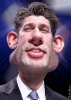
Paul Ryan - Caricature


9149
 

Attachments

  • 5634805518_55df1799c3.jpg
    5634805518_55df1799c3.jpg
    155.3 KB · Views: 28
Last edited:
The Bipartisan March to Fiscal Madness
http://www.nytimes.com/2011/04/24/opinion/24stockman.html?_r=1&ref=opinion

April 23, 2011
By DAVID A. STOCKMAN
David A. Stockman, a former Republican representative from Michigan, was the director of the Office of Management and Budget from 1981 to 1985.

IT is obvious that the nation’s desperate fiscal condition requires higher taxes on the middle class, not just the richest 2 percent. Likewise, entitlement reform requires means-testing the giant Social Security and Medicare programs, not merely squeezing the far smaller safety net in areas like Medicaid and food stamps.

Unfortunately, in proposing tax increases only for the very rich, President Obama has denied the first of these fiscal truths, while Representative Paul D. Ryan, the chairman of the House Budget Committee, has contradicted the second by putting the entire burden of entitlement reform on the poor. The resulting squabble is not only deepening the fiscal stalemate, but also bringing us dangerously close to class war.

This lamentable prospect is deeply grounded in the policy-driven transformation of the economy during recent decades that has shifted income and wealth to the top of the economic ladder. While not the stated objective of policy, this reverse Robin Hood outcome cannot be gainsaid: the share of wealth held by the top 1 percent of households has risen to 35 percent from 21 percent since 1979, while their share of income has more than doubled to around 20 percent.

The culprit here was the combination of ultralow rates of interest at the Federal Reserve and ultralow rates of taxation on capital gains. The former destroyed the nation’s capital markets, fueling huge growth in household and business debt, serial asset bubbles and endless leveraged speculation in equities, commodities, currencies and other assets.

At the same time, the nearly untaxed windfall gains accrued to pure financial speculators, not the backyard inventors envisioned by the Republican-inspired capital-gains tax revolution of 1978. And they happened in an environment of essentially zero inflation, the opposite of the double-digit inflation that justified a lower tax rate on capital gains back then — but which is now simply an obsolete tax subsidy to the rich.

In attacking the Bush tax cuts for the top 2 percent of taxpayers, the president is only incidentally addressing the deficit. The larger purpose is to assure the vast bulk of Americans left behind that they will be spared higher taxes — even though entitlements make a tax increase unavoidable. Mr. Obama is thus playing the class-war card more aggressively than any Democrat since Franklin D. Roosevelt — surpassing Harry S. Truman or John F. Kennedy when they attacked big business or Lyndon B. Johnson or Jimmy Carter when they posed as champions of the little guy.

On the other side, Representative Ryan fails to recognize that we are not in an era of old-time enterprise capitalism in which the gospel of low tax rates and incentives to create wealth might have had relevance. A quasi-bankrupt nation saddled with rampant casino capitalism on Wall Street and a disemboweled, offshored economy on Main Street requires practical and equitable ways to pay its bills.

Ingratiating himself with the neo-cons, Mr. Ryan has put the $700 billion defense and security budget off limits; and caving to pusillanimous Republican politicians, he also exempts $17 trillion of Social Security and Medicare spending over the next decade. What is left, then, is $7 trillion in baseline spending for Medicaid and the social safety net — to which Mr. Ryan applies a meat cleaver, reducing outlays by $1.5 trillion, or 20 percent.

Trapped between the religion of low taxes and the reality of huge deficits, the Ryan plan appears to be an attack on the poor in order to coddle the rich. To the Democrats’ invitation to class war, the Republicans have seemingly sent an R.S.V.P.

Washington’s feckless drift into class war is based on the illusion that we have endless time to put our fiscal house in order. This has instilled a terrible budgetary habit whereby politicians continuously duck concrete but politically painful near-term savings in favor of gimmicks like freezes, caps and block grants that push purely paper cuts into the distant, foggy future. Mr. Ryan’s plan gets to a balanced budget in the fiscal afterlife (i.e., the 2030s); the White House’s tactic of accumulating small-fry deficit cuts over the enormous span of 12 years amounts to the same dodge.

Such fiscal jabberwocky ignores the fact that we have experienced a recession every five years or so for the last six decades; that the budget is now exposed to even more frequent and amplified cyclical turbulence amid the aftershocks of the financial crisis; and that the United States does not have a divine right to issue any amount of interim debt that suits the ideological convenience of the two parties.

Nevertheless, the Democrats are immobilized because Keynesians insist on kicking the budgetary can down the road until cyclical “demand” has in their estimation fully recovered, while Republicans sit on their hands because supply-siders insist on letting the deficit fester until tax cuts work their alleged revenue magic.

A generation ago, such spurious ideological conceits would never have taken root, because deficits had adverse consequences like rising interest rates or an outflow of monetary reserves.

But for decades now, the central banks of the world have been giving policymakers a false signal that sovereign debt is cheap and limitless. Functioning like monetary roach motels, central banks have become a place where Treasury bonds go in but never come out — thereby causing bond prices to be far higher and interest yields much lower than would obtain in a market that wasn’t rigged.

Indeed, the Fed and currency-pegging central banks in East Asia and the Persian Gulf have absorbed nearly all of Uncle Sam’s multitrillion-dollar spree of debt issuance. Moreover, about $4.6 trillion, or more than half of all debt held by the public, is now sequestered in central banks — paid for with printing-press money.

Even central banks cannot defy the canons of sound finance indefinitely, however. Japan will buy less Treasury paper as it turns inward to recover from the wrath of nature. Likewise, China will drastically curtail its currency pegging and related Treasury bond purchases in order to suppress the rip-roaring imported inflation and speculative bubbles now engulfing its domestic economy. And unless the Fed wants to ruin the value of the dollar, it will need to keep its promise to get out of the bond-buying business, too, when its second round of quantitative easing ends in June.

With the central banks no longer ready to buy, the Treasury market will once again be driven by real investors — many of them likely to demand higher interest rates owing to the heightened fiscal risks recently highlighted by Standard & Poor’s. Ominously, the biggest and baddest of these real investors, the quarter-trillion-dollar Pimco Total Return Fund, has already thrown down the gauntlet by selling Uncle Sam’s paper short.


INTEREST rates have been falling for 30 years, but Pimco’s short call could well mark a generational reversal. If so, rates will continue to rise, and the fiscal time frame will be abruptly foreshortened from the distant foggy future to the Treasury’s borrowing needs in the here and now. Then the abject deficiencies of the dueling budget plans will be self-evident.

By 2014, for example, the Ryan plan does not save a dime from the $2.2 trillion baseline for Social Security, Medicare and national security spending. Then it extends all the Bush tax cuts at a cost of $350 billion while instructing the states to reduce spending for the poor by $100 billion and the Congress to slice domestic discretionary spending by 25 percent. That toxic brew is likely to find few takers — even at a Mad Hatter’s tea party.

The latest iteration of the Obama plan is little better. By 2014, it would generate $70 billion from taxing the rich and perhaps $30 billion from the president’s belated call to re-examine our over-financed military but virtually nothing from freezes on domestic programs or from Medicare reimbursement reforms.

So the Ryan plan worsens our trillion-dollar structural deficit and the Obama plan amounts to small potatoes, at best. Worse, we are about to descend into class war because the Obama plan picks on the rich when it should be pushing tax increases for all, while the Ryan plan attacks the poor when it should be addressing middle-class entitlements and defense.

In the real world, however, the global bond market is already rumbling — and around the corner, a fiscal conflagration surely lies.

 
The Progressive Budget Alternative
The Progressive Budget Alternative - NYTimes.com

I’ve been remiss in not calling attention to the budget proposal from the Congressional Progressive Caucus – Congressional Progressive Caucus : FY2012 Progressive Budget . It’s not going to happen — but then neither is the Ryan plan. And unlike the Ryan plan, it actually makes sense.

The CPC plan essentially balances the budget through higher taxes and defense cuts, plus some tougher bargaining by Medicare (and a public option to reduce the costs of the Affordable Care Act). The proposed tax hikes would fall mainly on higher incomes, although not just on the top 2%: super-brackets for very high incomes, elimination of deductions, taxation of capital income as ordinary income, and — the part that would be most controversial — raising the cap on payroll taxes.

None of this is economically outlandish. Marginal tax rates on high incomes would rise substantially — enough to make even liberal economists slightly uncomfortable — but the historical evidence suggests that the incentive effects wouldn’t be too severe. Overall taxes as a share of GDP aren’t given, but they would clearly remain well below European levels.

It’s worth pointing out that if you want to balance the budget in 10 years, you pretty much must do it largely by cutting defense and raising taxes; you can’t make huge cuts in the rest of the budget without inflicting extreme pain on millions of Americans. So the CPC plan is actually much more of a real response to the deficit worriers than all the nonsense we’re hearing from the right. What it doesn’t do is address the long-run health cost issue, which is essential looking beyond the next decade. But as a medium-term proposal, it’s quite sensible.

My guess, in fact, is that in the end we’ll do something along these lines, although probably with more of the tax burden falling on the middle class.

So why does this plan get no attention, while the cruel fantasies of the right get headlines? I’ll leave that as a question for readers.

Update: Aha. Although I couldn’t find share of GDP in the working paper, it’s right there on the home page. Revenues are 22.3 percent of GDP in 2021. That’s 3 points higher than what Ryan claims his plan would produce, although he hasn’t explained how he’s going to make up for those $3 trillion in tax cuts for the rich.

This would be a record level of revenue for the peacetime federal government, but it would still leave the overall tax take, including state and local, far below levels in most other advanced countries. And the point is that this would balance the budget without the savage cuts assumed in the Republican plan, or even the still painful cuts in the Obama plan. We supposedly face a fiscal crisis; why shouldn’t significant tax hikes be part of the response?
 

Attachments

Opinionator - A Gathering of Opinion From Around the Web
June 22, 2011, 9:05 pm
Medicare: Facts and Convictions
By GARY GUTTING

The Stone is a forum for contemporary philosophers on issues both timely and timeless.
Tags:

barack obama, Medicare, Paul Ryan, Philosophy, political debates

The Stone is featuring occasional posts by Gary Gutting, a professor of philosophy at the University of Notre Dame, that apply critical thinking to information and events that have appeared in the news.

We tend to view our political arguments as instruments of intellectual compulsion, forcing opponents to recognize the truth. This seldom happens. On major issues, politicians typically don’t change positions because they see the light but because they feel the heat.

It’s tempting to think that those who persist in disagreeing with us are intellectually or morally inferior — either fools or knaves — and sometimes this is true. Here, however, I want to explore another way of understanding intractable political disagreements, taking as an example my recent effort to get a handle on the current debate over Medicare.

I began in May by reading Paul Ryan’s speech on his debt-reduction plan. He rightly started with the essential first step in any helpful argument: with premises that he and his opponents agree on. Both sides accept that there must be drastic reductions in the level of our federal debt and that such reductions require serious constraints on federal spending for the Medicare program.

But, I thought, Ryan faltered in formulating the two main options in the current debate, his plan and President Obama’s. “Our plan,” he said, “is to give seniors the power to deny business to inefficient providers. Their plan is to give government the power to deny care to seniors.” Here Ryan identifies his proposal with what he claims as its principal benefit and Obama’s with what Ryan claims is its principal defect. A fair formulation requires a simple description of what Ryan and Obama propose to do, separate from alleged drawbacks of their doing it.

It took me a while to sort through the rhetoric on both sides to arrive at reasonably neutral descriptions of what Ryan and Obama propose. Simplifying quite a bit, I came up with the following: Ryan wants to control costs by introducing market mechanisms into the Medicare system, whereas Obama wants to control costs by having government agencies exercise various sorts of control over medical practices.

Putting it this way, it became clear to me that everyone agreed that either plan, if implemented, would significantly reduce government spending on medical care. The debate was about each plan’s further consequences. Roughly, critics of Ryan’s plan claim that it will require seniors to pay far too much for their medical care, while critics of Obama’s plan claim that it will keep seniors from receiving needed medical care.
Related More From The Stone

Read previous contributions to this series.

Go to All Posts »

At this point, it seemed that the debate was over empirical questions: What would be the effects of each of the policies? In principle, such questions should be answerable by objective economic analysis. So I began reading Congressional Budget Office reports, articles in The Economist, and opinions by columnists from Ross Douthat to Ezra Klein. My expectation was that I would find a stalemate, with strong arguments on both sides off-setting one another. But as it turned out, my judgment was that the empirical probabilities supported Obama over Ryan. Of course others as or more qualified than I have concluded otherwise.

More importantly, I realized that the relevant economic facts were soft (relatively malleable). Even if they pointed in Obama’s direction, they did not decisively refute Ryan. Economists with strong (relatively inflexible) convictions about the privileged role of markets and the dangers of government regulation could develop alternative interpretations of the facts that supported Ryan’s position. Such strong convictions would be irrelevant if they were ungrounded prejudices. But there is clearly a higher level of economic discussion on which the free-market economists as well as their opponents have developed what they see as a powerful historical and even philosophical case for their convictions. Paul Ryan was, perhaps, gesturing to this level of conviction when he said, “This is not a budget; this is a cause.”

The moral of my story is that understanding and effectively taking part in a debate requires awareness of the level at which we and our opponents are operating at any given point. When we are arguing from the facts, there is a reasonable possibility of convincing one another. When we find ourselves arguing about convictions, the ordinary point-counterpoint of political debate becomes ineffective. We can and should argue about convictions, but this can seldom be done fruitfully in the context of specific policy disputes. Once we’ve pushed the debate on Medicare or any other policy matter to the point where convictions become the sole basis of disagreement, it is time to vote.

Copyright 2011 The New York Times Company
Privacy Policy
NYTimes.com 620 Eighth Avenue New York, NY 10018
 
The Progressive Budget Alternative
The Progressive Budget Alternative - NYTimes.com

I’ve been remiss in not calling attention to the budget proposal from the Congressional Progressive Caucus – Congressional Progressive Caucus : FY2012 Progressive Budget . It’s not going to happen — but then neither is the Ryan plan. And unlike the Ryan plan, it actually makes sense.

The CPC plan essentially balances the budget through higher taxes and defense cuts, plus some tougher bargaining by Medicare (and a public option to reduce the costs of the Affordable Care Act). The proposed tax hikes would fall mainly on higher incomes, although not just on the top 2%: super-brackets for very high incomes, elimination of deductions, taxation of capital income as ordinary income, and — the part that would be most controversial — raising the cap on payroll taxes.

None of this is economically outlandish. Marginal tax rates on high incomes would rise substantially — enough to make even liberal economists slightly uncomfortable — but the historical evidence suggests that the incentive effects wouldn’t be too severe. Overall taxes as a share of GDP aren’t given, but they would clearly remain well below European levels.

It’s worth pointing out that if you want to balance the budget in 10 years, you pretty much must do it largely by cutting defense and raising taxes; you can’t make huge cuts in the rest of the budget without inflicting extreme pain on millions of Americans. So the CPC plan is actually much more of a real response to the deficit worriers than all the nonsense we’re hearing from the right. What it doesn’t do is address the long-run health cost issue, which is essential looking beyond the next decade. But as a medium-term proposal, it’s quite sensible.

My guess, in fact, is that in the end we’ll do something along these lines, although probably with more of the tax burden falling on the middle class.

So why does this plan get no attention, while the cruel fantasies of the right get headlines? I’ll leave that as a question for readers.

Update: Aha. Although I couldn’t find share of GDP in the working paper, it’s right there on the home page. Revenues are 22.3 percent of GDP in 2021. That’s 3 points higher than what Ryan claims his plan would produce, although he hasn’t explained how he’s going to make up for those $3 trillion in tax cuts for the rich.

This would be a record level of revenue for the peacetime federal government, but it would still leave the overall tax take, including state and local, far below levels in most other advanced countries. And the point is that this would balance the budget without the savage cuts assumed in the Republican plan, or even the still painful cuts in the Obama plan. We supposedly face a fiscal crisis; why shouldn’t significant tax hikes be part of the response?

Blah blah blah. Does anyone remember what happens when you take a country on the verge of suffering or actually suffering from stagflation and - gulp - lower taxes? Something amazing - tax revenues increase as the economy recovers. The real question is not whether to raise or lower taxes, but whether to raise tax revenue without stunting growth. The obvious answer is yes - to an intelligent non-ideologue. Raise taxes now and watch that double dip hit like a real bitch and bite hard. How about creating a business friendly environment, put more money in peoples pockets and watch the free market do what it always does - generate growth and by extension tax revenue increases. Reagan was no dummy, Carter was. Obama is Carter on steroids.

It sometimes helps think outside the box. And as Keynesian economics has never worked, it helps to look at history.
 
WSJ: Let’s not forget Obama’s already-imposed new taxes Hot Air

Not surprised. It is actually a blessing in disguise economists are predicting another recession in 2012 that will make the previous one look tame. It means Obama is out and we can begin to heal the wounds this waste of space has created to our economy. Big, gaping, wounds. It may take years, but with him out of office, the sooner we start the better. Bye, bye Obambi. Maybe Fidel and Hugo will take you in. Seeing as you sided with them on the Honduras issue (I wonder why?) while the rest of the world looked at you as if you must have just smoked some really good sh*t, it does not seem a stretch to say the three of you have a lot in common.
 
From a friend of mine:


How Businessmen Think
or
Why Consumers Won't Be

Two rock, mineral, and jewelry wholesale supply events are occurring in a location near me. Hundreds of varied vendors from all over the world are there, showing and offering their products wholesale, in a once a year chance for retail businesses to "stock their shelves".

In America's pre-obama era of prosperity, I used to plan my year around these events, and excitedly attended with a habit of overspending so that I could offer as many uniquely awesome products as possible to my customers.

However, now that obama, the marxist democrats and RINOs have purposefully ruined the economy, businessmen like me, are forced to make their decisions in an UNCERTAIN AND HOSTILE environment that at best, leads to cautious stagnation, or at worst, ceasing to do business at all.

Now, lest the businessmen and politicians shoulder the entire blame for this, please note that what I am describing is ALSO the result of A CONSUMER CHOICE. In other words, you as a consumer, by your political inaction (or failed actions) have CHOSEN the market in which you will live...and the way things are looking, I'd get used to the empty shelves you see in the attachment.
 

Attachments

  • 279341_254965077848955_100000063931719_1079233_3018867_o.jpg
    279341_254965077848955_100000063931719_1079233_3018867_o.jpg
    150.7 KB · Views: 1
Back
Top