Again, it's not. This isn't personal. Medical/pharmaceutical research doesn't work that way.
Pharma research for evaluating drug legality/usability? no.
That framing is also something I do not agree with. another part of the study that was poorly done.
Is this valid methodology for comparing 2 different drugs in a nonclinical setting, simply to highlight possible differences in metabolism/drug response? aka to learn more about the drugs/prodrugs themselves? Definitely.
An example where a third control group would be needed is Antidepressant A vs Antidepressant B.
Antidepressant A hits receptor ABC and affects neurotransmitter DEF
Antidepressant B hits receptor GHI and affects neurotransmitter JKL
One group takes A, the other B, and a third, a control, takes a placebo.
what effects are being reported? What efects can be maesured via questionares? etc.
Now we get to an example more closely related/ similar to the Test E vs Test C.
Insulin A has a half life of 72 hours.
Insulin B has a half life of 72 hours, but it gets that long lasting effect via a different mechanism as insulin A. Its molecule looks a bit different, and there is some anecdotal evidence to suggest some people might not reach similar serum insulin levels due to the odd shape it has.
Pharma company Novo-Lilly wants to test the differences in individual responses, because they fear that Insulin A might get metabolized differently than insulin B due to either: analysis of its structure and or: customer reports/anecdotes.
They take a hundred type 1 diabetics and give them insulin A in a trial. It works as they thought it would. serum insulin is at 27-34 in all subjects when measured (differences occur due to bodyweight differences, absorption differences, etc). This is their baseline which would be expected for insulin B as well.
So each individual now has a score attached to them.
Now the same 100 diabetics take insulin B. Equivalent dosages, all other variables accounted for. Serum insulin is about equal to the score for insulin A in 50 people.
The other half only shows a serum insulin of ~20. there may be some Glucose control issues in this half as well, but they are not quite sure.
That means they show a different serum score compared to the one they showed when taking insulin A, so now there is proof that some people have to either dose insulin B differently or switch to insulin A if they have issues with insulin B.
Novo-Lilly now knows, that there is something about those fifty people that changes the way the either absorb or metabolize Insulin B. They may now do whatever they want with that knowledge.
There is no need for a design that adds another control group of people who have nothing to do with insulin, like non-diabetic people (or in our case, testosterone and naturals) or diabetics who dont get any insulin (which would be cruel).
It is nonsensical to try to measure intraindividual differences with groupings used to measure interindividual differences.
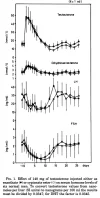
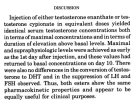
We are not evaluating if these drugs are effective or permissible to be prescribed or used in humans. This is not that type of research. No stage 3 human trial. We are evaluating if one of them has a specific characteristic which may impact their effectiveness compared to another prodrug, both of which are already widely used and have identical APIs.
In that scenario, you would be 100% right