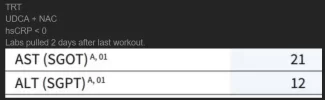
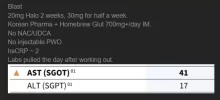
Come to think of it, having my AST almost within reference mid-cut and lower than my natural levels was pretty significant.
I’m trying to search up glutathione and study it further, I have a few things to add:
On the surface level, gluta injections seem inferior to nac for example:
- They do not enter liver cells effectively.
Apparently it stays in the bloodstream and It gets broken down by GGT and only fragments get reused and they don’t rly become intracellular liver glutathione
- Technically it only raises extracellular glutathione briefly
- Liver protection depends on intracellular glutathione — which NAC raises, not gluta injections.
Quick chat gpt:
1. Glutathione is broken down by GGT before it reaches liver cells
GGT (γ-glutamyltransferase) is an enzyme sitting on the outside surface of liver cells.
It’s designed to break down extracellular glutathione.
So when you inject GSH (IM or IV):
GGT immediately chops it into:
- glutamate
- cysteine
- glycine
Almost NONE of the intact glutathione molecule enters hepatocytes.
This is a textbook biochemistry fact, taught in med school metabolism:
“Glutathione must be broken down extracellularly before its components are used for intracellular resynthesis.”
This is why GSH itself is NOT taken up by liver cells efficiently.
2. Hepatocytes lack a transporter for intact glutathione
The liver does NOT have a membrane transporter capable of pulling full glutathione (GSH) inside the cell.
This has been confirmed repeatedly in liver physiology research:
- Hepatocytes export glutathione
- But they do not import intact glutathione
Meaning:
Injected GSH cannot enter hepatocytes directly
It cannot raise intracellular glutathione efficiently
Only cysteine (from NAC) can do that
This is why NAC is the only clinically effective way to raise intracellular GSH.
3. Plasma glutathione has a short half-life (~10–20 minutes)
Studies measuring blood GSH after IV glutathione show:
- Levels spike FAST
- Peak around 10–30 minutes
- Drop sharply
- Return to baseline within a couple hours
That’s because:
- It’s rapidly oxidized
- Rapidly broken down by GGT
- Rapidly filtered by kidneys
This is why IM/IV glutathione only gives a short-lived antioxidant spike, not lasting liver protection.
Bonus: Human trials confirm very low hepatocyte delivery
When researchers give IV glutathione:
- Blood GSH increases
- Intracellular liver GSH barely changes
- ALT/AST do not drop meaningfully
- Protection is minimal unless doses are extremely high (in hospitals)
BUT when they give NAC:
- Intracellular liver glutathione rises strongly
- ALT/AST drop
- Survival in acute liver injury improves
- It protects hepatocytes directly
This is why NAC is a medically approved antidote
and glutathione injections are not.
Final Clinical Claim (with mechanisms)
Injected glutathione is rapidly degraded by GGT before reaching liver cells
Hepatocytes cannot import intact glutathione
Plasma glutathione has a short half-life
Therefore, bioavailability to hepatocytes is poor
NAC raises intracellular liver glutathione far more effectively
This is not theory — this is biochemistry, hepatology, and toxicology 101.
But what rly annoys me is ur anecdotal experience and tests on it. I’m torn.
I’m thinking of switching to high dose nac maybe, tudca and sam-e are good but holy shit a bit expensive to run at high doses