
I have a good amount of homebrew from maybe 3-4 years ago. If I just rerun it through the filters it should still be good? I’ve noticed some particles of stoppers in a few of the bottles I’m guessing from the solvent breaking it down

MESO-Rx
Anabolic Steroids

Follow along with the video below to see how to install our site as a web app on your home screen.
Note: This feature may not be available in some browsers.

Yeah should be fine... Should.I have a good amount of homebrew from maybe 3-4 years ago. If I just rerun it through the filters it should still be good? I’ve noticed some particles of stoppers in a few of the bottles I’m guessing from the solvent breaking it down
That’s what I figured. I got no problem tossing it but didn’t want to if it stillYeah should be fine... Should.
I mean the particles will be filtered out but you need to check if the oil is rancid or not and the chemicals dissolved from the stoppers will be in the oil however... So up to you.
Same. And no it’s like 8 100ml vials that were in a bag. Only 1 or 2 had some floaters but seeing them made me think twiceKind of odd it’s gone bad that quick. I know I’ve used gear over than that. Was it sitting upright? Or oil touching the stopper?

Sounds pretty shitty then maybe I’ll just toss it I have a ton more raws vacuum sealed from a couple years agoWhat Sampei said.
It'll be free of particulates and sterile after filtering.
But the used tire chemical soup that held it together will still be in the oil.
Rancid (oxidized) oil would be wholesome in comparison to these endocrine disrupters and carcinogens.
Most commonly found in injectables after bromobutyl stoppers break down:
- *Isobutylene*
- *Isoprene*
- *Mercaptobenzothiazole (MBT)*
- *Butylated hydroxytoluene (BHT)*
- *Phenolic antioxidants*
- *Diphenylamine*
- *Phthalates*
Next time for long term storage use a PTFE lined stopper. Most of those won't leach anything or break down for 10 years+.

Smell yeah for the rancidThat’s what I figured. I got no problem tossing it but didn’t want to if it still
Might be good. How would I tell if it’s rancid just by smell
Yea out of the 8 vials there’s 2 vials where I saw what looked like small pieces of stopper.Are you sure the floaters are broken down stoppers. Were they laying down flat where the oil was touching the stoppers? Are you sure they are not cored stopper particles from fat ass syringes. What kind of oil is it? I've used 15-year-old test propionate i Home brewed without any issues. If the stoppers are truly disintegrating then you actually have a chemical soup in your oil not the stopper particles that would worry me. The actual breakdown of the stoppers into their more basic petrochemical parts mixed into your oil is most concerning. Never store these oils where the stopper is not straight up.
I dug through the old QSC thread in regards to sterility and endotoxins, shit smaller than .22 microns.What Sampei said.
It'll be free of particulates and sterile after filtering.
But the used tire chemical soup that held it together will still be in the oil.
Rancid (oxidized) oil would be wholesome in comparison to these endocrine disrupters and carcinogens.
Most commonly found in injectables after bromobutyl stoppers break down:
- *Isobutylene*
- *Isoprene*
- *Mercaptobenzothiazole (MBT)*
- *Butylated hydroxytoluene (BHT)*
- *Phenolic antioxidants*
- *Diphenylamine*
- *Phthalates*
Next time for long term storage use a PTFE lined stopper. Most of those won't leach anything or break down for 10 years+.
I dug through the old QSC thread in regards to sterility and endotoxins, shit smaller than .22 microns.
Tracy never said the vials were sterilized anymore than a .22 micro filter.
And their setup was just glassware/tubes in a non-lab setting.
Does this imply all their injectables are just non-sterile crap and .22 filtering?
Pharmaceutical test can have an expiration 3 years out. And there is no recommendation on the label to store them up right. So it would be good well past that point. I have used homebrew i have made that was 10+ years old with no problem. And there were no particles in the vials. If the stoppers were breaking down it would seems to me that they were of very poor quality at leas to have such a low amount of solvent effect them. .

In my 25 years of home brewing i have never had any stopper issues other then in my early days drawing repeatedly to many times using an 18 gauge needle. Which beat the stopper up. Switched to smaller gauge for drawing and have not had any issues since. I have never gone with the cheapest supplies i could get. Some things are worth the extra price for the quality you get.Shitty bromobutyl stoppers are common from China. Pharma in the US uses chlorobutyl, and they have perform "leachable/extractable" accelerated aging tests to make sure they won't transfer anything into the liquid.
I think QSC wins the prize for the most trash stoppers on earth. Some would deteriorate into mush in transit.
How QSC stoppers were made:
View attachment 325722
In my 25 years of home brewing i have never had any stopper issues other then in my early days drawing repeatedly to many times using an 18 gauge needle. Which beat the stopper up. Switched to smaller gauge for drawing and have not had any issues since. I have never gone with the cheapest supplies i could get. Some things are worth the extra price for the quality you get.
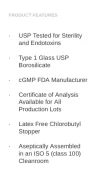


The main difference between UGL/Homebrew and compounding pharma or commercial factories is that the later two use aseptic production, and sterile filtration is just a safeguard in case something went wrong. Sometimes radiation or heat is used on the sealed vial instead of filtration for "terminal sterilization".
In other words, everything is sterile to begin with, and kept sterile in a controlled environment. Then "just in case" there's another sterilization step.
UGL uses unsterile ingredients in an unsterile environment, and sterile filtration removes most bacteria (but not the endotoxin bacteria leave behind). Then benzyl alcohol prevents whatever small amount of bacteria that gets into the brew from multiplying.
In other words, you could take cesspool water, run it through a .22um filter into a solution with BA, and it would be as "sterile" as UGL gear, but no where near as clean as aseptically produced commercial injectables.
Obviously no one is dying from infections caused by homebrew or UGL gear, but thousands of injections of small amounts of endotoxin, residual bacteria, and particulates like rubber and glass will contribute over the long term to things like reactive arthritis destroying joints. and some organ damage from particles that the body can't remove like glass getting lodged in tiny blood vessels.
That's why filtering UGL gear yourself, and using particulate free vials from an FDA inspected manufacturer for homebrew is cheap insurance and contributes to reducing harm over the long term.
If you have lots of raws, then no need to salvage this batch and use this as a learning curve.Yea out of the 8 vials there’s 2 vials where I saw what looked like small pieces of stopper.
I had them piled up in a bag so they weren’t stored straight up.
The stoppers were never punctured the vials were just used as storage after the brew.
It sounds like you’re right and if it’s chemical soup then it’s getting tossed. No big deal I’d rather be safe I have a ton more raws vacuum sealed from a couple years ago I can just make
What's the most sterility someone home brewing could achieve?If you have lots of raws, then no need to salvage this batch and use this as a learning curve.
For us who have been at this for a while, we learned to brew only what you need and add maybe 50ml more. And when you do, avoid using the jugs, for myself 30ml is the max to avoid breaking down the stopper from the amount of punctures with your draw needle especially if you use harpoons lol.
I used a bottle of decade old bottle of tren 3 years ago and it still did it’s job, the oil didn’t go rancid and no floaters upon inspection.


