I'd Rather Die Standing Than Live on My Knees - Charlie Hebdo Pays the Price for Free Speech

Your reading comprehension skills are even worse than your logic. He's "using scripture" to differentiate killing from murder. So it's "OK" to kill in a war. For our purposes, there's no reason to distinguish between killing and murder, either is violence. Do you even remember your challenge?

Indeed I do. And so do you. My reading comprehension and logic have nothing to do with you needing to expand the definition of what is considered invoking scripture to justify violence in order to support your position.


But to say biblical verses can't be or aren't used to justify violence is absurd.


Prove it. Show me an example of a Christian invoking scripture to to justify violence and I'll happily retract that statement. Where are these Christian terrorists?

I'm not saying Christians haven't committed violence in Christianity's name, but they don't do it because there are commandments in the Bible ordering them to. No Christian can find an example from the teachings or example of Christ to support violence.
You can easily find such commandments from Muhammed. Using Hitler as an example of Christianity is absurd.


I gave you three examples. They are used routinely to command people to submit to and obey the government which commits violence. And incidentally, you said nothing about terrorism. You said violence, and dropping bombs on innocent civilians is violence as well as terrorism. Sending people to prison for political crimes is violence. Executing criminals is violence, is well supported by the Old Testament and never denounced in the New.

All those knights weren't care free about killing, looting and raping because they were given God's permission and exoneration?


I think when you said violence, you meant terrorism, and by terrorism you meant individuals or groups of "extremists" running around blowing shit up and shooting people. But violence has a lot of different forms, and terrorism shouldn't be denied just because it's employed by government. And if Christians submit to and support government because of scripture, then scripture supports violence.

I'm claiming the crusaders were inspired by Christianity, not driven by its teachings. Perhaps you can find the scripture that gave the crusaders God's permission and exoneration to kill, loot and rape. I won't be holding my breath, though.

Nonsense. Your logic is faulty. If scripture commands Christians to support government, that in no way proves scripture supports violence. Be serious.
 
The term no-go zone originates from a 2006 Daniel Pipes article on what the French call zones urbaines sensibles (ZUS) (http://sig.ville.gouv.fr/Atlas/ZUS/). Pipes has since revised his position and now regrets calling these areas no-go zones but the term lives on.

The 751 No-Go Zones of France

by Daniel Pipes
Nov 14, 2006

updated Jan 14, 2015


They go by the euphemistic term Zones Urbaines Sensibles, or Sensitive Urban Zones, with the even more antiseptic acronym ZUS, and there are 751 of them as of last count. They are conveniently listed on one long webpage, complete with street demarcations and map delineations.

What are they? Those places in France that the French state does not fully control. They range from two zones in the medieval town of Carcassonne to twelve in the heavily Muslim city of Marseilles, with hardly a town in France lacking in its ZUS. The ZUS came into existence in late 1996 and according to a http://www.lesechos.fr/regions/atlas/atlas_06_08_2004.htm, nearly 5 million people live in them.

Comment: The proliferation of ZUS suggest that the French state no longer has full control over its territory. (November 14, 2006)

Nov. 28, 2006 update: For an insight into how bad things are, the police in Lyons demonstrated on Nov. 9, denouncing "violence against the forces of order." Things have reached a pretty sad state when the police have to demonstrate in the streets against the criminals.

Jan. 5, 2008 update: In a remarkable statement, http://www.telegraph.co.uk/news/main.jhtml;jsessionid=IJOW0YY42PA2BQFIQMFSFFWAVCBQ0IV0?xml=/news/2008/01/06/nislam206.xml, the Pakistani-born bishop of Rochester, writes in the Daily Telegraph about the situation in Great Britain:

there has been a worldwide resurgence of the ideology of Islamic extremism. One of the results of this has been to further alienate the young from the nation in which they were growing up and also to turn already separate communities into "no-go" areas where adherence to this ideology has become a mark of acceptability. Those of a different faith or race may find it difficult to live or work there because of hostility to them.

Jan. 16, 2008 update: Paul Belien of Brussels Journal provides an update on the ZUS, connecting them to organized crime in a way that helps explain police reluctance to intervene:

In May [2007], the French voters elected Mr. [Nicolas] Sarkozy as president because he had promised to restore the authority of the Republic over France's 751 no-go areas, the so-called zones urbaines sensibles (ZUS, sensitive urban areas), where 5 million people - 8 percent of the population - live. During his first months in office he has been too busy with other activities, such as selling nuclear plants to Libya and getting divorced. While the French media publish nude pictures of the future (third) Mrs. Sarkozy, the situation in the ZUS has remained as "sensitive" as before.

People get mugged, even murdered, in the ZUS, but the media prefer not to write about it. When large-scale rioting erupts and officers and firemen are attacked, the behavior of the thugs is condoned with references to their "poverty" and to the "racism" of the indigenous French. The French media never devote their attention to the bleak situation of intimidation and lawlessness in which 8 percent of the population, including many poor indigenous French, are forced to live. Muslim racism toward the "infidels" is never mentioned.

Xavier Raufer, a former French intelligence officer who heads the department on organized crime and terrorism at the Institute of Criminology of the University of Paris II, thinks that organized crime has a lot to do with the indifference of the French establishment.

The ZUS are centers of drug trafficking. According to a recent report of the French government's Interdepartmental Commission to Combat Drug Traffic and Addiction (MILDT) 550,000 people in France consume cannabis on a daily basis and 1.2 million on a regular basis. The annual cannabis consumption amounts to 208 tons for a market value of 832 million euros ($1.2 billion in U.S. dollars). MILDT estimates that there are between 6,000 and 13,000 small "entrepreneurs" and between 700 and 1,400 wholesalers who make a living out of dealing cannabis. The wholesalers earn up to 550,000 euros ($820,000) per year. Since they operate from within the ZUS the drug dealers are beyond the reach of the French authorities.

The ZUS exist not only because Muslims wish to live in their own areas according to their own culture and their own Shariah laws, but also because organized crime wants to operate without the judicial and fiscal interference of the French state. In France, Shariah law and mafia rule have become almost identical.

Military uniforms in public 'risk offending minorities'."


Certain areas in Britain will still have to remain off-limits for servicemen and women in military gear, despite the Government's desire for a nationwide uniform free-for-all, senior RAF sources acknowledged yesterday. … one senior air force source said that military commanders had to be aware of potential problems of personnel wearing combat and other military clothes in the street. "We're aware of the sensitivities, for example, in some ethnic minority communities which is why we need to have a dialogue with local authorities and police if we don't want to cause a problem."

Mar. 16, 2008 update: John Cornwell, a leading historian and commentator on religion, is generally skeptical of Nazir-Ali's no-go areas but finds that if anyplace fits the profile, it's Bury Park in Luton:

Luton, like other enclaves, has experienced a spate of incidents that look all too like attempts to make Bury Park a no-go area to non-Muslims. Between November of last year and last month there were 18 attacks – all registered by the police – on five non-Muslim homes in the area. One couple, Mr and Mrs Harrop, white residents in their eighties, have had bricks hurled through their windows. The home of Mrs Palmer, a widow of West Indian origin, aged 70, has been attacked four times; on one occasion a metal beer keg crashed through her bay window while she was watching TV.

Such attacks are not typical of the activities of the sort of radicals who preach a global Islamic state, or potential terrorists, who, according to one of my MI5 informants, merge into a background of "innocent normalcy" till the last minute. DCI Ian Middleton of Bedfordshire police says: "It's the perception of the victims that their Muslim neighbours are to blame, and we have to respect that. But we have our doubts." Middleton suspects, as does Margaret Moran, MP for Luton South, that the attacks could be the work of small groups of white or Muslim extremists, stirring up racial and inter-religious hatred for its own sake.

I was to come across comparable "no-go" incidents in other parts of Britain, such as threats against Muslim converts to Christianity, and attacks on visiting social workers and Salvation Army facilities.

July 28, 2008 update: For information on the German case, see Kristian Frigelj, "Unter Feinden," Die Welt. The teaser explains that "In many German urban areas, the police hardly dare enter because they are immediately assaulted." July 29, 2008 update: For a translation of this article, see "In Enemy Territory."

Jan. 12, 2009 update: I consider the potential political import of these no-go zones at "Muslim Autonomous Zones in the West?"

July 19, 2010 update: Due to problems with Turkish delinquents, German police want their counterparts from Turkey to come in and patrol problem areas of North Rhine-Westphalia. Also today, Baron Bodissey discusses the general issue of no-go zones at "A Little Piece of Dar al-Islam."

Aug. 22, 2011 update: Soeren Kern returns to this subject with an important overview at "http://www.hudson-ny.org/2367/european-muslim-no-go-zones."

Islamic extremists are stepping up the creation of "no-go" areas in European cities that are off-limits to non-Muslims. Many of the "no-go" zones function as microstates governed by Islamic Sharia law. Host-country authorities effectively have lost control in these areas and in many instances are unable to provide even basic public aid such as police, fire fighting and ambulance services.

The "no-go" areas are the by-product of decades of multicultural policies that have encouraged Muslim immigrants to create parallel societies and remain segregated rather than become integrated into their European host nations.

He then surveys developments in the United Kingdom, France, Belgium, Germany, Italy, the Netherlands, and Sweden.

Aug. 4, 2012 update: The French Interior Ministry has created a new type of no-go zone, called Zones de Sécurité Prioritaires (ZSP), or Priority Security Zones. The first batch contains 15 of them, basically the Muslim-majority regions of major cities like Lille, Paris, Strasbourg, Lyons, and Marseilles, as well as in French Guyana. Aug. 24, 2012 update: Soeren Kern explains these new zones in "France Seeks to Reclaim 'No-Go' Zones."

Jan. 16, 2013 update: I had an opportunity today to travel at length to several banlieues (suburbs) around Paris, including Sarcelles, Val d'Oise, and Seine Saint Denis. This comes on the heels of having visited over the years the predominantly immigrant (and Muslim) areas of Brussels, Copenhagen, Malmö, Berlin, and Athens.

A couple of observations:
    • For a visiting American, these areas are very mild, even dull. We who know the Bronx and Detroit expect urban hell in Europe too, but there things look fine. The immigrant areas are hardly beautiful, but buildings are intact, greenery abounds, and order prevails.
    • These are not full-fledged no-go zones but, as the French nomenclature accurately indicates, "sensitive urban zones." In normal times, they are unthreatening, routine places. But they do unpredictably erupt, with car burnings, attacks on representatives of the state (including police), and riots.
Having this first-hand experience, I regret having called these areas no-go zones.

3042.jpg

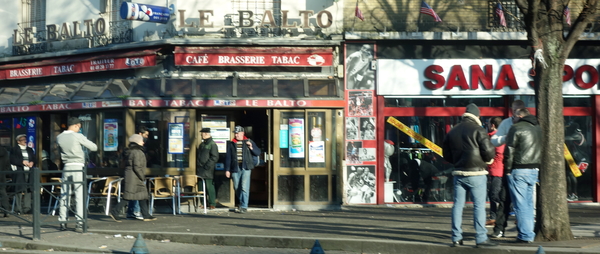
A typical sight in the commercial areas of "94," one of the most heavily Muslim areas of France.

3043.jpg

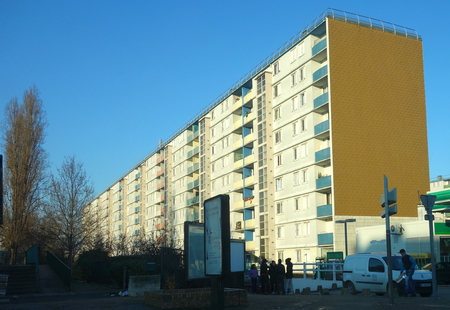
Typical housing.​


Nov. 11, 2013 update
: Andrew Harrod discusses the problems in Bonn at "http://frontpagemag.com/2013/andrew-harrod/germanys-sharia-no-go-zones/print/."

En nationell översikt av kriminella nätverk med stor påverkan i lokalsamhället ("A national survey of criminal networks with great influence in the local community"). No ethnicity is mentioned but many happen to be regions with Muslim majorities.


Nigel Farage, leader of the United Kingdom Independence Party, says that most big French cities have "no-go zones" where non-Muslims, including police, cannot enter:


It's happening right across Europe. We have got no-go zones in most of the big French cities. We've been turning a blind eye to preachers of hate that have been coming here from the Middle East and saying things for which the rest of us would be arrested. In parts of northern England we've seen the sexual grooming of under-age girls committed by Muslim men, in the majority, and for all of these things we are seeing the law not being applied equally, we're seeing the police forces not doing their job because we've suffered from moral cowardice. We have through mass immigration and through not checking the details of those people who have come to our countries, we have allowed big ghettos to develop and when it comes to confronting tough issues we're run a mile and that is why we're in the mess we're in, we've been led very badly. … So, wherever you look, wherever you look you see this blind eye being turned and you see the growth of ghettos where the police and all the normal agents of the law have withdrawn and that is where Sharia law has come in."

He added that he is "hoping and praying" that similar no-go zones do not develop in British cities.

Jan. 14, 2015 update: Jack Sommers, a UK-based reporter for Huffington Post, posed this series of questions to me about the ZUS and their equivalents elsewhere in Europe:

Could you describe the places you visited in more detail? What were your impressions of these places before you visited them? Did you feel personally safe visiting them? Do you think there is any truth to the claims being made that police and non-Muslims fear to visit them?

My reply:

I have visited predominantly immigrant (and largely Muslim) areas of Brussels, Copenhagen, Malmö, Stockholm, Berlin, Paris, and Athens. In the case of Paris, I spent time both in Belleville and in such suburbs as Sarcelles, Val d'Oise, and Seine Saint Denis.

Before my travels, I expected these areas to be similar to the worst areas of the United States, such as the Bronx or Detroit, where buildings are decrepit, streets menacing, and outsiders feel distinctly unwelcome.

My experiences starting in 2007 belied this expectation. All the immigrant areas turned out to be well maintained, with safe streets, and no sense of intimidation. I walked around, usually with camera in hand, and felt at ease. I encountered no difficulties at all.

That said, there is a reason why the French government calls these regions sensibles (sensitive, delicate). They contain many social pathologies (unemployment, drugs, political extremism), they seethe with antagonism toward the majority society, and are prone to outbreaks of violence.

So, from an American point of view, these areas are a bit confusing: potentially dangerous, yes, but in normal times very ordinary looking and with no sense of foreboding. Thus, the term no-go zone does not accurately reflect the situation.

http://www.danielpipes.org/blog/2006/11/the-751-no-go-zones-of-france
 
he term no-go zone originates from a 2006 Daniel Pipes article on what the French call zones urbaines sensibles (ZUS) (http://sig.ville.gouv.fr/Atlas/ZUS/). Pipes has since revised his position and now regrets calling these areas no-go zones but the term lives on.

Daniel Pipes, January 2015: There are currently "no European countries with no-go zones."

In an e-mail to Bloomberg Businessweek today, Pipes says that a no-go zone "is a place where the government has lost control and cannot enforce the rule of law." There are, he now says, "no European countries with no-go zones."

Source: http://www.businessweek.com/articles/2015-01-14/debunking-the-muslim-nogo-zone-myth
 
Indeed I do. And so do you. My reading comprehension and logic have nothing to do with you needing to expand the definition of what is considered invoking scripture to justify violence in order to support your position.
Scripture is still being used to justify violence. If you want a theological debate on the meaning of scripture there are plenty of Christians who will disagree with your viewpoint, including the pastor who's pro-war sermon I linked, the priests leading thousands of crusader knights in their war prayers and countless popes and bishops. They certainly did find passages in the bible commanding them to violence.
 
Well...maybe the problem is that the god your reading about in the Torah (old testament) is not the same God your reading about in the New Testament. It is a little difficult in seeing much resemblance.
 
French Prime Minister: 'I Refuse to Use This Term Islamophobia'

Manuel Valls argues that the charge of 'Islamophobia' is often used to silence critics of Islamism.
Jeffrey Goldberg Jan 16 2015, 10:38 AM ET


lead.jpg

Demonstrators hold a banner reading "Unity Against Islamophobia" at a conference on the Islamization of Europe in 2010. (Michel Euler/AP)


The prime minister of France, Manuel Valls, has emerged over the past tumultuous week as one of the West’s most vocal foes of Islamism, though he’s actually been talking about the threat it poses for a long while. During the course of an interview conducted before the Charlie Hebdo attacks, he told me—he went out of his way to tell me, in fact—that he refuses to use the term 'Islamophobia' to describe the phenomenon of anti-Muslim prejudice, because, he says, the accusation of Islamophobia is often used as a weapon by Islamism's apologists to silence their critics.

Most of my conversation with Valls was focused on the fragile state of French Jewry—here is my post on his comments, which included the now-widely circulated statement that, “if 100,000 Jews leave, France will no longer be France”—and I didn’t realize the importance of his comment about Islamophobia until I re-read the transcript of our interview.

“It is very important to make clear to people that Islam has nothing to do with ISIS,” Valls told me. “There is a prejudice in society about this, but on the other hand, I refuse to use this term 'Islamophobia,' because those who use this word are trying to invalidate any criticism at all of Islamist ideology. The charge of 'Islamophobia' is used to silence people. ”

Valls was not denying the existence of anti-Muslim sentiment, which is strong across much of France. In the wake of the Charlie Hebdo attack, miscreants have shot at Muslim community buildings, and various repulsive threats against individual Muslims have been cataloged. President Francois Hollande, who said Thursday that Muslims are the “first victims of fanaticism, fundamentalism, intolerance,” might be overstating the primacy of anti-Muslim prejudice in the current hierarchy of French bigotries—after all, Hollande just found it necessary to deploy his army to defend Jewish schools from Muslim terrorists, not Muslim schools from Jewish terrorists—but anti-Muslim bigotry is a salient and seemingly permanent feature of life in France. Or to contextualize it differently: Anti-Muslim feeling appears to be more widespread than anti-Jewish feeling across much of France, but anti-Jewish feeling has been expressed recently (and not-so-recently) with far more lethality, and mainly by Muslims.

It appears as if Valls came to his view on the illegitimacy of 'Islamophobia' after being influenced by a number of people, including and especially the French philosopher Pascal Bruckner and the writer (and fatwa target) Salman Rushdie. Rushdie, along with a group of mainly Muslim writers, attacked the use of the term 'Islamophobia' several years ago in an open letter: “We refuse to renounce our critical spirit out of fear of being accused of ‘Islamophobia’, a wretched concept that confuses criticism of Islam as a religion and stigmatization of those who believe in it.”

Bruckner http://www.signandsight.com/service/2123.html that use of the word 'Islamophobia' was designed to deflect attention away from the goals of Islamists: “t denies the reality of an Islamic offensive in Europe all the better to justify it; it attacks secularism by equating it with fundamentalism. Above all, however, it wants to silence all those Muslims who question the Koran, who demand equality of the sexes, who claim the right to renounce religion, and who want to practice their faith freely and without submitting to the dictates of the bearded and doctrinaire.”

It is difficult to construct a single term that captures the variegated expressions of a broad prejudice. 'Anti-Semitism,' of course, is a terribly flawed term to describe anti-Jewish thought or behavior, and not only because it was invented by an actual hater of Jews, Wilhelm Marr, to prettify the base hatred to which he subscribed.

According to Bruckner, the term was first used in its current manner to excoriate the writer Kate Millett, who had called upon Iranian women living under a theocratic yoke to take off their chadors. The term seems to have come into widespread use after the U.K.-based Runnymede Trust issued a report in 1997 entitled “Islamophobia: A Challenge for Us All,” and by 2001, the United Nations had recognized Islamophobia as a form of prejudice at its Durban conference on racism (this is the same conference from which the official U.S. delegation walked out, to protest the widespread trafficking in anti-Israel and anti-Jewish tropes). The Runnymede Trust defined Islamophobia as “unfounded hostility towards Muslims, and therefore fear or dislike of all or most Muslims.” This corresponds, in some ways, to my colleague Conor Friedersdorf’s definition of Islamophobia as the “irrational fear of mainstream Muslims.”

I don’t think that Valls would disagree with the notion that the fear of “mainstream Muslims” is grounded in anything but prejudice. But the question he is asking (and answering) is this: Can hostility to the various related ideologies of Islamism—ideologies rooted in a particular reading of Muslim texts, theology, and history—be properly defined as Islamophobic?

Michael Walzer, in the most recent issue of Dissent, provides one answer. He argues that it is quite rational to fear Islamism:

I live with a generalized fear of every form of religious militancy. I am afraid of Hindutva zealots in India, of messianic Zionists in Israel, and of rampaging Buddhist monks in Myanmar. But I admit that I am most afraid of Islamist zealots because the Islamic world at this moment in time (not always, not forever) is especially feverish and fervent. Indeed, the politically engaged Islamist zealots can best be understood as today’s crusaders.

Is this an anti-Muslim position, not a fear but a phobia—and a phobia that grows out of prejudice and hostility? Consider a rough analogy (all analogies are rough): if I say that Christianity in the eleventh century was a crusading religion and that it was dangerous to Jews and Muslims, who were rightly fearful (and some of them phobic)—would that make me anti-Christian? I know that crusading fervor isn’t essential to the Christian religion; it is historically contingent, and the crusading moment in Christian history came and, after two hundred years or so, went. Saladin helped bring it to an end, but it would have ended on its own. I know that many Christians opposed the Crusades; today we would call them Christian “moderates.” And, of course, most eleventh-century Christians weren’t interested in crusading warfare; they listened to sermons urging them to march to Jerusalem and they went home. Still, it is true without a doubt that in the eleventh century, much of the physical, material, and intellectual resources of Christendom were focused on the Crusades.
Walzer doesn’t understand how opposition to a misogynistic, homophobic, anti-Semitic, anti-free-speech theocratic strain of totalitarianism could make a person a “racist” (a particularly inapt term for prejudice against Muslims, who are found among all races) or “Islamophobic,” or anything but a secular-minded progressive who is interested in defending the rights of women and minorities.

“I frequently come across leftists who are more concerned with avoiding accusations of Islamophobia than they are with condemning Islamist zealotry,” Walzer wrote. “There are perfectly legitimate criticisms that can be made not only of Islamist zealots but also of Islam itself—as of any other religion.”

Hussein Ibish, writing in The National, offered a definition of Islamophobia that makes sense to me, and I would imagine, makes sense to Valls.

The key to a practicable definition of Islamophobia that can help identify truly objectionable speech, must be that it refers to living human beings and their fundamental rights. It cannot be about protecting people from being offended, or having their feelings hurt. Still less can it be about protecting abstract ideas, religious dogmas, or cultural norms from being questioned, critiqued or even lampooned.

The proper metric to identify genuinely bigoted speech is whether or not the expression in question is intended or likely to have the effect of promoting fear and hatred against broad categories of people based on their identity. Would such speech make it more difficult for communities to function effectively in their own society? In other words, does the speech attack the legitimate rights and interests of identity-based communities? Does it prevent them being seen as, and treated as equal by, and with regard to, other communities?
Ibish argues that Charlie Hebdo, against which accusations of Islamophobia continue to be leveled, does not meet his standard: While many of the images it printed over the years were offensive to Muslims and many others, and were intended to be so, did its track record really suggest that its presence on the French scene in any way compromised, challenged, or complicated the ability of the Arab and Muslim migrant communities in France to function properly in that society? Clearly, the answer is no.

Prejudice against Muslims is repulsive. Criticism of Islamist doctrine, and the lampooning of religious beliefs, is not.

http://www.theatlantic.com/internat...minister-manuel-valls-on-islamophobia/384592/
 
This would actually be funny if it was so embarrassing.

The Obama administration stands in solidarity with the French: A 'hug' and a song will make it all better. SMFH


Awkward: John Kerry Brings James Taylor to Paris, Sings ‘You’ve Got a Friend’


In the days following the attack on the offices of Charlie Hebdo and a kosher grocery store, the White House has come under intense criticism for not dispatching a high-level official to join last Sunday’s solidarity march in Paris. More than 40 world leaders joined French President Francois Hollande for the event, but the United States only sent along its ambassador in Paris.

On Friday, Secretary of State John Kerry sought to sing his way out of the controversy. Following meetings with Hollande, Kerry — a notorious Francophile and classical guitar player — appeared at the Paris city hall alongside James Taylor, who delivered a rendition of “You’ve Got a Friend.”

Prior to traveling to Paris, Kerry had said he hoped to give the French people a “big hug.” On Friday, he laid wreaths at the offices of Charlie Hebdo and the grocery.
 
Prejudice against Muslims is repulsive. Criticism of Islamist doctrine, and the lampooning of religious beliefs, is not.

I agree with many points in the article and entirely with the concluding paragraph of the article:

"Prejudice against Muslims is repulsive. Criticism of Islamist doctrine, and the lampooning of religious beliefs, is not."

I find the semantics arguments interesting and realize that many terms used to describe discrimination are semantically imperfect e.g. Islamophobia and anti-semitism.

What I don't agree with are those that argue that somehow it is not possible to condemn anti-Muslim prejudice and also condemn Islamic fundamentalism (and/or criticize Islam) at the same time.

If the use of the term Islamophobia is used by "leftists" to silence critics of Islamic fundamentalism, then "rightists" who quabble over the semantic meaning of the term are just as guilty of doing it to silence critics of anti-Muslim prejudice. I strongly disapprove of either motive.

I have regularly used the word Islamophobia to describe anti-Muslim sentiment. But my use of the term does not extend to silencing free speech that is critical of religion.

I'm not a fan of the political correctness requirements of eschewing the term when everyone knows exactly what I mean i.e. opposing anti-Muslim prejudice as well as supporting freedom of speech (in the tradition of Charlie Hebdo) with the same intensity.

I like Hussein Ibish's definition of islamophobia. And in the absence of a better and more semantically-appropriate term, I think properly defining islamophobia with a stricter more precise definition may be the best approach:

The key to a practicable definition of Islamophobia that can help identify truly objectionable speech, must be that it refers to living human beings and their fundamental rights. It cannot be about protecting people from being offended, or having their feelings hurt. Still less can it be about protecting abstract ideas, religious dogmas, or cultural norms from being questioned, critiqued or even lampooned.

The proper metric to identify genuinely bigoted speech is whether or not the expression in question is intended or likely to have the effect of promoting fear and hatred against broad categories of people based on their identity.
 
Pope Francis defended violence as a "normal" response to insults and provocation. Not only that, he said he would personally respond with violence to certain types of insults/provocation. For this reason, the Pope believes freedom of expression should be limited. These statements sound like the Catholic Church is "blaming the victim" for Charlie Hebdo attack.

Source: http://www.theguardian.com/world/2015/jan/15/pope-francis-limits-to-freedom-of-expression
I just came across the video of Pope Francis demonstrating how he would personally respond with violence if a friend insulted him:


A Vatican spokesperson said that the Pope's remarks and gestures "in no way intended to be interpreted as justification for the violence and terror that took place in Paris last week."

Source: http://edition.cnn.com/2015/01/15/world/pope-francis-punch/index.html
 
As Kipling said "East is East and West is West and never the twain shall meet" Two cultures that will be forever at odds with one another. I hope were getting to the point that we understand this. But...what are we going to do about it? Is there a viable answer?


Nadim Koteich
Published: 13/01/2015 01:08 PM | Updated: 15/01/2015 02:01 PM

We are all ISIS

These killers are us. They are our religion at its most extreme.

000_del6386531.jpg


Condemnations are no longer sufficient. They were never enough in the first place and they never bore any weight except as an entry point to more advanced steps.

They are not enough, especially when what follows them amounts to no more than idiotic expressions suggesting that a crime like the Charlie Hebdo massacre is not an expression of “true Islam.” In an effort to divorce Islam from responsibility for other crimes, some have said that the Islamic State (ISIS), Jabhat al-Nusra, Asa’ib Ahl al-Haqq, Hezbollah, Boko Haram, Somalia’s Al-Shabab, the Taliban and hundreds of other armed groups also do not represent true Islam.

So what is this true Islam that those who condemn crimes committed in the name of Islam are supposed to be bestowing upon us? Beyond condemnation, what confrontation with the criminals have the proponents of true Islam been engaged in since the defeat of the Mu’tazila — the defeat of rationality in Islam 1,100 years ago?

Condemnation alone is not enough. The people from the Sunni camp of contemporary Islam who carried out the Charlie Hebdo massacre, the Pakistani school massacre before it, the massacres by ISIS in Syria and Iraq, the 9/11 attacks and other atrocities all belong to true Islam. The same applies to the people in the Shiite camp of contemporary Islam who kidnapped and killed foreign journalists in Beirut, and issued and renewed the fatwa that said the blood of British writer Salman Rushdie could be spilt. They are a central part of true Islam and its many schools of jurisprudence.

It doesn’t matter which Islamic text, whether it is a Qur’anic or jurisprudential text, or a text recounting the sayings of the Prophet Mohammad; the killers do not kill for nothing, they kill in the name of books, fatwas, ayahs and age-old tradition. All of these things are inseparable parts of true Islam. They will remain Muslims as long as they pronounce the shahada and as long as the religious institution doesn’t dare to modernize the criteria for being a Muslim.

These killers are us. They are our religion at its most extreme. They are our true Islam taken to its furthest extent and they are not beyond the scripture. If the West says in one united voice “we are Charlie” we should say “we are ISIS.”

As Muslims, what should we do with Ayat as-Sayf, the fifth verse of Surat at-Tawbah, one of the last Qur’anic chapters delivered to the Prophet in the city of Medina, and thus of central importance with regard to the structure of Islamic rulings and the system for the relationship with the other? The ayah says:

“Then, when the sacred months have passed, slay the idolaters wherever ye find them, and take them (captive), and besiege them, and prepare for them each ambush. But if they repent and establish worship and pay the poor-due, then leave their way free. Lo! God is Forgiving, Merciful.”

With this in mind, was the ayah not instrumental in building Islam’s military glory? Didn’t Islam become a vast empire of might, dominion, high renown, money and power? Was this ayah not the central compass that directed the wars of the Muslims, from the preparations for the conquest of Mecca to jihadist pamphlet “The Neglected Duty,” by Muhammad abd-al-Salam Faraj, one of the clearest and most dangerous pieces of jihadist literature ever written? For those who are unfamiliar with Faraj, he was the emir of the Al-Jihad group that assassinated Anwar Sadat in the name of the very same true Islam.

What kind of ruling can there be against “idolaters” in the 21st century and what should we make of the ruling to slay them “wherever [we] find them” now that we have international law and the nation state? Where do today’s Muslims draw the line between Islamic jurisprudence and law?

As Muslims, what should we do with the 20th verse of Surat at-Tawbah, which is dedicated to our relationship with Christians and Jews? The text is as follows:

“Fight those who do not believe in God or in the Last Day and who do not consider unlawful what God and His Messenger have made unlawful and who do not adopt the religion of truth from those who were given the Scripture - [fight] until they give the jizyah willingly while they are humbled.”

Do these ayahs belong to the so-called ayahs of forgiveness that Muslims praise as evidence of Islam’s kindheartedness in conferences of flattery and social deception? Are they really all we have left of Islam in its latest incarnation?

What is the verdict on the fatwas of Sheikh ul-Islam Ibn Taymiyyah who still presides over the jurisprudence of jihad eight centuries after his death, from the Muslim Brotherhood to ISIS? What is his position, in view of who he is in the history of Islamic jihadist jurisprudence, in today’s Muslim world? Who will draw the borders between the jurisprudence of jihad as one of the Islamic sciences and the criminal jurisprudence that was practiced in Paris, especially as both of them are derived from the same original texts?

It was very telling that straight after the announcement of the Charlie Hebdo massacre people’s thoughts turned to Islamist extremists, despite the fact that the French magazine’s satire spared not Judaism, Christianity nor the French political establishment. This is because Islam’s relationship with the present is in crisis, and any group going through such a crisis is always the first suspect. In fact, Islam as a whole stands accused in advance, and not only its extremist fringe. The original texts that form an inseparable part of true Islam and inspire the ongoing crimes committed in its name are also guilty. This will be true as long as there is no central authority to reorganize the relationship between the Islamic text, as a piece of history, and the necessities of the present day, in the same way the Qur’anic text itself acclimatized as the ayahs were gradually sent down, with some new rulings replacing older ones.

The truth is that what the killers did in Paris has only reinforced the images drawn by the artists of Charlie Hebdo. The only difference between the actions of the artists and the killers is that the number of people who follow caricatures is far less than those who followed the international drama caused by the massacre. Nothing can insult Islam and Muslims as much as such crimes, and yet we still make do with saying that they do not represent true Islam, without providing a clear description of what true Islam is, beginning with our religious schools, some of which are factories for crime, to our constitutions which are rigged with the mines of Islamic jurisprudence and Sharia law.

Nothing insults Islam more than the Charlie Hebdo massacre, which says, from the belly of true Islam itself: Those of us who love the Prophet most are our greatest criminals.

This commentary has been translated from the original Arabic by Ullin Hope.

Nadim Koteich is the host ofThe DNA Show on Future News. He tweets @NadimKoteich

https://now.mmedia.me/lb/en/commentary/564668-we-are-all-isis
 
The answer to French anti-Semitism

By CAROLINE B. GLICK \01/15/2015 22:24


Valls words were uplifting; But it is hard to see how they change the basic reality that the Jews of France face.
ShowImage.ashx

Parisians gather at Place de la Republique to support Gaza. (photo credit:REUTERS)


January 16 is the nine-year anniversary of the beginning of the Ilan Halimi disaster.

On January 16, 2006, Sorour Arbabzadeh, the seductress from the Muslim anti-Jewish kidnapping gang led by Youssouf Fofana, entered the cellphone store where Halimi worked and set the honey trap.

Four days later, Halimi met Arbabzadeh for a drink at a working class bar and agreed to walk her home. She walked him straight into an ambush. Her comrades beat him, bound him and threw him into the trunk of their car.

They brought Halimi to a slum apartment and tortured him for 24 days and 24 nights before dumping him, handcuffed, naked, stabbed and suffering from third degree burns over two-thirds of his body, at a railway siding in Paris.

He died a few hours later in the hospital.

In an impassioned address to the French parliament on Tuesday, Prime Minister Manuel Valls gave a stirring denunciation of anti-Semitism, and demanded that his people stop treating it as someone else’s problem.

In his words, “Since Ilan Halimi in 2006... anti-Semitic acts in France have grown to an intolerable degree. The words, the insults, the gestures, the shameful attacks... did not produce the national outrage that our Jewish compatriots expected.”

Valls insisted that France needs to protect its Jewish community, lest France itself be destroyed.

“Without its Jews France would not be France, this is the message we have to communicate loud and clear. We haven’t done so. We haven’t shown enough outrage. How can we accept that in certain schools and colleges the Holocaust can’t be taught? How can we accept that when a child is asked, ‘Who is your enemy?’ the response is ‘The Jew?’ When the Jews of France are attacked France is attacked, the conscience of humanity is attacked. Let us never forget it.”

Valls words were uplifting. But it is hard to see how they change the basic reality that the Jews of France face.

When all is said and done, it is their necks on the line while humanity’s conscience is merely troubled.

Ilan Halimi’s case is more or less a textbook case of the impossible reality French Jewry faces. And, as Valls noted, the situation has only gotten worse in the intervening nine years. Much worse.

But back when things were much better, Ilan Halimi was kidnapped, tortured for 24 days and murdered. As Tablet online magazine’s Marc Weitzmann reported last September in an in-depth summary of ordeal, the gang that perpetrated the atrocity had been hunting for Jewish victims for several weeks before Arbabzadeh set her trap for Halimi. All their previous attempts had failed. Their previous marks included Jewish doctors, lawyers, television directors and human rights activists, as well as Jews of no particular distinction aside from the fact that they were Jews.

The anti-Jewish nature of the gang was clear from its chosen victims. The anti-Semitic nature of their atrocious crime against Halimi was obvious from the first time they contacted his mother, Ruth Halimi, demanding ransom for his release. They made anti-Jewish slurs in all their communications with her.

And as she heard her sons tortured cries in the background, Ruth was subjected to his torturers’ recitation of Koranic verses.

And yet, throughout the period of his captivity, French authorities refused to consider the anti-Jewish nature of the crime, and as a result, refused to treat the case as life threatening or urgent.

The same attitude continued well after Halimi was found. As Weitzmann noted, the investigative magistrate insisted “There isn’t a single element to allow one to attach this murder to an anti-Semitic purpose or an anti-Semitic act.”

The denial went on through the 2009 trials of the 29 kidnappers and their accomplices. Anti-Semitism was listed as an aggravating circumstance of the crime – and as such, a cause for harsher sentencing – only for the gang leader Fofana. And in the end, even for him, the judges did not take it into account at sentencing.

As for those 29 kidnappers and accomplices, as Weitzmann notes, each one of them had a circle of friends and family.

As a consequence, by a one reporters’ conservative estimate, at least 50 people were aware of the crime and where Halimi was being held, while he was being held. And not one of them called the police. Not one of them felt moved to make a call that could save the life of a Jew.

After the fact, the media in France were happy to publish articles by the torturers’ defense lawyers insisting, “Only people motivated by ‘political reasons’ would try to sell the opinion that anti-Semitism is eating away at French society.”

When the Halimi family lawyer boasted of close ties to the government and announced he would appeal the sentences of the perpetrators if he didn’t think their punishments were sufficient, the French media eagerly shifted the conversation from the torture and murder of a Parisian who just happened to be a Jew by a band of sadists who just happened to be Muslims, to the more comfortable narrative of the Jewish lobby and Jewish power. So, too, when Halimi, and six years later when the three children and the rabbi massacred at Otzar Hatorah Jewish day school in Toulouse, were brought to Israel for burial, the media reported their decision in a negative way hinting that it was evidence of the basic disloyalty, or otherness of the Jews of France.

In other words, what Halimi’s murder exposed is that anti-Semitism in France is systemic. Muslims are the main perpetrators of violence. And they operate in social environments that are at a minimum indifferent to Jewish suffering and victimization. This violence and indifference is abetted by non-Islamic elites. French authorities minimize the unique threat Jews face. And the media are happy to ignore the issue, or when given the slightest opportunity, to claim that the Jews are responsible for their own victimization.

Indeed, in live reports from the scene of the hostage taking at the kosher supermarket in Paris last week, Weitzmann noted that in the early hours of the attack, French media failed to mention that the hostages were Jews.

Under these circumstances, where the entire French system is stacked against them, what can be done for French Jewry? What can they do for themselves? It is far from clear that France is capable of correcting its downward trajectory.

Demography is moving France in a different direction. According to Israeli political scientist Guy Bechor, Marseilles will be the first Western European city with a Muslim majority. The ruling Socialists owe their victory to the Muslim vote. It is hard to see French President François Hollande and his comrades taking actions that could anger that constituency which votes as a bloc.

Moreover, anti-Semitism in all its forms is manifested throughout French society. For instance, the prosecutor in the Halimi murder trial is the son of a French Nazi collaborator and according to Weitzmann, spent an inordinate amount of the trial trying to understand the perpetrators.

Then there is the Israel issue. Valls has distinguished himself from his colleagues for his willingness to acknowledge that anti-Zionism is anti-Semitism.

But his is a voice in the wilderness. The overwhelming sentiment of the French elites is hostility toward Israel.

This sentiment was manifested in Hollande’s treatment of Israel, and through it of the French Jewish community, in the aftermath of the supermarket massacre last Friday.

Hollande told Prime Minister Benjamin Netanyahu not to attend the anti-terror march in Paris on Sunday, claiming that Netanyahu’s presence would detract from the message of unity against terrorism that he hoped the march would communicate.

The underlying assumption of Hollande’s message is deeply disturbing.

That assumption is that anti-Zionism is not anti-Semitism and is not, as a result, evil. The subtext is that the murder of Jews by Islamic terrorists who seek Israel’s destruction is similarly not a crime deserving of the same condemnation as the jihadist murder of French journalists.

Netanyahu rightly ignored Hollande’s request that he not attend. And for this move he was subjected to harsh criticism by the French media which accused him of crashing the party and pushing himself onto center stage against the wishes of his unwilling hosts.

Their criticism was then parroted by the Israeli media that studiously ignored the endemic anti-Israel hostility of the French media and the anti-Israel policies of the Hollande government. The Hebrew media, together with Hatnua leader Tzipi Livni, also ferociously attacked Netanyahu as well as Foreign Minister Avigdor Liberman and Economy Minister Naftali Bennett for upsetting French sensibilities by calling on French Jewry to make aliya.

But aliya is the key for contending with the increasing danger that the Jews of France face from the systemic nature of French anti-Semitism. This is true first of all because as France makes it clear that it is not a warm home for its Jews, Israel is a better option. Israel exists so that Jews always will have a better option than suffering at the hands of hostile non-Jews.

Speaking of aliya is also essential because so far the only thing that has caused French authorities to speak directly against anti-Semitism and take action to defend French Jewry has been the prospect of a mass exodus of their Jews.

The year 2014 saw a 50 percent increase in French aliya. And the Jewish Agency anticipates that that number will double to 15,000 in 2015, with 50,000 more not far behind.

After Ilan Halimi was murdered, out of fear of upsetting the French, no Israeli leader, including then-foreign minister Livni, uttered a word of condemnation against the atrocity. No Israeli representative attended his memorial ceremony.

No one urged French Jews to make aliya.

And the number of anti-Semitic attacks increased massively each year. French governmental hostility toward Israel similarly escalated with each passing year.

There is unfortunately every reason to believe that the massacre at the kosher supermarket in Paris last Friday will not be the last one. But it is also clear that the best way to avert more suffering is to speak often and forcefully about the option of moving to Israel. Israel must also take active steps to prepare the country for the arrival of our French brothers and sisters.

Hollande will certainly express his annoyance as he continues to condemn Israel at every turn for imaginary misdeeds. But the French Jews will be strengthened. While the conscience of humanity may be uselessly miffed by the victimization of Jews, the Jews of France will know that there is one place on earth that exists to prevent that victimization, and that they are welcome here whenever they choose to come.

caroline@carolineglick.com


http://www.jpost.com/Opinion/Column-One-The-answer-to-French-anti-Semitism-387925

 
OIC weighs legal action against French magazine

JEDDAH: ARAB NEWS
Published — Sunday 18 January 2015

The Organization of Islamic Cooperation (OIC) intends to take legal measures against the French magazine, Charlie Hebdo, for publishing blasphemous cartoons, Secretary General Iyad Madani told a local daily on Friday.

“OIC is studying Europe and French laws and other available procedures to be able to take legal action against Charlie Hebdo,” he said. “If French laws allow us to take legal procedures against Charlie Hebdo, OIC will not hesitate to prosecute the French magazine,” he said.

“This (the publication by Charlie Hebdo) is an idiotic step that requires necessary legal measures,” Madani said on his Twitter account while condemning the republication of the anti-Islam cartoons.

“These cartoons have hurt the sentiments of Muslims across the world,” said Madani. “Freedom of speech must not become a hate speech and must not offend others. No sane person, irrespective of doctrine, religion or faith, accepts his beliefs being ridiculed,” he added.

http://www.arabnews.com/featured/news/691261
 
Why French Law Treats Dieudonné and Charlie Hebdo Differently

BY ALEXANDER STILLE - January 15, 2015

The different treatment accorded to Charlie Hebdo and Dieudonné is, however, built into France’s complex cluster of laws regulating protected speech. These laws are alternately very free and highly restrictive. Right after the French Revolution, France abrogated its old laws making blasphemy a crime—and so Charlie Hebdo’s blasphemous depictions of Muhammad are not a crime. At the same time, France’s press laws, which date to the late nineteenth century, make it a crime to “provoke discrimination, hatred, or violence toward a person or group of persons because of their origin or belonging to a particular ethnicity, nation, race, or religion.” In other words, you can ridicule the prophet, but you cannot incite hatred toward his followers. To take two more examples, the actress Brigitte Bardot was convicted and fined for having written, in 2006, about France’s Muslims, “We are tired of being led around by the nose by this population that is destroying our country.” Meanwhile, the writer Michel Houellebecq (whose new novel was featured in the issue of Charlie Hebdo that came out just before the attack) was brought up on charges, but acquitted, for having said in an interview that Islam “is the stupidest religion.” Bardot was clearly directing hostility toward Muslim people, and was thus found guilty, while Houellebecq was criticizing their religion, which is blasphemous, but not a crime, in France.

This complex distinction reflects modern France’s anti-clerical roots: individuals are protected, but churches and their doctrines are not
.

Source: http://www.newyorker.com/news/news-desk/french-law-treats-dieudonne-charlie-hebdo-differently
 
Apples and oranges. An attempt to take arms away from Americans will result in civil war. I mean that literally.
 
Back
Top